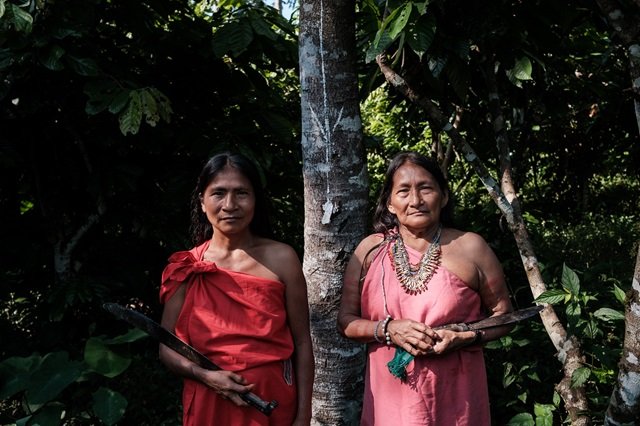
The number of recorded HIV infections in Peru’s remote Condorcanqui province has risen sharply over the past decade, alongside a documented pattern of sexual abuse that has left Awajún women organising their own support networks as healthcare services remain difficult to reach. Ministry of Health figures show that 43 HIV infections were recorded in 2014, compared with 340 in 2024. The figure fell to 256 in 2025, but the cumulative number of known infections is now around 2,000. Authorities say the actual number is considerably higher because many people cannot reach health posts or do not appear in official records.
For Lisenia, an Awajún woman from the native community of Waisim in Peru’s Amazonas department, the figures became personal when her nine-year-old daughter, Sekut, was diagnosed with HIV and dengue. Reaching the nearest hospital in Santa María de Nieva required almost an hour by peque-peque, a small wooden boat named after the sound of its motor, followed by two and a half hours on a rough road. At the hospital, Lisenia struggled to understand what was happening because the doctors did not speak her language and the only bilingual nurse had already left.
Sekut’s diagnosis came after repeated bouts of diarrhoea. Lisenia eventually arranged blood tests for herself, her husband and her children when medical professionals arrived from Lima. Her own test and her husband’s were negative, but staff asked to repeat Sekut’s test because they suspected an error. The result was positive. Lisenia already knew the circumstances that had placed her daughter at risk. Her former husband, Sekut’s father, had sexually abused another daughter when she was two years old and had repeatedly raped his elder daughter, according to Lisenia. That daughter later died by suicide. Lisenia says Sekut was also abused by her father after her elder sister’s death.
The cases have emerged in a community where sexual violence has been documented on a significant scale. Rosemary Pioc, an Awajún leader and director of the Awajún Wampis Women’s Council, spent years seeking official figures after observing cases as a teacher. In 2025, she obtained figures from Peru’s Ministry of Education showing more than 500 registered cases of sexual assaults by teachers against pupils in Condorcanqui over the previous decade. By March 2026, the number had risen to 664. Two months before the account was published, a public defender working for Peru’s Ministry of Justice and Human Rights in Santa María de Nieva was found in a room with a minor and subsequently reported for rape.
Women from the Awajún and Wampís communities have responded by building networks to support survivors. With donations and private funding, they travel to victims, pay transport costs and have established a maloca, a communal house where women affected by sexual abuse and HIV can receive assistance. They are also pressing state representatives to pursue alleged perpetrators and protect victims and their families from being forced back into communities where they may remain exposed to the aggressor. Santa María de Nieva has no state shelter for such cases.
“When in the house they came in to abuse us, our mother defended us like a jaguar against these predators,” Pioc tells Lisenia, presenting women as a source of protection within the community. But those defending victims have themselves faced threats and violence. Several defenders, including Pioc, have been threatened or beaten, while one was seriously injured.
“Every day we receive reports of sexual assaults and now, with this disease that has arrived, there are infections among young people and deaths in our families are increasing,” Pioc says. “If we continue like this, we are going to exterminate ourselves as a people, which is why we need to help each other.” She also says that most deaths from HIV are not recorded by the Ministry of Health.
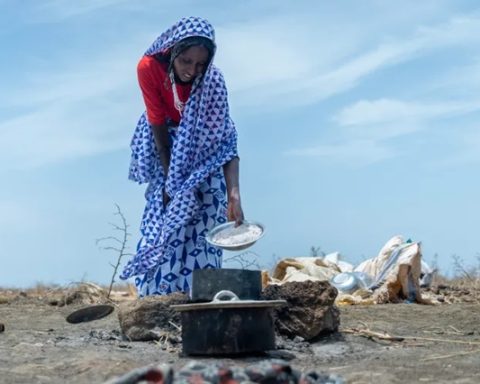
The Awajún are Peru’s second-largest indigenous people, numbering about 70,000 and living across five regions, many in remote areas where transport costs make state services difficult to provide. In Condorcanqui, some people do not possess a national identity document, others do not speak Spanish, and some live eight hours or more by river from health centres. Distrust of outsiders from urban areas also leads some residents to seek treatment independently.
Renzo Cuadros, the doctor responsible for HIV strategy at Hospital I in Santa María de Nieva, says the recorded figures do not capture the full scale of infection. “There are many hidden cases, often because of stigma, because of the fear of being rejected; they go elsewhere, to other regions, to go unnoticed, so they do not appear here,” he says. Some patients also abandon treatment once they begin feeling better. Ministry of Health data show that 29% of seropositive patients in Condorcanqui discontinue treatment.
Amelia Etsem, a 55-year-old Awajún nurse who has worked at the hospital for 20 years, describes seeing increasing numbers of people with symptoms compatible with AIDS who later died. “I go here, I know so-and-so and they have it [HIV], I go this way, I know this person, they have it; I go over there and they have it too, so I am practically surrounded by this disease,” she says. “I am worried because I know that soon we will have it throughout Nieva. That is why I say that soon we will be finished.”
The response to HIV is complicated further by beliefs about illness. Within Awajún and Wampís worldviews, disease can be understood as temporary, like a cold or a tree affected by a pest, and treated with herbs and care. When an illness persists, it may instead be associated with witchcraft or with someone deliberately causing harm.
Rosita experienced that uncertainty when her daughter became progressively thinner after initially testing negative for HIV in Pucallpa. A later test in Bagua was positive. Rosita sought various forms of treatment and was told that her daughter had suffered “native harm”. Her daughter eventually died.
Rosita had previously cared for Mariana, a young mother she met seven years earlier in Saramiriza. Mariana eventually confessed that she had AIDS and asked Rosita to care for her two-year-old daughter, Loreley. Years later, after Mariana’s death, Rosita found Loreley again, severely ill and abandoned. A rapid test confirmed HIV. Treatment began immediately, her wounds closed, she gained weight and, at nine, she has begun school and learnt to read.
Rosita continues to care for her grandchildren and works with a motor-taxi despite a childhood case of polio that left one leg unusable. She has faced repeated prejudice from relatives because of HIV, but understands that the virus is not transmitted through an embrace or sharing a plate of food, and that antiretroviral treatment is essential.