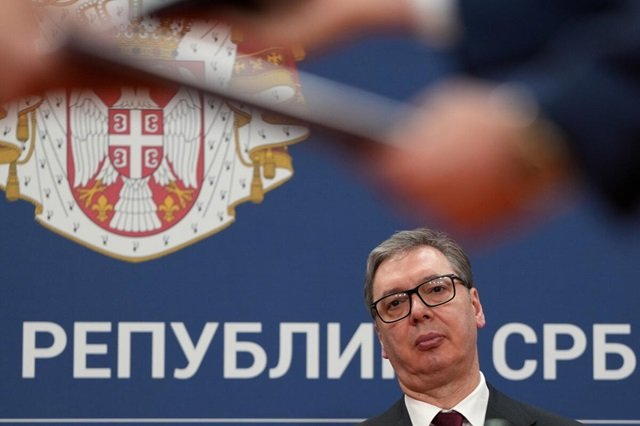
Serbian President Aleksandar Vučić has resigned from office ahead of parliamentary elections on October 25, a move that allows him to contest the vote as the leading candidate of his Serbian Progressive Party (SNS) and potentially become prime minister if the party wins. Vučić’s resignation ends his second presidential term before its scheduled conclusion and transfers presidential duties to parliamentary speaker Ana Brnabić pending the election of a new president.
Vučić called the parliamentary election for October 25 while still president, and the decision has been presented in the source as an attempt to move quickly before his current political position is constrained by the presidential term limit. The Serbian government has formally scheduled the early parliamentary election, while Vučić is now campaigning for a return to executive power through the prime minister’s office.
The move has been compared with Vladimir Putin’s transfer from Russia’s presidency to the prime minister’s office in 2008, when Dmitry Medvedev became president before Putin returned to the presidency in 2012. The source argues that Vučić, like Putin at the time, is seeking to retain political influence despite limits on his presidential tenure.
The resignation came amid continuing political tensions following mass protests that began after the collapse of a railway station canopy in the northern city of Novi Sad in November 2024, in which 16 people died. The disaster became a focus of allegations of corruption and demands for political accountability. Students and pupils became prominent in the subsequent protest movement, with several hundred thousand people taking part in demonstrations in Belgrade at its peak.
Vučić responded to the protests with criticism of demonstrators and the mobilisation of police and supporters. On the day of his resignation, he also pardoned 23 people whom he said had been connected with events during the previous year and a half. He justified the pardons by saying that those affected were young. “I want to protect every young person because I believe there is hope that they could change in the future,” he said.
The opposition challenge has since developed beyond street demonstrations. A student-backed electoral movement has entered the parliamentary contest, with cardiologist Ilija Srdanović leading the Student List. The list was formally certified for the October 25 election after receiving 69,099 valid signatures.
The source says SNS remains ahead in polling, while also noting concerns about the reliability of Serbian opinion surveys. It portrays Srdanović as a politically inexperienced candidate who has attracted attention partly because he is new to national politics. The student movement has emerged as a significant electoral challenge to Vučić’s party, with supporters campaigning ahead of the early vote.
Serbia’s relationship with the European Union is another issue surrounding the election. The country has been an EU candidate since 2012, while Vučić has pursued relations with the EU alongside close ties with China and Russia. In recent weeks, EU officials have criticised Serbia over the funeral of former Bosnian Serb commander Ratko Mladić, who was convicted of genocide, war crimes and crimes against humanity.
European Commission President Ursula von der Leyen and European Council President António Costa described the images from Mladić’s funeral as “shocking” and criticised the presence of senior Serbian officials, saying the event conflicted with the values underpinning Serbia’s path towards EU membership.
Vučić has denied that the funeral constituted a state ceremony and did not attend it, citing other obligations, although several ministers from his government were present. The controversy has added another point of tension between Belgrade and Brussels as Serbia approaches the October parliamentary election.