
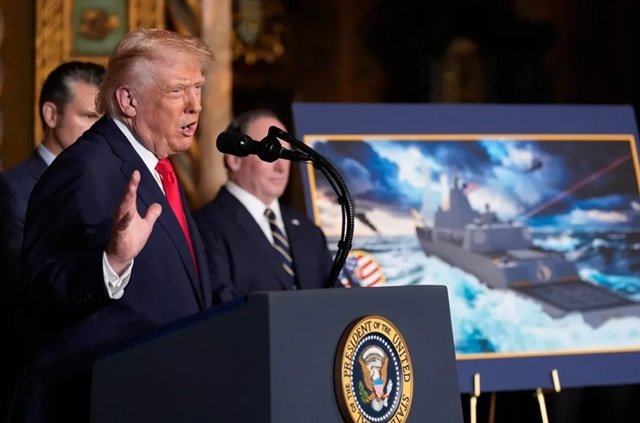
Of the many ridiculous, counterproductive, and outright harmful things that Donald Trump has done, his effort to create a “Golden Fleet” of “Trump-class” battleships is far from the worst offense. But it is absolutely typical of the personalistic and processless state into which American national security decision making has fallen in his second term.
The United States has not commissioned a new battleship since it launched the USS Missouri in 1944. There are good reasons for this: in an age of naval aviation and missiles, battleships become huge floating targets liable to be sunk way before any of their weapons can be put to use. Battleships had already been made obsolete by aircraft carriers during the Second World War, and since then have been used for shore bombardment when facing an enemy like Iraq that didn’t have the means of fighting back. They would be worse than useless in a war with China or even Iran, both of which field huge numbers of ballistic and cruise missiles that could easily strike such big targets.
Trump evidently decided on his own to direct the Navy to build new battleships based on his having watched the black-and-white television series Victory at Sea when he was young. He bemoaned the fact that the United States was building smaller ships and boasted that his planned battleships would be “the fastest, the biggest, and by far—100 times—more powerful.”
I remember watching and loving Victory at Sea when I was a child growing up in the late 1950s. But I recognize that the world has moved on since then. It hasn’t for Trump: making America great again consists, in so many domains, of reproducing the world the way he remembers it when he was a young man, when the United States was an industrial powerhouse and women and racial minorities weren’t so prominent in the workplace. His project fully reflects the president’s vanity: ship classes are usually named after the lead ship (in this case a planned USS Defiant); Trump wants them named after himself, and to have the moniker “Golden” attached to the name of the fleet like Theodore Roosevelt’s “Great White Fleet.” The major cost of this misconceived initiative will divert planning and design funds already appropriated away from ships the Navy really wants to build.
Fortunately, it is very unlikely that any of these ships will ever be built. Trump has no way of authorizing the many billions of dollars this fleet would cost, and there doesn’t seem to be any enthusiasm for the project either in Congress or the Navy apart from campaign donors like former Navy Secretary John Phelan. Phelan himself was apparently pushed out of his post because he told Trump that the new ships couldn’t be completed during the president’s second term, and that they might have to be constructed in foreign shipyards.
Trump’s national security policy from top to bottom has been devoid of process. There is no one in the administration capable of telling the president that building new battleships is a stupid idea, and no inhibition on Trump’s part in asserting expertise in an area he knows less than nothing about. The adolescent Trump watching Victory at Sea is now an 80-year-old adolescent directing the world’s most powerful country. National security decision-making, absent regular process and careful vetting, risks getting the United States into conflicts with huge unanticipated consequences.
Oh wait—maybe that’s happened already.