


The formal end of the US military support mission in Iraq on September 30 will mark a major change in the relationship between Washington and Baghdad, shifting the emphasis from a US-led security presence towards wider regional and geopolitical cooperation. The withdrawal, agreed under a September 2024 US-Iraq accord, also leaves Iraq’s government facing a central test of its sovereignty: whether it can bring Iran-aligned Shia militias under state control without provoking domestic unrest. The assessment was made by the Soufan Center in its latest analysis of Iraq’s changing security and regional position.
US forces have been central to Iraq’s security for more than two decades. After overthrowing Saddam Hussein’s regime and suppressing insurgencies, American troops withdrew in 2009 but returned in 2011 after Islamic State launched an offensive that nearly brought down the government. Washington and Baghdad now assess that Islamic State has been sufficiently weakened and Iraq’s security forces strengthened enough for the US mission to end. Although a small residual US force will remain to assist in combating Islamic State remnants and other threats, Washington has not publicly specified either its expected size or its rules of engagement. The departure will reduce the direct military influence that the United States has exercised over Iraqi decision-making, even after the American force was reduced far below the roughly 100,000 troops deployed during 2003-04.
Iraq has already begun presenting itself as a state seeking a broader international role. Prime Minister Ali al-Zaidi, an entrepreneur and political newcomer selected in April for his stated ability to attract international investment and promote political stability and prosperity, travelled to Washington in July for discussions with the Trump administration. In his address to the 81st UN General Assembly last week, Zaidi said Iraq wanted to become “an effective economic power in the region” and a “global hub for energy production”, citing plans to increase crude production, develop gas fields and expand refining and petrochemicals. On the sidelines of the General Assembly, he also joined Arab and regional leaders in a meeting with President Trump on efforts to bring the war in Iran to an end.
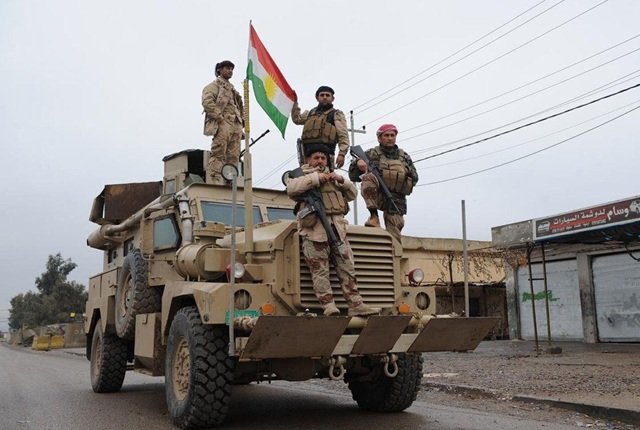
The withdrawal also changes the security equation in Iraq’s Kurdish north. A 2022 memorandum of understanding between Washington and the constitutionally authorised Kurdistan Regional Government expires on September 30. The agreement had transferred responsibility for paying the Peshmerga, the Kurdish security forces, to the Iraqi Federal Government and required the merger of party-aligned units, principally those associated with the Kurdistan Democratic Party and Patriotic Union of Kurdistan, under a single ministry. Kurdish leaders formally inaugurated the merger last week. KRG President Nechirvan Barzani said the unified force would become “part of the Iraqi national defense system”.
The Kurdish administration nevertheless faces greater exposure to attacks and pressure from neighbouring powers and Baghdad. Since the war involving Iran began on February 28, the US-led coalition’s air defences intercepted roughly 95 per cent of drones and missiles launched by Iran and its Iraqi militia allies against targets in Kurdistan, including US facilities. With the coalition’s departure, the KRG will no longer possess an independent capability comparable to that protection and will become more dependent on the Iraqi Federal Government, with which relations have often been unreliable and sometimes openly hostile.
The withdrawal may simultaneously ease another source of pressure. Türkiye and Iraq have agreed to gradually transfer Ankara’s military base at Bashiqa to Baghdad. The agreement followed a meeting between Zaidi and Turkish President Recep Tayyip Erdogan during the UN General Assembly. Zaidi’s office said the two leaders had agreed on “fully establishing state authority in Sinjar and ending the presence of outlawed foreign armed elements”, referring to PKK-linked fighters in the Sinjar region. Türkiye established the Bashiqa base in 2015 under an agreement with the KRG, deploying 600 soldiers to train Iraqi Peshmerga forces fighting Islamic State. Baghdad objected to the Turkish deployment, viewing it as a violation of Iraqi sovereignty.
The most difficult challenge for Baghdad, however, remains the Iran-aligned militias. Several continue to operate independently of the Iraqi command structure and have opposed the United States and its regional allies, particularly Kuwait and Saudi Arabia. Their political wings support Iran’s “resistance ideology”, while some groups retain strong social support among Iraqi Shias who regard them as protectors against the government, the United States and predominantly Sunni Arab states. Groups including Kata’ib Hezbollah, Kata’ib Sayyid Al-Shuhada and Harakat Hezbollah al-Nujaba have rejected disarmament by the September 30 deadline, although they have not ruled out eventual disarmament. Other groups, including Asa’ib Ahl Haq and fighters loyal to Moqtada Al Sadr, have responded since early 2026 by moving towards integration into national armed forces.
Zaidi has insisted that the Iraqi state must be “the ultimate decision maker in matters of peace and war”, with weapons held only by constitutional institutions. Yet he has also acknowledged that the timetable for dismantling the militias will slip. He told The New York Times that the new deadline is June 30, 2027, while Iraqi media reported that the process would begin on September 30 with a 90-day halt to militia attacks. Baghdad has also shifted from demanding immediate full disarmament towards the gradual integration of individual fighters into the Popular Mobilization Units under Iraqi military and governmental oversight. The future of the militias’ political wings remains unclear, including those led by figures who hold seats in Iraq’s parliament.










