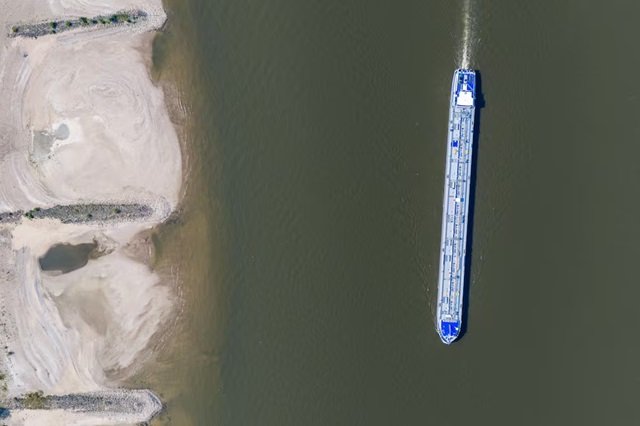
Europe’s major rivers recorded exceptionally low flows this summer, disrupting freight transport and energy production as prolonged drought combined with repeated heatwaves. The Copernicus Climate Change Service says the average discharge of 12 of the continent’s major rivers between June and August was the lowest since records began in 1992. Among them, the Rhine, Danube, Po, Loire, Rhône and Seine all recorded simultaneous record-low flows during July and August.
The figures form part of Copernicus’s seasonal assessment of a summer marked by particularly intense and early heatwaves, beginning in May. Across Europe, it was the third-warmest summer on record, while western Europe experienced its hottest summer in the available record, surpassing 2003, when extreme heat was associated with tens of thousands of deaths across the European Union. While a detailed assessment of heat-related deaths for 2026 remains unavailable, Copernicus has identified the condition of the continent’s major rivers as one of the summer’s most consequential developments because of their importance to transport and electricity generation.
The 12 rivers examined by Copernicus play major roles in European industry. The Rhine and Danube, in particular, carry large volumes of commercial freight and provide water for cooling nuclear power stations. Copernicus found that the severe and prolonged drought preceding the summer created conditions for the lowest river flows recorded across the continent since the European Flood Awareness System began keeping records in 1992. The analysis examined average discharge at the rivers’ mouths during June, July and August against the 1992–2020 average.
Samantha Burgess of the European Centre for Medium-Range Weather Forecasts, which oversees Copernicus, said that since the mid-2010s there had been a trend towards summer river flows significantly below average across Europe, particularly in eastern Europe. She also pointed to the faster warming of south-eastern Europe compared with the European average. But Burgess cautioned against drawing a definitive long-term conclusion from the available record because the dataset begins only in 1992. “It is a short-term dataset to really analyse long-term trends,” she said.
Copernicus has not yet conducted an attribution study for the summer of 2026 and therefore cannot “directly quantify the role of climate change”. It does, however, identify established mechanisms through which higher temperatures associated with climate change can intensify drought, including increased evaporation and greater loss of water from the soil. Climate projections have also for years pointed towards declining summer river flows across many parts of Europe.
The consequences were felt most directly in inland shipping. In August, vessels carrying goods from Rotterdam in the Netherlands and Antwerp in Belgium could travel along the Rhine with only about 15% of their normal cargo capacity in order to avoid running aground. On the Danube, barge capacity fell to around 30% of normal levels, according to a report published this week by the International Transport Forum, part of the OECD.
The reduced capacity increased the cost of moving goods. Freight rates on inland waterways rose, in some cases doubling, the International Transport Forum reported. The organisation warned that as droughts become more frequent and severe, navigation on rivers carrying essential goods will become increasingly difficult, disrupting supply chains and increasing logistics costs. Belgium, the Netherlands and Romania are particularly exposed because inland waterways account for between 15% and 45% of total freight transit in those countries. Spain, despite recurring drought, is less exposed because river freight transport is virtually non-existent.
The economic implications have precedent. During a comparable collapse in Rhine water levels in 2018, a scientific study found that the disruption reduced Germany’s gross domestic product by as much as 0.4%. The International Transport Forum said similar economic effects could be expected from current low water levels.
Energy systems have also been affected. Nuclear plants require substantial quantities of water for cooling, and in France some facilities were affected by unusually warm river water that could not be used under national environmental regulations, forcing plants to reduce or halt operations. In Hungary, the Paks nuclear power station on the Danube, which produces more than 40% of the country’s electricity, reduced operations because the river could not provide sufficient cooling water.
Hydropower generation was also hit in the Alps. Austria produced only 51% of its usual hydropower generation, while Switzerland produced 26%. An OSCE study described these developments as “not isolated incidents, but early signals of a systemic challenge in the way billions of people access energy”. It reported that industrial activity slowed as electricity supplies became less stable, while wholesale prices surged as demand increased, requiring emergency protocols across energy infrastructure.