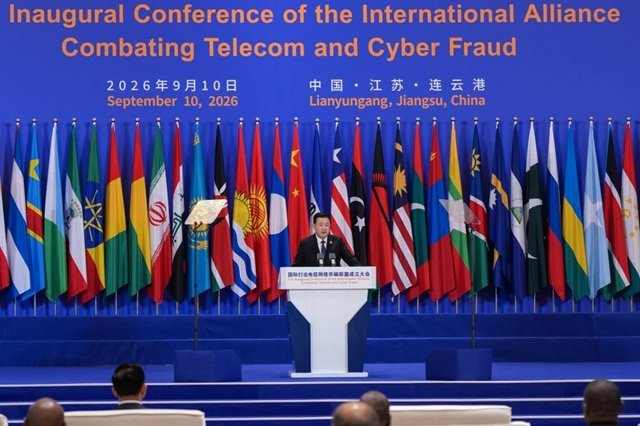
China and African governments are strengthening law-enforcement cooperation as a rise in cross-border cybercrime and fraud draws police forces closer together. The cooperation ranges from investigations into online gambling and cybercrime operations to efforts against SIM swapping, money laundering and scam networks operating across continents.
China hosted East African security ministers and police chiefs in Lianyungang, Jiangsu province, on September 10 for discussions on terrorism, kidnapping, unlawful detention and telecoms and online fraud. Chinese Public Security Minister Wang Xiaohong said Beijing would strengthen law-enforcement cooperation with East Africa and work jointly against those threats.
The same day, China launched the International Alliance Combating Telecoms and Cyber Fraud, with 46 founding countries, including Kenya. Beijing said the alliance would promote regular police cooperation, professional training, joint exercises and coordinated action against cross-border telecoms fraud.
The initiative also serves China’s interest in protecting its citizens, companies and projects in Africa, where it has substantial commercial interests. African governments, meanwhile, are seeking greater access to police training, technology, intelligence sharing and investigative capabilities.
Alessandro Arduino, an associate fellow in international security at Britain’s Royal United Services Institute, said the initiative fitted into Beijing’s wider effort to expand its security engagement with Africa through China’s Global Security Initiative. “Cyberfraud, an endemic problem in Africa, provides China with an especially useful entry point, as it is a genuine transnational security problem but one that also directly affects Chinese citizens and investments across Africa,” he said.
Arduino said Beijing was using multilateral institutions and established policing networks, including Interpol, while also promoting China-initiated mechanisms for intelligence sharing and coordinated law-enforcement operations. He said China was steadily expanding training for African police and security officials as part of its China-Africa security agenda.
The cooperation comes as Chinese citizens and organisations have increasingly become involved in or affected by investigations into suspected criminal operations across Africa. On August 25, China warned its citizens to leave eSwatini or relocate to safer areas such as South Africa because of alleged telecoms fraud and gambling crimes. The warning followed March police raids on suspected illegal online gambling centres around the capital, Mbabane. Forty Chinese nationals arrested during those operations were reportedly still detained in late August.
In Zambia, authorities in August detained 79 people, including 11 Chinese nationals, during a raid on a suspected cybercrime operation in Lusaka. In Kenya, four Chinese nationals appeared in court in Nairobi on September 1 over an alleged SIM-swapping and money-laundering scheme.
African nationals have also been targeted by international scam networks. Kenya’s foreign minister, Musalia Mudavadi, told lawmakers in May that 751 Kenyans had been rescued from scam compounds in Myanmar between 2022 and 2026, while another 406 were rescued from Cambodia during the first four months of this year and 29 from Laos. “Over time, three Kenyans have reportedly lost their lives in the scam compounds due to illness, while one expectant lady passed on after the scammers attempted to forcefully terminate the pregnancy,” Mudavadi said.
China has already signed dozens of public-security and law-enforcement agreements with African countries, including a 2024 agreement in Beijing involving 14 members of the Eastern Africa Police Chiefs Cooperation Organisation.
Liselotte Odgaard, a senior fellow at the Hudson Institute, said China increasingly regarded telecoms fraud, cybercrime, kidnapping, human trafficking and related crimes as threats requiring international coordination. The new alliance, she said, was unlikely to replace existing policing organisations soon, but could eventually “evolve into a China-led security platform”. Georg Lammich of the University of Duisburg-Essen said African governments were also actively seeking additional partners and law-enforcement capacity. “Police cooperation gives China a way to deepen security relationships without relying on formal alliances or a large permanent military presence,” he said.