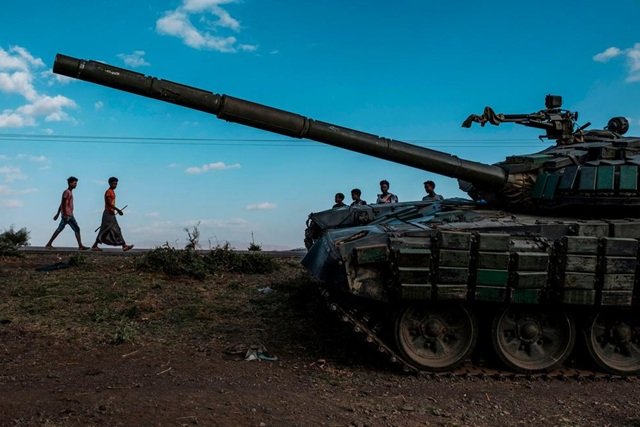
Reports that Eritrean troops have crossed into Ethiopia and advanced towards the northern region of Tigray have heightened fears of a renewed war in the Horn of Africa, following warnings from the European Union earlier in the week about the risk of regional escalation. Conflict analysts and eyewitnesses reported the movement on Wednesday, although the available information does not establish the full scale of the deployment or its precise objectives.
Jalale Getachew Birru, an East Africa analyst at the conflict data organisation Acled, said Eritrean forces had crossed the border and moved into Tigray. She also reported that Ethiopian drones had attacked the troops. Eyewitnesses told the BBC that dozens of lorries carrying soldiers were travelling southwards, while researchers at the US security institute Critical Threats Project assessed several images and videos circulating online that purported to show Eritrean troops in Tigray as authentic.
The reported incursion comes amid accusations by Ethiopia that Eritrea is supporting rebels in Tigray who have formed alliances with insurgents in other parts of the country. Over the weekend, Ethiopia’s government moved troops into Tigray to push back the rebels and took control of the regional capital, Mekelle. The deployment has intensified concerns about the possibility of a wider confrontation between Ethiopia and Eritrea, including fears that Addis Ababa could be preparing an attack on its neighbour to secure access to the Red Sea.
Eritrea has rejected Ethiopia’s accusations. Its information minister accused the Ethiopian government of making false allegations to justify a war of aggression against Eritrea. Birru offered a different interpretation of the reported Eritrean military movement, suggesting that Asmara wanted to prevent a possible advance by Ethiopian forces into its territory. By supporting rebels in Tigray, Eritrea could also seek to establish a buffer zone along its border, she said.
The competing claims reflect a sharp deterioration in relations between countries that once fought together against the Tigray People’s Liberation Front (TPLF). Eritrea became independent from Ethiopia in 1993 after a long struggle for separation. The two neighbours subsequently fought a bloody border war before reaching a peace agreement in 2018. Ethiopian Prime Minister Abiy Ahmed received the Nobel Peace Prize in 2019 in recognition of his efforts to achieve reconciliation with Eritrea.
The rapprochement later gave way to military cooperation during Ethiopia’s civil war. From 2020 to 2022, Ethiopian and Eritrean forces fought together against the TPLF, which had dominated Ethiopian politics for decades before the conflict. The war caused catastrophic loss of life, with estimates suggesting that several hundred thousand people died. All sides faced accusations of serious human rights violations and war crimes.
Relations have deteriorated significantly since that conflict ended. One of the central disputes concerns Ethiopia’s long-standing ambition to obtain its own access to the Red Sea. Since Eritrea’s independence, Ethiopia has been a landlocked country, relying almost entirely on neighbouring Djibouti for its maritime trade. Access to the sea has therefore remained a major strategic concern for Addis Ababa, while Eritrea has viewed Ethiopia’s ambitions and military posture with suspicion.
The dispute over maritime access adds another dimension to the tensions surrounding Tigray. Ethiopia’s military operations against the rebels, Eritrea’s alleged support for them and the possibility of Ethiopian forces moving towards the Eritrean border have created a situation in which local fighting could become entangled with the wider rivalry between the two states. However, the evidence presented in the reports does not establish that Ethiopia has decided to launch an invasion of Eritrea or that the reported Eritrean deployment is intended to prepare for a broader war.
The potential consequences extend beyond the two governments. According to United Nations figures cited in the report, Ethiopia has a population of approximately 139 million, including around six million people in Tigray. Hundreds of thousands of people in the region remain displaced, many without adequate access to food and medical care. Renewed fighting would therefore threaten communities already affected by the previous war and its aftermath.
Eritrea, by comparison, has a population of about 3.7 million. The impoverished and largely isolated country has been governed by President Isaias Afwerki since independence in 1993. Its security concerns are closely connected to its relationship with Ethiopia, the former dominant regional power from which it separated, and to the unresolved strategic tensions between the neighbours.
The latest reports of Eritrean troops entering Tigray have emerged as Ethiopian forces move against rebels in the region and the two governments exchange accusations over their intentions. While eyewitness accounts and analysts have reported a cross-border advance, the scale of the operation and the immediate objectives of the forces involved remain unclear.