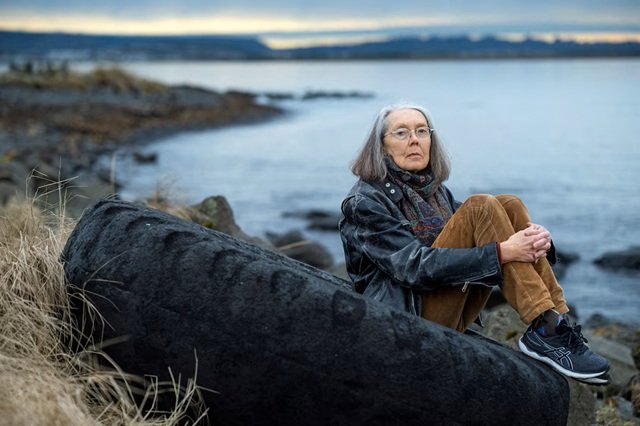
Canadian poet and writer Anne Carson has been awarded the Nobel Prize in Literature for a body of work that combines classical scholarship with experimental poetry, essays, translations, storytelling and performance. Announcing the award in Stockholm, the Swedish Academy praised her use of playful dialogues in classical forms to create new genres for contemporary literature. In an assessment published by the German newspaper Die Zeit, journalist Carlotta Wald argues that Carson’s significance extends beyond literary innovation: her work offers a way to challenge intellectual conformity and reconsider how people understand themselves and the world.
Born in Toronto in 1950, Carson has developed a distinctive literary practice that draws on Greek and Roman antiquity while disrupting conventional forms of modern writing. Her work places the ancient world alongside ordinary contemporary experiences, bringing figures such as Heracles, the hero of Greek mythology, into contact with everyday anecdotes and juxtaposing creation myths with the difficulties of finding motivation in daily life. The result is a body of writing that moves between scholarly analysis, personal observation and imaginative reconstruction, resisting straightforward divisions between poetry, philosophy and narrative.
Carson’s influence has grown across literary and artistic circles. Her poetry, performances, essays and anecdotes initially attracted audiences in experimental cultural communities, while her essay The Gender of Sound gained particular attention in feminist and queer circles. Her work has subsequently reached broader international audiences, establishing her as a prominent figure in contemporary poetry and related arts. According to Die Zeit, the breadth of her appeal reflects not simply the originality of her style but the capacity of her writing to give readers new ways of approaching questions about human existence.
That appeal has been visible at literary events across Europe and North America. At Berlin’s poetry festival, audiences reportedly queued for hours, with lines extending hundreds of metres, to see Carson. People also travelled from across Europe, Canada and the United States to attend the Louisiana Literature Festival in Copenhagen, where she performed twice in one day during the summer. Her writing has reached beyond poetry festivals, too. Actors Cate Blanchett and Nina Hoss incorporated an essay by Carson, on acting, into the programme accompanying their production Electra/Persona at London’s National Theatre, a work that examines the nature and possibilities of acting.
Carson’s performances demonstrate how her writing moves between abstract questions and ordinary experience. In Lecture on the History of Skywriting, she presents an alternative account of the origins of the world from the perspective of the sky, connecting that imagined history with her own life as a writer. One passage asks: “Is the sky something or merely what remains because everything else has contours? Can the sky break when it breaks, can it be rebuilt? Is there one sky or many? If there are many, do they know about one another or do they ask themselves that?”
The questions illustrate a method that avoids offering definitive answers. Carson uses mythology, philosophical inquiry and everyday observations to unsettle assumptions about how the world can be explained. Her writing moves between the universal and the personal, treating ancient stories and seemingly trivial experiences as equally capable of revealing something about human life. Rather than placing rational analysis above mythology or personal experience, she allows different ways of understanding to coexist and challenge one another.
Wald identifies this resistance to established categories as central to Carson’s achievement. Her collection Wrong Norma provides a useful expression of that approach: a refusal to accept conventional standards simply because they have become familiar. Carson’s work repeatedly interrupts the comfort that can develop when readers believe they have settled on a single interpretation. It encourages uncertainty, contradiction and reconsideration rather than a fixed account of reality.
This approach also helps explain Carson’s interest in questions that might otherwise appear marginal or absurd. She considers whether war might look different from the perspective of the sky, why nymphs can transform a narrative, and how people might recover the capacity to imagine and carry the world differently. Such questions connect classical mythology with contemporary concerns without reducing either to a simple lesson. Her writing instead creates an intermediate space in which the ancient and modern, the intellectual and the mundane, can alter one another.
Carson’s resistance to intellectual uniformity has become particularly relevant to the interpretation offered by Die Zeit. Wald describes her as a kind of literary punk, challenging what she sees as the false norms of contemporary life. Her work does not rely solely on anger or explicit argument to contest established assumptions. Poetry, performance and essay writing become alternative means of questioning accepted ideas, including the belief that the future necessarily offers greater understanding than the past or that a single rational framework can explain human behaviour.
The Nobel Prize recognises this combination of formal experimentation and intellectual independence. Carson’s writing does not fit comfortably within one literary category, drawing instead on classical philology, translation, myth, performance and personal narrative. The Swedish Academy’s recognition of the new genres she has developed acknowledges that hybrid practice, while the international response to her performances demonstrates its reach beyond specialist literary audiences.
For Wald, the award is therefore both fitting and an invitation to readers to reconsider what literature can do. Carson’s achievement lies not only in creating new forms but in using them to resist easy answers, reopen familiar questions and make room for experiences that established intellectual and artistic conventions can overlook.