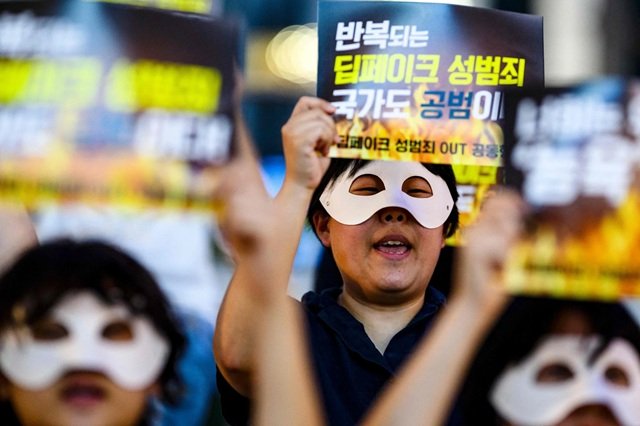
A decade after South Korea shut down Soranet, a notorious online network that distributed secretly filmed and non-consensual sexual videos, authorities are still confronting a succession of websites and online communities accused of facilitating sexual exploitation. Recent investigations involving thousands of explicit videos, artificial intelligence-generated deepfakes and illegal images of women have highlighted the limits of tougher legislation in suppressing the networks.
Last month, a man was detained over an alleged offshoot of Soranet that investigators said had shared more than 2,000 sexually explicit videos, illegally filmed material and deepfakes. The site allegedly recruited participants for partner-swapping sessions that were subsequently filmed and uploaded, while members circulated photographs of family members and acquaintances for other users to rate their bodies. The allegations illustrate how online communities can facilitate the production, distribution and circulation of intimate material without the consent of those depicted.
Soranet became a symbol of South Korea’s digital sex-crime crisis through its extensive collection of illegal pornography, which attracted more than a million users in the country. Its content included secretly recorded footage from toilets and changing rooms, as well as intimate videos posted by former partners without the women’s permission. Some victims featured in the material later took their own lives. Public outrage, including large street protests organised by women’s groups, eventually forced the authorities to act. The site’s operators were arrested and the platform was shut down in 2016.
Its closure, however, did not prevent similar networks from appearing, particularly smaller operations that have proved difficult for investigators to detect. In May, police dismantled a Soranet-inspired platform known as the Honours Club after discovering that approximately 6,300 members had shared and watched photographs and videos of group sex and orgies facilitated through the site. Another notorious website, Yadong Korea, reappeared last month under its former name after being shut down in August, prompting the feminist political group the Women’s Party to call for renewed investigations into illegal pornography networks.
The problem has also extended to the use of artificial intelligence to manufacture sexually explicit images of real people. A police officer in Seoul was recently detained on suspicion of creating and distributing hundreds of AI-generated sexual deepfakes and possessing about 5,600 illegal sexual images and videos. The officer was identified through an undercover investigation by the Busan Metropolitan Police Agency into a Telegram chat room where such material was circulated. Investigators also suspected him of possessing child sexual exploitation material and creating more than 400 AI-generated images and videos depicting acquaintances as nude.
South Korea has repeatedly strengthened its laws in response to such cases. During the molka, or spycam, crisis of the 2010s, legislation was tightened to criminalise the non-consensual distribution of intimate images regardless of who had originally recorded them. The Nth Room case in 2020 exposed a further dimension of online exploitation, involving the production and sale of sexual material and the blackmail of victims, including minors. It prompted the so-called Anti-Nth Room Act, which expanded criminal liability beyond creators and distributors to buyers and viewers.
Purchasing, downloading or knowingly viewing illegally filmed sexual exploitation material can carry a sentence of up to three years in prison or a fine of 30 million won (US$22,440). Following public outrage over Telegram-based networks distributing manipulated images of women and girls, South Korea also overhauled its laws on sexual deepfakes. Creating sexually explicit deepfakes can now carry up to seven years in prison or a fine of 50 million won, while possessing, purchasing, storing or knowingly viewing such material can also attract criminal penalties.
An Gab-chul, a lawyer at Gammyung Law Firm who specialises in sexual crimes, said the law had become clearer about the circumstances in which the distribution of intimate material constitutes an offence. “There are cases where the footage was originally recorded with the person’s consent. But if that material is later distributed without the person’s consent, that in itself constitutes a violation of the law,” he said.
An nevertheless argued that enforcement remained inadequate because perpetrators were frequently identified only after victims reported the offences. Undercover investigations, once uncommon in South Korea, were authorised in 2021 for crimes involving minors and expanded last year to cover digital sexual offences involving adult victims.
A representative of the National Police Agency told This Week in Asia that a team of 20 investigators drawn from four regional police agencies had been established this month to investigate websites promoting sexual exploitation. The representative said operators increasingly attempted to avoid detection by using overseas servers and other methods to conceal their activities. “These cases are becoming increasingly difficult to investigate, but we are also working hard to keep pace with those changes,” the representative said.
An was sceptical that the networks could be eliminated through shutdowns alone. “What I found through my research is that whenever one of these sites is shut down, another one keeps appearing,” he said. “They disappear, and then they are created again.” He argued that demand for such material and the financial opportunities associated with distributing it continued to sustain the underground networks. The problem, he added, extended beyond dedicated pornography websites to online communities and open chat rooms that had become gateways to sexual exploitation and prostitution.
Joohee Kim, an assistant professor of women’s studies at Duksung Women’s University in Seoul, said the cases exposed longstanding limitations in South Korea’s legal understanding of sexual violence. “The legal understanding of sexual violence has historically focused more on whether an act was forced through violence or threats than on whether the woman consented,” she said.
Kim cited choehyeobui-seol, a legal interpretation under which rape or indecent assault was established only when violence or threats were sufficiently serious to make resistance impossible or extremely difficult. That interpretation influenced criminal justice practice and legal scholarship for decades, and its legacy persisted despite a 2023 Supreme Court ruling that lowered the threshold for establishing indecent assault.
Kim Yeo-jin, director of the Korea Cyber Sexual Violence Response Centre, attributed part of the problem to online cultures that normalise the sexual objectification of women. She identified male-dominated forums such as DCinside and FMkorea as spaces where misogynistic language and sexually explicit images and videos have circulated in open chats. “The biggest underlying problem is that attitudes towards sexually objectifying women without their consent have not fundamentally changed,” she said.
Kim called for changes in how the public perceives and treats victims of sexual exploitation, arguing that such a shift was necessary to understand the scale of the offences and enable deeper discussion about how society should respond.