Ken Russell’s The Devils, a controversial 1971 film about religious persecution, political power and alleged demonic possession in 17th-century France, is returning to cinemas in the United Kingdom and Spain in a complete, remastered version after more than two decades of restoration work. The film, which provoked religious outrage and suffered cuts by British and American censors, will be screened in its entirety following festival appearances at Cannes and Sitges. Its restoration brings back a sequence lasting less than a minute that was removed by British censors and long believed to have been lost.
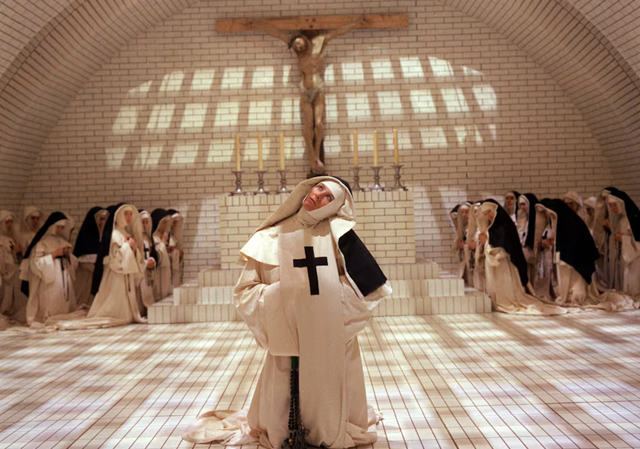
As reported by the Spanish newspaper El País, the recovered footage depicts a group of nuns in an orgiastic frenzy tearing down an enormous crucifix and sexually desecrating the sculpted figure of Jesus. The sequence became one of the most notorious elements of the film’s censorship history. Its rediscovery has also restored material central to Russell’s depiction of the intersection between religious hysteria, institutional authority and political persecution.
The film draws on events that took place in 1634 in Loudun, a fortified town in France, where the priest Urbain Grandier was tortured and burned at the stake after being accused of witchcraft and of bewitching the Ursuline nuns of a local convent. The convent’s mother superior, Jeanne des Anges, became the central figure in one of the most famous episodes of alleged collective demonic possession. The story reached Russell through Aldous Huxley’s 1952 novel The Devils of Loudun and John Whiting’s 1960 play The Devils, both of which provided the basis for his screenplay.
Russell’s interpretation placed the accusations within a wider struggle over political authority. According to the account presented in the film and its literary sources, King Louis XIII had permitted Loudun to retain its fortified status, angering his powerful chief minister, Cardinal Richelieu, who wanted to centralise authority. Grandier publicly opposed Richelieu’s plans to demolish the town’s fortifications and was alleged to have written a book attacking the cardinal. The resulting political hostility formed part of the circumstances surrounding his destruction.
Grandier was also portrayed as a priest whose sexual relationships conflicted with his religious position. According to Huxley’s novel, he refused to become the convent’s spiritual director, unaware that Jeanne des Anges had become obsessed with him after seeing him from a distance and hearing accounts of his sexual exploits. His rejection of her added another dimension to the accusations against him.
Oliver Reed played Grandier, while Vanessa Redgrave portrayed Jeanne des Anges, whose physical deformity and fixation on the priest became central to the film’s disturbing psychological drama. Redgrave, now among the few surviving members of the cast alongside Gemma Jones, later selected The Devils, together with The Charge of the Light Brigade, among her finest works in her memoirs. Glenda Jackson had originally been Russell’s first choice for the mother superior but declined the role, believing she had already played similar characters for the director.
The controversy surrounding the film began before its commercial release. The Vatican attacked it when it was screened at the Venice Film Festival and called for the festival director to resign. In Britain, the film received an X certificate but was ordered to lose the crucifix sequence, which formed part of 89 seconds of officially documented cuts. The American version was edited further by the Motion Picture Association of America, which also removed the ending in which, following Grandier’s torture and execution, Jeanne is mockingly handed part of his charred femur and uses it to masturbate.
Russell maintained a good relationship with John Trevelyan, then head of the British Board of Film Censors, and correspondence between the two showed the director explaining that many controversial scenes were based on historical accounts. He also reduced the historical explicitness of other passages in an effort to secure approval. According to film critic Richard Crouse’s book Raising Hell: Ken Russell and the Unmaking of The Devils, Russell filmed what was written in the screenplay rather than adding material to provoke the studio or manufacture controversy. Warner Bros produced the film during a period when major Hollywood studios were uncertain about which kinds of films would succeed.
The missing sequence was eventually recovered through the persistence of British film journalist Mark Kermode. Interviewing Russell for Sight and Sound magazine in 1995, Kermode learnt that the footage had disappeared. “But you won’t find it,” Russell told him. “They’ve probably destroyed it.” Kermode subsequently contacted film libraries, archives and Warner Bros, searching for the missing material.
Years later, he discovered a reference to a film canister marked “C Cut 89″” in a Warner storage facility. After persuading an employee to retrieve it, he found that the film inside was beginning to decompose. The missing sequence had survived. Speaking to The Hollywood Reporter, Kermode recalled: “I have a prodigious memory, and I remembered that 89 seconds [the total of that sequence and other cuts] was what the BBFC had officially cut from The Devils.” He added: “The most incredible thing was that it was exactly as Ken had described it. He wasn’t making anything up.”
The recovery itself faced resistance within Warner Bros. Tim Everett, who works for the studio’s British operation, spent a year collaborating with its storage department and requesting film canister after film canister. He then arranged for the footage to be transferred so it could be viewed safely. However, he encountered opposition from colleagues at the studio’s headquarters in Burbank, California. “They weren’t at all happy with me for having done this,” he told The Hollywood Reporter.
Russell approved a reconstructed version of the film in 2004 but died in 2011 without seeing the complete restoration. The project took 22 years from its beginning to reach its current release, becoming possible only after a change in Warner’s management and the creation of Warner Clockwork, a label established to revive the studio’s historical catalogue.
For Kermode, restoring the missing footage was essential to the film’s meaning. “By putting those sequences back in, the film makes sense. It tells the story it should tell,” he said. “There are no demons here except human demons. It is about the unholy alliance between Church and State and the instrumentalisation of religion for political purposes.”