Poland’s public mood towards Ukrainian refugees has shifted sharply since Russia launched its full-scale invasion in February 2022, with opposition to accepting displaced Ukrainians now exceeding support for the first time. Rising hostility, fuelled by political polarisation, historical disputes and online disinformation, has left members of the country’s largest foreign community increasingly anxious about speaking their native language in public. Polish authorities have also warned that Russia is exploiting tensions between the two neighbouring countries to weaken domestic support for Ukraine, even as Warsaw maintains its military and institutional backing for Kyiv.
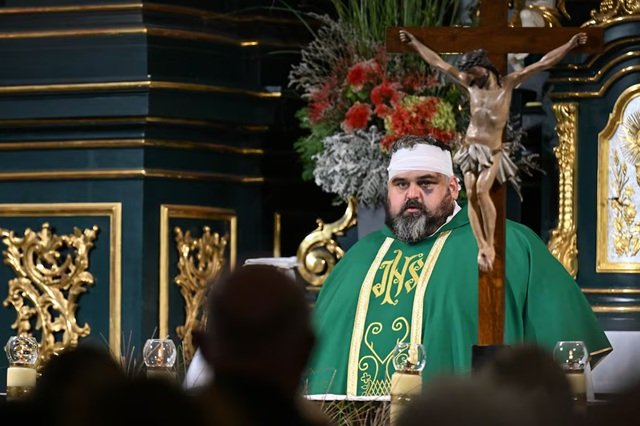
The latest escalation followed a knife attack at a monastery in Jarosław, eastern Poland, in which a priest was killed and four other people were injured. Polish authorities reported that the Ukrainian assailant had suffered an acute psychotic episode. Ukraine’s government immediately condemned the attack, while the Catholic Church appealed for restraint. Adrian Mantykiewicz, one of the injured priests, asked for clemency for the attacker and urged people not to blame an entire nation for the actions of one individual. The appeal did little to calm online hostility. Polish media described an atmosphere close to mob violence on social networks, while the state monitoring centre for disinformation, NASK, reported that expressions of hatred had reached their highest level since July.
Pawel Cymbor, a disinformation analyst at Fakenews.pl, said the priest’s appeal changed how some users perceived him. “The homily radically changed attitudes towards the priest on social media, where a section of users went from considering him a victim to labelling him a traitor and a defender of [Stepan] Bandera,” he said. Bandera, a Ukrainian nationalist regarded by some in Ukraine as a national hero, remains a deeply contentious figure in Poland because of the Ukrainian Insurgent Army’s association with massacres in Volhynia and Galicia during the Second World War.
For the more than 1.5 million Ukrainians living in Poland, who account for about 4% of the population, the changing atmosphere has affected everyday life. Oleksandra Fedorchuk, a journalist with Slawa, the Ukrainian-language channel of Polish public broadcaster TVP, arrived in Poland in March 2022, shortly after Russia began its full-scale invasion. She now avoids speaking Ukrainian in public. “We avoid speaking Ukrainian in the street and on public transport; it is safer to try to make ourselves invisible,” she said. Dmytro Dymydyuk, who works at Ukrainski Dom, an organisation advising refugees on housing, employment and documentation, has received increasing reports of harassment involving Ukrainian children at school, including incidents involving classmates, teachers and strangers. Although he has not personally experienced abuse, he also avoids speaking his language in public “so as not to provoke the Poles”. “I am not proud of it, but I want to live in peace,” he said.
The change is reflected in polling. According to the public opinion research centre CBOS, 91% of Poles supported accepting Ukrainian refugees in April 2022, while only 4% opposed it. By July 2026, opposition had risen to 52%, overtaking the 42% who supported accepting refugees. Meanwhile, the number of reported hate crimes against Ukrainians has increased. According to the Polish newspaper Rzeczpospolita, police received 180 reports of such offences in the first half of 2026, 30% more than in the same period a year earlier. The conflict-monitoring organisation ACLED recorded 13 physical attacks against Ukrainians in Poland between January and the end of August, almost twice the total for all of 2025 and a substantial increase from just one recorded incident in 2024.
The deterioration has unfolded alongside renewed disputes over the countries’ shared history. In May, Ukrainian President Volodymyr Zelensky awarded an army unit the honorary name “Heroes of the UPA”, referring to the Ukrainian Insurgent Army. In Poland, the organisation is associated with the killings of Polish civilians in Volhynia and Galicia during the Second World War. Polish President Karol Nawrocki responded by withdrawing the Order of the White Eagle, Poland’s highest national distinction, which Zelensky had received in 2023. Prime Minister Donald Tusk’s government also urged Kyiv to reverse the decision, but the controversy continued for weeks without a change in Ukraine’s position.
A CBOS survey conducted shortly after the diplomatic dispute found that 46% of Poles viewed bilateral relations negatively, the worst result in the series. Some 65% blamed Ukraine for the poor state of the relationship. The dispute also coincided with a surge in online abuse. According to the Polish Institute of International Affairs (PISM), mentions containing extremely offensive terms directed at Ukrainians increased by 171% between 26 May and 13 July, reaching 364,000. The posts generated 1.2 million reactions, with the institute linking many of them to pro-Russian campaigns.
PISM has warned that Moscow benefits from the growing distance between Poland and Ukraine, using propaganda and disinformation to deepen divisions. Cymbor, however, cautioned against attributing anti-Ukrainian sentiment solely to Russian interference. Poland’s highly polarised domestic political environment also provides fertile ground for hostility, he said, while Fakenews.pl has identified numerous actors and disinformation networks operating within the country. A recurring tactic is to amplify crimes suspected of involving Ukrainians and encourage the belief that all Ukrainians should be judged by the actions of individuals.
Political decisions have contributed to the changing climate. Tusk condemned attackers who assault people for speaking with a different accent and ordered stronger action against hate crimes, describing perpetrators as acting “in favour of Russia”. Yet his government has also reduced refugee benefits to the point of near elimination. Hanna Machinska, a lawyer and professor at the University of Warsaw, argues that the cuts reinforce negative stereotypes by suggesting Ukrainians are unwilling to work. A recent study by Deloitte and the UN refugee agency, UNHCR, estimated that Ukrainian refugees contributed 2.4% of Poland’s gross domestic product in 2025.
Machinska fears the atmosphere will deteriorate further ahead of parliamentary elections scheduled for autumn 2027. At a recent meeting, she recalled, a Ukrainian woman said acquaintances had asked whether she was afraid to travel to Poland. “Afraid to travel to Poland when coming from a country at war! It is a dramatic message,” Machinska said.