Morocco’s efforts to secure international backing for its proposed autonomy plan for Western Sahara face a renewed obstacle at the United Nations, where Secretary-General António Guterres has insisted that any future arrangement must preserve the Sahrawi people’s right to self-determination. In his latest report on the disputed territory, Guterres has proposed that the autonomy framework be submitted to a genuine consultation in which the population can accept or reject it, challenging expectations that Morocco’s preferred solution would become the established basis for resolving the decades-long conflict.
The report, presented ahead of the renewal of the mandate of the United Nations Mission for the Referendum in Western Sahara (MINURSO), due for a Security Council vote on 31 October, is Guterres’s final official recommendation on the dispute before his second term ends on 31 December. As reported by the Spanish newspaper El País, the intervention could complicate Morocco’s efforts to consolidate the diplomatic gains it secured a year earlier, when the Security Council endorsed its autonomy proposal as a basis for a political settlement.
Morocco enjoys the support of the United States, France and the United Kingdom, all permanent members of the Security Council with veto powers. Washington recognised Moroccan sovereignty over Western Sahara in 2020, at the end of Donald Trump’s first presidency. However, Guterres’s report reiterates that the future status of the territory cannot be settled by imposing an arrangement on its population.
Staffan de Mistura, the UN secretary-general’s personal envoy and the principal mediator in the dispute, presented a detailed report to the Security Council and warned that autonomy “cannot simply be imposed under any circumstances”. He added that “the future of Western Sahara depends on achieving a solution to the conflict through the free exercise of the Sahrawi people’s right to self-determination”.
Western Sahara, formerly Spain’s largest African colony, was abandoned by Madrid half a century ago and remains divided between Morocco and the pro-independence Polisario Front. Morocco controls approximately 80 per cent of the desert territory west of a defensive sand-and-stone berm, while the Polisario operates in the remaining 20 per cent, relying on bases in exile in Algeria. The movement demands a self-determination referendum that would include the possibility of independence.
Security Council resolution 2797, adopted a year earlier, called for negotiations based on Morocco’s autonomy proposal, with the aim of achieving a definitive political solution acceptable to all parties that would provide for the self-determination of the people of Western Sahara. It also encouraged the parties to submit ideas towards an agreed settlement. The carefully worded resolution passed without opposition, although Russia, China and Pakistan abstained and Algeria left the chamber to register its disagreement.
Some Moroccan media outlets interpreted De Mistura’s latest remarks as support for the Polisario’s position. However, the previous resolution had already combined endorsement of Morocco’s autonomy proposal as a negotiating basis with explicit references to self-determination. The latest report brings that tension back to the centre of the diplomatic process.
Direct negotiations between Morocco and the Polisario, visibly relaunched in Madrid in February and continued in Washington, remain stalled after seven years of deadlock. Riccardo Fabiani, International Crisis Group’s director for North Africa, said the autonomy plan had encountered firm resistance from the Polisario, which continues to insist on a vote on self-determination. According to Fabiani, the United States has also opened contacts with Sahrawi interlocutors outside the Polisario.
On 30 June, the US ambassador to the UN, Mike Waltz, met a delegation from the Sahrawis for Peace Movement, an organisation founded in 2020 that supports Morocco’s autonomy plan. Meanwhile, American lawmakers have introduced proposals in Congress to designate the Polisario as a foreign terrorist organisation, a move that could severely restrict its diplomatic standing.
Washington is also considering changes to MINURSO, whose mandate is due for renewal. International Crisis Group has observed that the Trump administration appears willing to pursue a strategic review of the mission’s functions alongside Morocco. Sources in El Aaiún in contact with the UN mission have indicated that Rabat and Washington want to reduce its personnel and operating costs. The mission’s budget stood at around €60 million in 2025, its lowest level in 35 years.
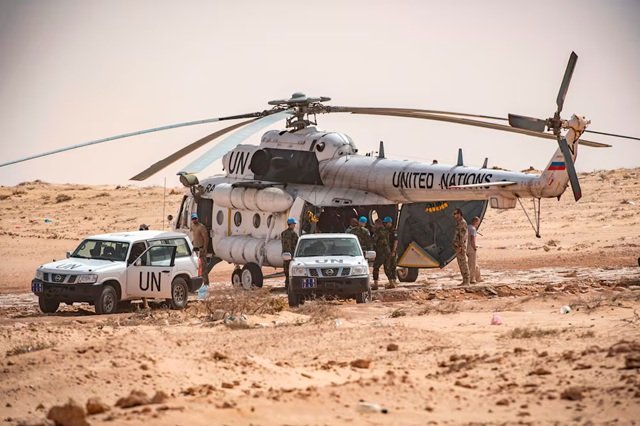
MINURSO was established to organise a self-determination referendum, a process that has remained paralysed for more than two decades, and to monitor a ceasefire that broke down six years ago. It now operates largely as a military observer without the authority to intervene between the parties. Its personnel have fallen from more than 500 deployed troops 15 years ago to around 300 today.
A source familiar with conditions on the ground described Guterres’s latest report as his “swan song”, noting that it referred not explicitly to a referendum but to a consultation of the Sahrawi population on an autonomy statute with guarantees. The source said the proposal represented a setback for Morocco compared with the expectations created by resolution 2797, while ensuring that an autonomy arrangement could not simply be imposed.
Morocco submitted a revised autonomy proposal earlier this year, following its original plan in 2007. The new framework envisages an autonomous government and parliament, as well as a regional police force. Rabat maintains that the proposal should be put to a vote involving all Moroccan citizens, rather than only the inhabitants of Western Sahara, a position that prevents the process from being treated as a referendum on self-determination in the sense demanded by the Polisario.
The same source argued that excluding the Polisario from negotiations would be difficult because the UN recognises it as a party to the conflict, although other pro-Moroccan groups could also be included. The source added that MINURSO was unlikely to be dismantled immediately, but financial pressure could gradually weaken its capacity. Guterres and De Mistura have recommended against reducing the mission’s resources or changing its functions without corresponding progress in negotiations, citing the need to protect regional stability.
The military balance adds another complication. In June, Morocco killed senior Polisario military and political figure Lahbib M. Abdelaziz in a drone strike, disrupting the succession prospects of a leader regarded as a potential future head of the movement. The attack affected the Sahrawi exile community in the Tindouf refugee camps in south-western Algeria and removed a possible successor to Brahim Gali, who, at 80, is serving his third consecutive term as Polisario leader. Morocco’s expanding drone capabilities, including the acquisition of more than 230 unmanned aerial vehicles over four decades, have reinforced its air superiority in a conflict that has continued for 50 years.