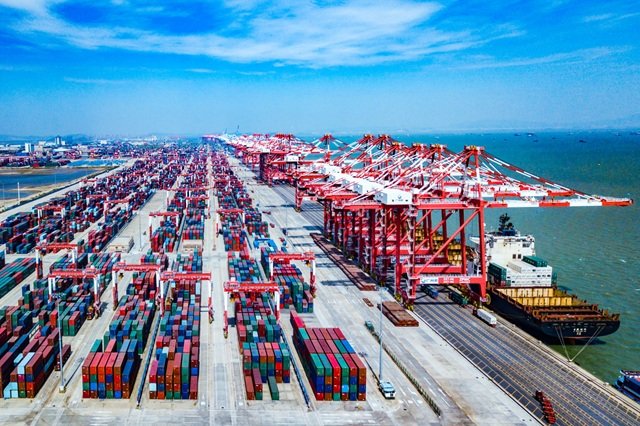
China’s exports rose 36.3 per cent year on year to US$447.18 billion in September, accelerating from August and substantially exceeding economists’ forecasts as demand for technology products strengthened ahead of the country’s “golden week” holiday.
Customs data released on Wednesday showed that export growth surpassed the 25.7 per cent increase forecast by economists polled by financial data provider Wind and the 25 per cent recorded in August. Imports also grew faster than expected, rising 31 per cent to US$313.65 billion against a forecast of 23.79 per cent.
The figures produced a monthly trade surplus of US$133.53 billion, reflecting the continued strength of China’s external trade. Total trade during the first nine months of 2026 increased 23.8 per cent compared with the same period last year.
“Foreign trade growth in the first three quarters was the fastest in the past five years,” Wang Jun, vice-minister of the General Administration of Customs, said at a press conference in Beijing on Wednesday.
Wang attributed export growth partly to technology products, including chips and electronic components, as global demand increased for artificial intelligence computing capacity and electricity infrastructure. Shipments also benefited from a pre-holiday rush ahead of the golden week break.
China’s cumulative trade surplus reached US$938.11 billion in the first nine months of 2026, an increase of about 7.2 per cent from the corresponding period last year, according to customs data. The country is on course to record another annual high after its US$1.2 trillion surplus last year attracted increased scrutiny from Western trading partners.
Exports to the United States rose 39.56 per cent in September, although the increase was measured against a low base in the previous year. The growth came after Chinese President Xi Jinping met US President Donald Trump in Washington late last month. The two leaders agreed to establish an artificial intelligence dialogue and recommended tariff reductions covering US$30 billion worth of goods on each side.
Trade with the European Union also expanded, with Chinese exports to the bloc rising 25.25 per cent in September. However, relations between Beijing and Brussels remain under pressure from disputes over trade imbalances and market access.
Chinese and European Union officials held talks late last week and reached an agreement to cap Chinese exports of hybrid cars to the bloc while facilitating approval of Chinese export licences for rare earths. The discussions followed growing European concerns about the scale of China’s trade surplus and its effects on European industries.
France and Germany had called earlier in the week for a new trade instrument that would restrict access to the EU market when third countries caused severe economic distortions. The proposal reflects continuing debate within Europe over how to respond to trade imbalances and competition from Chinese exporters.
The September figures show that China’s trade growth remained strong across both exports and imports, with technology demand contributing to higher shipments even as the country faced continuing disputes with major trading partners.