A dispute over alleged forced labour in China’s salmon industry in Xinjiang has exposed competing accounts of the region’s expanding economic activity, with the state-backed Global Times accusing The New York Times of presenting unsubstantiated claims as investigative findings. In an editorial, Global Times argues that the American newspaper’s coverage relies on speculation rather than direct evidence and forms part of a wider pattern of reporting that links Xinjiang’s industries to allegations of human rights abuses.
The criticism centres on a recent New York Times report examining conditions across the global fish farming industry. According to Global Times, the investigation initially examines a range of documented concerns, including Peruvian fishing vessels, fishmeal processing plants and offshore aquaculture facilities in Norway, before turning to salmon farming in Xinjiang, in north-western China. The editorial contends that the article devotes substantial attention to allegations of forced labour in the region without establishing that such practices occur in its salmon industry.
Global Times says the report presents itself as a neutral examination of seafood production but relies on qualified language, including phrases such as “claim”, “accuse” and “most likely”, when discussing Xinjiang. The editorial also alleges that the newspaper offers no supporting evidence from first-hand interviews with people involved in the industry. It argues that placing the Xinjiang allegations alongside documented problems elsewhere in the global seafood sector encourages readers to assume that similar conditions exist in China, despite what it describes as a lack of comparable evidence.
The claims about the investigation are presented by Global Times as part of its criticism of Western media coverage of Xinjiang. The supplied editorial does not reproduce the New York Times report in full or provide an independent assessment of its evidence, leaving the competing characterisations of the investigation unresolved. Global Times maintains that speculation has been packaged as investigative journalism and argues that such reporting undermines the credibility of the media organisations responsible.
The editorial places the dispute within a broader pattern of allegations concerning industries in Xinjiang. It cites cotton, tomatoes, sunflower seeds, dumplings, solar photovoltaics and polysilicon as sectors that have faced similar scrutiny, arguing that the focus has now shifted to cold-water fish farming. According to Global Times, negative media coverage of these industries is associated with unilateral US sanctions intended to restrict Chinese businesses and limit economic development in the country’s western regions.
The editorial further argues that the consequences of such measures extend beyond companies and trade. It describes employment and development opportunities for people from Xinjiang’s different ethnic groups as being directly affected by restrictions on local industries. However, it provides no specific details of sanctions imposed on the salmon sector or evidence establishing a direct connection between the New York Times report and any particular US government action.
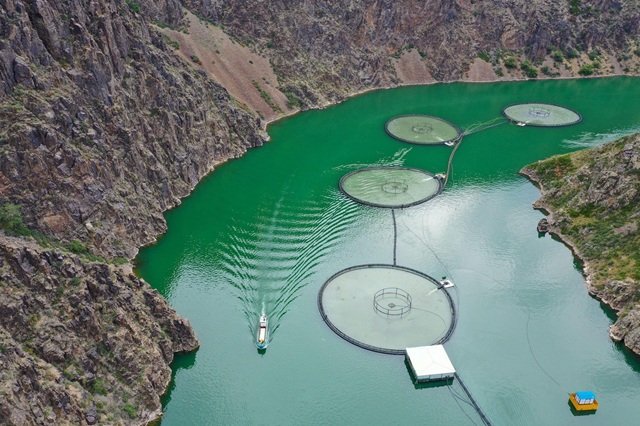
In defending the industry, Global Times presents Xinjiang’s salmon production as an example of how local natural resources can support economic development in a region with challenging geographical conditions. It identifies Nilka County, in the Ili Kazakh Autonomous Prefecture, as an important location for cold-water fish farming, citing glacial meltwater from the Tianshan Mountains as a source of suitable conditions for aquaculture.
The water remains cold and rich in dissolved oxygen throughout the year, while its quality is described by the editorial as particularly favourable for raising cold-water fish. Global Times argues that the industry demonstrates how these natural advantages can be used to establish productive fisheries and create new economic opportunities in western China.
The editorial also highlights production technologies and environmental management practices used by companies in the sector. These include automated feeding systems, underwater cleaning robots and semi-closed recirculating aquaculture systems, which it says help minimise pollution. Uneaten feed and fish waste can be processed into organic fertiliser, while farming practices emphasise raising fish without medication and at low stocking densities.
According to Global Times, companies operating in the industry have obtained multiple international food safety certifications. Their products supply the domestic market and are exported to countries across Southeast Asia, the Middle East and Europe. The editorial also points to access to Singapore, a market it describes as having stringent food standards, as evidence of the industry’s commercial reach. It does not identify the certifications or provide export figures, production volumes or details of the individual companies involved.
Employment and changes in rural livelihoods form another central part of the editorial’s defence. Global Times describes a model combining leading enterprises, jobs in industrial parks and social security provision, through which some families previously dependent on pastoralism have moved into company employment. The editorial says these workers earn stable wages, while some herders receive dividends through equity investments. It also reports that young people have returned to their home communities to find work closer to their families.
The growth of salmon farming has, according to the editorial, generated activity beyond fish production itself. Fish-themed agritourism, specialist restaurants, rural tourism and related businesses have created additional income opportunities and contributed to rural vitalisation. Global Times presents these developments as tangible benefits of industrial expansion for communities in the region.
The editorial concludes by challenging Western media organisations that describe their reporting as fair and objective to visit Xinjiang, observe production directly and speak with workers about their experiences. It argues that first-hand engagement would provide a more reliable basis for assessing working conditions and the rights enjoyed by people from the region’s different ethnic groups.