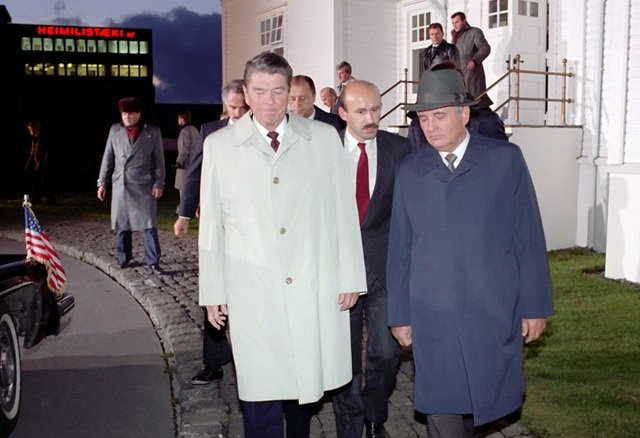
The United States and the Soviet Union came closer to an agreement to abolish nuclear weapons than the public was led to believe after their leaders met in Reykjavik in October 1986, according to a newly assembled collection of declassified documents revealing how the American administration moved to suppress Ronald Reagan’s disarmament ambitions in the aftermath of the summit.
The records show that Reagan repeatedly described a proposal to eliminate nuclear weapons within ten years during discussions with British Prime Minister Margaret Thatcher immediately after the summit. Yet within days, his national security adviser, Admiral John Poindexter, was urging the president to abandon public references to nuclear abolition and redirect attention towards the narrower objective of eliminating ballistic missiles. By November, the administration’s formal policy documents had removed the central ambition that had animated Reagan’s discussions with Soviet leader Mikhail Gorbachev.
The documents also reveal the depth of the resulting misunderstanding between Washington and Moscow. Gorbachev believed Reykjavik had established a new starting point for negotiations that could lead to the complete elimination of nuclear arsenals. The Reagan administration, facing opposition from military officials, political allies and its own national security bureaucracy, increasingly treated the summit’s most ambitious proposals as a political liability.
A draft record of Reagan’s telephone conversation with Thatcher on 13 October 1986 offers particularly striking evidence. According to the original memorandum prepared by notetaker Peter R. Sommer, Reagan described an arrangement under which the superpowers would reduce every kind of nuclear weapon by 50 per cent during the first five years and eliminate the remaining half during the following five. The president repeatedly referred to “the total elimination of all nuclear devices”.
Thatcher reacted with alarm. According to the draft, she told Reagan: “Giving up nuclear weapons is the sort of thing that Neil Kinnock advocates. This would be tantamount to surrender.” She was concerned that abandoning nuclear weapons would undermine the West’s defence, particularly given what she regarded as the Soviet Union’s conventional military advantage in Europe.
The significance of the conversation becomes clearer when the original American draft is compared with the official version subsequently circulated through the National Security Council’s executive secretariat. Although both records listed Sommer as the notetaker, the official version had been substantially edited by National Security Council staff member Alton Keel, with Poindexter’s approval. References to eliminating all nuclear weapons were replaced with language about ballistic missiles. The commitment to remove the remaining half of “every kind of nuclear weapon” became a commitment to eliminate the remaining half of ballistic missiles.
A separate British record, prepared by Thatcher’s private secretary Charles Powell, supports the original American draft rather than the edited official version. Powell recorded Reagan proposing that the United States refrain from deploying a strategic defence system for ten years in return for an undertaking to eliminate all American and Soviet nuclear weapons over the same period. The Margaret Thatcher Foundation later observed that it was “impossible to reconcile” the British account with the official American version on this crucial point.
The subsequent policy shift was made explicit in a top-secret memorandum dated 16 October. Entitled “Why We Can’t Commit to Eliminating All Nuclear Weapons Within 10 Years”, Poindexter’s advice instructed Reagan to “step back” from his abolition rhetoric and “make no further public comment” suggesting that he had agreed with Gorbachev on eliminating nuclear weapons. Instead, the president was encouraged to focus on ballistic missiles, a more limited proposal that US defence officials believed could better serve American strategic interests.
Poindexter outlined several obstacles to abolition, including conventional military imbalances, the consequences for American alliances, verification difficulties and the possibility that a state outside an agreement could secretly develop nuclear weapons and gain a decisive advantage. Defence Secretary Caspar Weinberger and senior military officials opposed the wider proposal, while the Joint Chiefs of Staff argued that eliminating ballistic missiles would require substantial increases in conventional military expenditure to compensate for the loss of nuclear deterrence.
The opposition extended beyond Washington. Thatcher, other NATO leaders, West German Chancellor Helmut Kohl and Japanese officials were among those concerned about Reagan’s willingness to contemplate abolition. Even the more restricted missile proposal encountered resistance. In a report on a meeting with Poindexter, British ambassador Antony Acland described the discussion as “unsatisfactory”, finding the national security adviser evasive and, at times, contradictory. British officials insisted that conventional and chemical military imbalances would have to be addressed before ballistic missiles could be abolished.
Meanwhile, Gorbachev interpreted the American retreat as a distortion of the understandings reached in Iceland. In notes taken by his aide Anatoly Chernyaev during the flight back to Moscow on 12 October, the Soviet leader described himself as “even more of an optimist after Reykjavik”. He believed the summit marked a transition from limiting nuclear weapons to pursuing their total abolition.
At the Soviet Communist Party Politburo meeting on 14 October, Gorbachev described Reykjavik as a breakthrough that had raised disarmament to a “higher level from which now we have to begin a struggle for liquidation and complete ban on nuclear armaments”. By late October, however, he was accusing the Americans of “fraudulent maneuvers in order to distort the facts and confuse the public”. He concluded that “Reagan cannot keep a rein over his crowd”.
The disagreement was not confined to competing interpretations of the past. On 30 October, Gorbachev and Foreign Minister Eduard Shevardnadze discussed a significant adjustment to the Soviet position on Reagan’s Strategic Defense Initiative, permitting certain tests in laboratories, in the air and at ground test sites, but not in space. The change represented a substantial concession towards the American position. Yet when Shevardnadze subsequently raised the proposal with Secretary of State George Shultz, the American side declined to discuss it.
Gorbachev remained convinced that the opportunity should not be abandoned. “We cannot go below Reykjavik,” he told Chernyaev on 17 November, while worrying that “the Americans will not go above Reykjavik”.
The White House’s retreat became institutionalised through National Security Decision Directive 250, signed by Reagan on 3 November. The directive sought to organise post-summit policy around eliminating ballistic missiles while omitting Reagan’s and Shultz’s expressions of support for the abolition of nuclear weapons. A further proposal prepared by National Security Council Russia specialist Jack Matlock outlined a three-phase plan for nuclear abolition, but it failed to gain traction. As the Iran-Contra scandal engulfed the administration and Poindexter resigned, senior officials argued that a dramatic proposal centred on “the total elimination of nuclear weapons” would be politically damaging.
The episode illustrates how the Reykjavik summit’s failure to produce a formal agreement concealed substantial progress. The two leaders had discussed 50 per cent reductions in strategic arsenals, intermediate-range missile reductions and cooperation on nuclear testing. In retrospect, these tentative understandings helped establish the basis for the Intermediate-Range Nuclear Forces Treaty, signed in December 1987, which eliminated an entire class of American and Soviet nuclear missiles.
But the wider ambition of nuclear abolition was pushed aside by institutional resistance, alliance concerns and competing strategic calculations. Gorbachev had expected Reykjavik to inaugurate a new era; Washington increasingly treated it as a proposal from which the administration needed to retreat. As the newly disclosed records suggest, the summit’s legacy was shaped not only by what Reagan and Gorbachev failed to agree, but also by the struggle over what their governments were willing to acknowledge afterwards.