In north-western Sri Lanka, an electric fence stretching 14 kilometres along the Siyambalangamuwa tank is the main defence protecting more than 2,000 families from wild elephants entering nearby villages. For wildlife officer Dewagiri Mudiyanselage Thilakaratne Bandara and his team, maintaining the barrier has become a daily task in a region where encounters between people and elephants have turned increasingly deadly. The conflict reflects a wider crisis driven by shrinking forests, expanding human activity and the growing number of elephants living outside protected areas.
Sri Lanka has recorded an average of 138 human deaths a year in encounters with elephants since 2019, the second-highest toll in the world. Elephant deaths have been even higher, averaging 402 annually over the same period, the highest figure globally. The figures, reported by Reuters, illustrate the scale of a conflict that is placing rural communities and one of the island’s most culturally significant animals under growing pressure.
“Twenty years ago, we didn’t have this situation because across from the tank there were large forests, but they were eventually cleared and then the elephants started moving closer and that’s how this village started being affected,” Bandara said as he repaired the fence with his team. The 48-year-old, who lives near the reservoir, has witnessed the transformation of the area from a place where elephants were encountered occasionally to one where they regularly approach homes after dark.
“When we were little, we had to go to a corner of the tank to see elephants. Now, in the nights, the elephants come to see us,” he said.
Forest loss is central to the problem. Sri Lanka’s forest cover has fallen from roughly 70% in the 1920s to about 34% today, according to World Bank data cited in the Reuters report. Forests cleared for farming have reduced the habitat available to elephants, pushing them towards settlements in search of food. As many as 70% of the country’s estimated 7,451 wild elephants live outside protected areas, increasing the likelihood of encounters with people. The elephant population has also grown by 27% over the past decade, according to the latest census data.
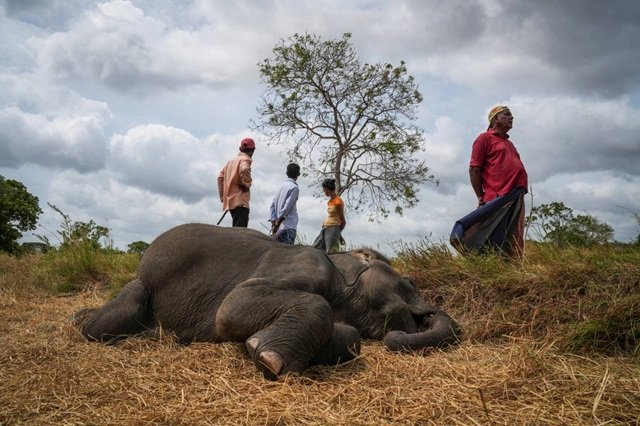
The consequences are visible in the rising number of elephant deaths. Sri Lanka recorded a record 488 elephant deaths in 2023, according to the Department of Wildlife Conservation. The animals have been shot after entering villages, poisoned, electrocuted or killed in train accidents. Others have fallen into wells. The deaths reflect the hazards elephants face as they move through increasingly fragmented habitats and enter areas occupied by people.
For Bandara, the statistics have become a personal reality. Last December, an elephant entered his backyard to eat mangoes. When it attacked him, his wife, Rathnayake Mudiyanselage Shirani Rathnayake, rushed to help and was also attacked. Bandara suffered a broken leg and a dislocated shoulder. Rathnayake, also 48, was trampled and subsequently had her right leg amputated. She now uses a wheelchair.
“Our lives are now completely different from before the elephant attack. My wife and I used to do everything together. We used to farm together. But 200% of those activities have been disrupted,” Bandara said outside his home. “Now we must look after her and the mental strain of that is something we both feel.”
The attack has changed the couple’s daily lives, while the wider community has reorganised its routines to reduce the risk of similar incidents. A nearby school begins lessons 30 minutes later than the nationally mandated starting time of 7.30am to avoid the early morning period when elephants may be present. Villagers finish work earlier to reach home before darkness, and weddings and funerals are arranged with the risk of elephant encounters in mind.
Communication and collective action have become important parts of village life. Bandara and his neighbours use a WhatsApp group to monitor elephant movements and warn one another when animals approach. Residents gather to drive elephants away from homes, shouting and setting off firecrackers. They also help transport people to hospital following attacks.
Sri Lanka has deep cultural and economic ties to elephants. The animals feature prominently in colourful temple processions, and owning an elephant is regarded as a status symbol. They are also a major attraction for the country’s $4 billion tourism industry. Yet their cultural significance has not prevented growing friction in communities where encounters can result in death, severe injury and damage to livelihoods.
Bandara supports an end to forest clearing, particularly for agriculture, and wants a stronger commitment to reforestation. The challenge is intensified by the number of elephants living beyond protected boundaries and the continuing pressure on their habitat. As forests diminish and settlements expand, people and elephants increasingly compete for the same spaces and resources.
Despite the injuries suffered by him and his wife, Bandara said he felt no hatred towards the elephant that attacked them. He attributed the animal’s presence in his backyard to human activity and the loss of its natural habitat.
“I do not feel any hatred towards the animal or any animal. He was hungry because of the activities of us humans,” he said. “I see this situation more as karma that my wife and I must endure. What will I get by hating that animal? He is innocent.”