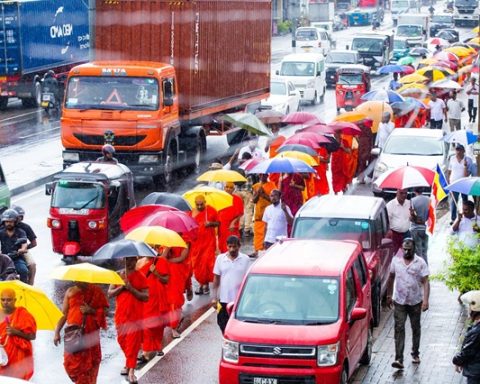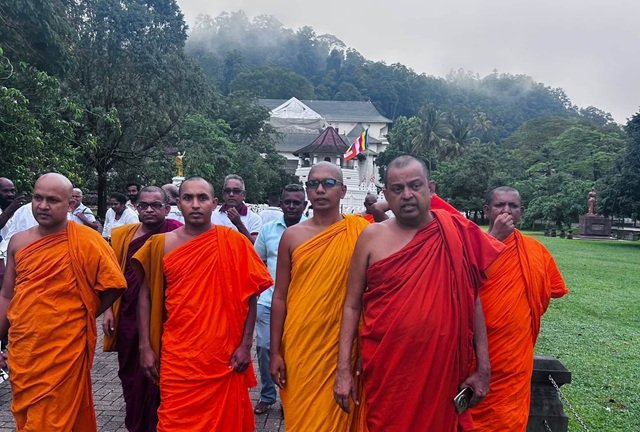
A group of Buddhist monks and laypersons were staging a sit-in near the Presidential Secretariat at the time of going to press. The police obtained a court order yesterday morning prohibiting the protest on the grounds that it was being held in a high-security zone. Speculation was rife that the police would be able to disperse the protesters. However, all indications are that the campaign for the release of Ven. Galagoda Aththe Gnanasara Thera from prison is unlikely to end, and the current protest may be shifted to some other venue.
Ironically, the monks’ staged their sit-in at the cradle of Aragalaya, which paved the way for the JVP-NPP’s meteoric rise to power. What began to unfold near the Presidential Secretariat yesterday is more than a protest; it is a test of strength for the government, which may try every trick in the book to prevail in the current dispute.
Opinion may be divided on the protesting monks’ demand for a presidential pardon for Gnanasara Thera, but the current crisis has stemmed from the government’s mishandling of the decision to produe him in court in lay attire. The government first sought to justify the prison officers bringing him to court, dressed in a sarong and shirt. Then, it made an about-turn and changed the prison rules and regulations, allowing monks in jail to appear in court, wearing saffron robes. The Opposition and independent legal experts have argued that there was no need for President Anura Kumara Dissanayake to appoint a committee to review prison regulations, and the Minister of Justice could have simply directed the prison authorities to do what the committee took days to recommend. The government’s delayed action drove the protesters to launch a march from Kandy to Colombo and escalate their demand, calling for the immediate release of Gnanasara Thera. This is what happens when governments overestimate their strength, ignore the ground reality and refuse to take prompt action to resolve issues.
Sri Lankan governments with two-thirds majorities paradoxically become their own enemies. Impervious to reason, they act according to the whims and fancies of their leaders and take unnecessary risks much like drunk drivers recklessly speeding across unprotected level crossings. The SLFP-led United Front government (1970-77) succumbed to the arrogance of power and its two-thirds majority became its undoing, as it were. President J. R. Jayewardene’s government (1977-88) plunged itself as well as the entire country into chaos by misusing its supermajority. President Mahinda Rajapaksa suffered a painful pratfall in 2015 as his government misused its two-thirds majority, and President Gotabaya Rajapaksa had to head for the hills, together with his siblings, and resign although his government had mustered a supermajority. The incumbent government has not learnt from the predicament of its predecessors.
Political rhetoric may be effective in the short term, but it cannot help suppress the truth or obscure reality. At a recent meeting with a group of representatives of the Maha Nayake Theras, who argued that Gnanasara Thera should be allowed to wear his robe, President Anura Kumara Dissanayake said he did not want to issue an order making an exception for one individual while prison regulations remained unchanged and he would appoint a committee to look into the matter and make recommendations. The committee recommended that Buddhist monks and other members of the clergy serving jail terms be permitted to appear in courts in their robes. It was obvious that the President had the prison regulations amended primarily to benefit Gnanasara Thera, while extending the same benefit to other imprisoned monks. The President said something similar when he met a delegation of the Bar Association of Sri Lanka over his government’s move to raise the retirement ages of the superior court judge. He insisted that it was not for the benefit of any particular individual that the 22nd Amendment (22A) would be enacted. But it was obvious that although the government moved to increase the retirement ages of all judges subsequently, 22A was primarily intended to benefit one particular judge who was reaching the age of 65.
The government may have thought trouble would end for it with Gnanasara Thera’s return to prison, but his imprisonment has become an even bigger problem, with President Dissanayake coming under increasing pressure to grant him a presidential pardon. If he gives in, the government will face serious questions over its reversal of policy on presidential pardons and what its supporters may view as a capitulation to the very forces it pledged to defeat. He thus finds itself in a dilemma.