Deeds of monastic misconduct existed even in the time of the Buddha. They were certainly present in ancient Lanka. The difference between then and now is their normalisation in our times and the impunity enjoyed by their perpetrators today.
The first recorded incidents of monastic misconduct happened during the reign of King Saddhâtissa. When monks of Anuradhapura turned lax, the king stopped giving them alms, writes Dr EW Adikaram basing himself on Sammohavinodinî, Monk Buddhaghosa’s commentary on the Abhidhamma Pitaka. “When questioned by the people as to the reason…, he gave meals on the following day to the bhikkus at Anurâdhapura and justified his attitude by pointing out to the people the unsatisfactory manner in which the bhikkus behaved in accepting the food” (Early History of Buddhism in Ceylon).
When misconduct intruded into the territory of the monarchical power and prerogatives, harsher retributions ensued. According to Manorathapûrani, monk Buddhaghosa’s commentary on Anguttara Nikaya, a young monk conceived a passion for a lady of King Saddhâtissa’s household. “Reciprocal feelings arose in the woman too, and, we are told, both died as a result of that excessive lust,” writes Dr Adikaram (ibid). Mahavamsa approvingly chronicles a mass execution of monks accused of conspiring against King Kanirajanu-Tissa (89-92CE). “…sixty Bhikkus who were involved in the crime of high treason did the king order to be taken captive, with all that was theirs upon the Cetiyapabbata, and he commanded these evildoers to be flung into the caves called Kanira.” Whether these monks were executed in their robes – or not – Mahavamsa doesn’t say, probably because the Chronicle sees nothing wrong in the punishment despite its grisly nature.
Ancient kings also acted vigorously to cleanse the monkhood of Vinaya-violators. Such cleansing was accepted by both the Sangha and the people as a key component of a monarch’s duty of protecting Buddhism. RALPH Gunawardane writes that King Parakramabahu I disrobed hundreds of monks “who would ruin the Order in their quest for gain.” He set them up in lucrative occupations. King Nissankamalla offered the carrot of continued tax exemption to erring monks who stayed in their robes to enjoy that particular financial privilege (Robe and Plough). King Vikramabahu I of Pollonnaruwa, as part of a reform drive, confiscated monastic property. The monks opposed this measure. Many left to Ruhuna taking the tooth relic and the alms bowl with them. But there is no record of the laity opposing this move, let alone rebelling against it. “It is not impossible that the growth of the wealth of the monasteries and the unwise participation in political affairs by monks had roused some resentment among the laity who, even if they did not acquiesce in the actions of the king, saw no reason to oppose him… This wealth was not restored by his successors, even though many like Parakramabahu I, were generous patrons of the sangha (ibid). All of this points to a tradition of judging a monk not by the robe but by his conduct while wearing it.
Given this history, it is easy to imagine what would have happened to the likes of Galagoda-Atte Gnanasara, had they lived under ancient Sinhala kings. Their fate would have ranged from disrobing (forcibly or via a golden-handshake) to imprisonment and even death. They certainly would not have been able to stay in Sasana while violating both the Vinaya and the law of the land repeatedly and with impunity, as they do now.
When Galagoda-Atte Gnanasara interrupted the proceedings of the Homagama magistrate court, ignoring repeated warnings by magistrate Ranga Dissanayake, he proclaimed, in justification, “This is the white man’s law. We don’t accept it.” But it is precisely the ‘white man’s law’ which protects him and his robed cronies from the punitive fist of autocratic rule.
The Robe and the Crime
In June 2026, the Colombo High Court convicted a monk of sexually assaulting a young female child suffering from mental trauma. Pronouncing the sentence of 10-year rigorous imprisonment (plus fines), justice Rashmi Sangappuli stated that the monk had established a temple in a low-income community and posed as a healer. His victim had come to him with her grandmother and brother seeking relief from her malady. Imposing a tough sentence on religious leaders who so violate the trust placed in them sends a powerful message to society, the judge observed.
That monk would now be in prison. As per regulations, his robe would have been removed and he would be in a prison jumper.
Should this child-abuser be permitted to wear the robe while he serves his sentence, despite the fact that his crime is also a violation of the first Vinaya rule?
In ancient Lanka, kings disrobed erring priests. Today a new tradition has been manufactured claiming that only the chief prelates of the nikayas have the right to disrobe a monk. According to the Vinaya, a monk who engages in sexual relations with a woman (even consensual relations) commits a pârâjika and cannot continue as a monk. How many monks have the chief prelates of each nikaya expelled for violating this first Vinaya rule?
On 3 May 2012, London’s Isleworth Crown Court found Pahalagama Somarathana thera, chief incumbent of Thames Buddhist Vihara and Chief Sanghanayaka of the UK, guilty of four counts of sexual assault against a nine-year-old girl. His appeal was rejected in 2013. His six-year jail sentence was commuted to three-and-a-half for good behaviour. He was banned from working with children for life and his name was added to the sexual offenders list.
In prison, he was disrobed. He spent his sentence wearing prison clothing. Having done so, he returned to Sri Lanka in robes and is now a venerated figure whose activities include running a pirivena for novice monks.
If he can spend a prison sentence in prison attire and don the robes afterwards becoming a full-fledged monk, why cannot Galagoda-Atte Gnanasara?
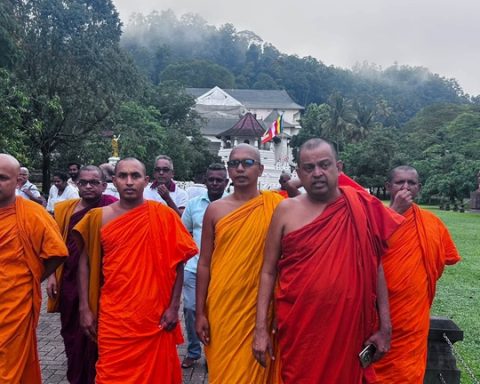
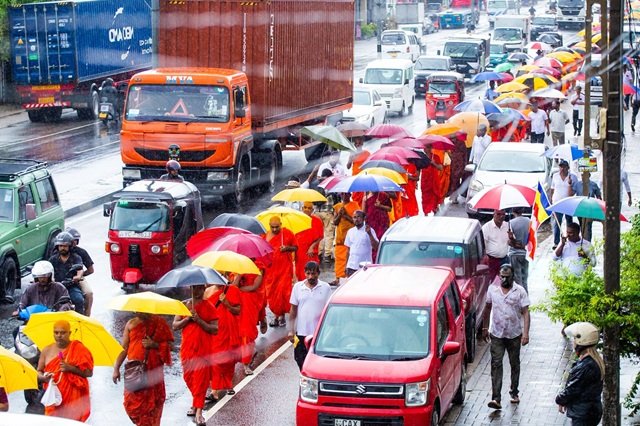
Despite attempts at amplification via electronic and social media, the monk-march from Kandy to Colombo has met with public indifference. Obviously, the Lankan public has no time for a group of monks who are demanding an immediate presidential pardon for Galagoda-Atte Gnanasara and total impunity for all monks from laws and norms. What else is the meaning of the slogan, Don’t touch the robe (Sivurata atha nothabanu) but a demand for freedom from both the Vinaya and the law of the land?
A recent incident in the South gives an indication of what such a lawless future could hold. In October 2026, a French tourist alleged that a young monk at the Kadurupokuna Rajamaha Vihara in Tangalle tried to sexually assault her. As she wrote on social media (apologising for her not-quite-grammatical English), “I went this morning to a temple for a morning chant. A monk saw me and saw I was lost because I couldn’t find the room, then he guide me to a place saying this is the room, the room was really dodgy… When I try to leave he just grab me by my wrist…and try to force me on the wall… By pushing and punching then I free myself and run as fast as I could… Now I’m on the police station and they are trying everything to just make me accept his apologies.”
Eventually, she got her two minutes in court. Literally. “Today we went to court.
The judge called him and me, she asked him are you guilty and he said no. Then they asked me if I want to settle the situation or keep going. It took just two minutes to close the case”.
The next hearing was set for February 2027. The alleged victim cannot be present, naturally. Eventually the case would be thrown out due to the continued non-presence of the complainant.
Monks already enjoy a great deal of impunity in Sri Lanka, even when the alleged victim is far from poor and powerless. Now they want to be placed beyond and above the law totally and formally. Is this the future we want for ourselves and the future generations?
The canker of opportunism
According to Mahinda Rajapaksa, “The government is hunting not just monks. It is also hunting Buddhism. Hiding behind the slogan of reconciliation, the government is carrying out a programme to bring disrepute on Buddhism” .
Mr Rajapaksa made that statement not in October 2026 but in August 2018. It was made in response to the Appeal Court denying Galagoda-Atte Gnanasara the leave to appeal against his 6-year jail sentence. The government Mahinda Rajapaksa was referring to was not the current NPP administration but the Sirisena-Wickremesinghe government.
Today almost every leader and minister of that administration is crying crocodile tears over Galagoda-Atte Gnanasara and demanding his instant release. The SJB has forgotten its core principles to such an extent, that its leaders are accusing the current administration of imprisoning a monk to gain minority votes.
When Galagoda-Atte Gnanasara was jailed and his robe was replaced with a jumper as per regulations, Kotapitiye Rahula thero wrote to the then minister of justice Thalatha Atukorale demanding special treatment. Her reply to him is a model the NPP should have emulated, but didn’t. Responding to Kotapitiye thero’s assertion that only chief prelates have the right to disrobe a priest (a lie debunked by our own ancient history again and again), Minister Atukorale wrote on 19 June 2018, “I inform you respectfully this is not the established law of the country… I would also like to inform you that under an independent judiciary, all the citizens of the country are bound to obey and respect the law of the land” (Translation mine – TG).
Today Thalatha Atukorale in her new avatar as the UNP General Secretary, states, “I say with responsibility that he was in robes when he was in prison.” She also says that the monk was given a general pardon. He wasn’t. He was given a presidential pardon in May 2019 by Maithripala Sirisena who by that time was back in the Rajapaksa camp.
Former chief justice Sarath N Silva has joined the fray trying to frame the entire Galagoda-Atte Gnanasara saga as a conspiracy (possibly a Christian one). He claims that Magistrate Ranga Dissanayake wrote to the president of the Appeal Court Preethi Padman Surasena asking for his intervention to impose a stricter sentence on Galagoda-Atte Gnanasara. Mr Silva also says this was a highly unusual move since mere magistrates never write to a personage as august as the president of the Appeal Court.
He is lying, either knowingly or unknowingly.
Galagoda-Atte Gnanasara disrupted the proceedings of the Homagama Magistrate Court on 25 January 2016. The magistrate immediately wrote to the Homagama police asking them to apprehend the monk and his associates for disrupting the court. The monk was arrested the next day, produced before the court, and remanded, resulting in an even bigger drama by his supporters inside and outside the courthouse.
On 18 March 2016, Ranga Dissanayake wrote to the president of the Appeal Court. But the president at that time was not Mr Surasena but Vijith Malalgoda. The case against Galagoda-Atte Gnanasara commenced under Mr Malalgoda’s stewardship on 10 August 2016. Mr Surasena was appointed the president of Appeal Court only on 15 January 2018.
Mr Dissanayake, by writing to the Appeal Court, was acting in accordance to the Article 105(3) of the Constitution. This grants the Supreme Court and the Appeal Court the power to punish contempt of court incidents against lower jurisdictions (https://www.parliament.lk/files/pdf/constitution.pdf). And unlike the lower courts, the two apex courts have the constitutional power to impose a sentence as long or as short as they see fit for contempt of court cases. Thus Mr Silva was mistaken or lying when he declared the Appeal Court’s six-year sentence on Galagoda-Atte Gnanasara to be illegal.
The reason for Mr Silva’s fabrications is not hard to guess. He claims that he is on the same journey as Galagoda-Atte Gnanasara. Only their methods are different.
What was Galagoda-Atte Gnanasara’s trajectory?
Galagoda-Atte Gnanasara was brought to the national stage by the Mahinda Rajapaksa regime to create a new enemy to replace the dead Tiger. He and Bodu Bala Sena birthed the Halal issue in 2012. In June 2014, he ignited anti-Muslim violence in Aluthgama. The initial incident – the alleged attack on a Buddhist monk and his driver by three Muslim youths – was an accident. Nothing would have happened had Galagoda-Atte Gnanasara and the BBS hadn’t entered the scene with a free pass by the Rajapaksa regime to hold an incendiary rally in Aluthgama town. After the meeting, his mostly white-clad audience turned into a mob setting Aluthgama on fire. That devastation – and the Digana violence of 2018 in which the infamous monk played a key role – were contributory factors to the Easter Sunday Massacre by a group of radicalised Muslim extremists. That attack enabled the return of the Rajapaksas with Gotabaya Rajapaksa as president.
In The Work Of Kings, Prof HL Seneviratne observes, “the Sangha cannot be a power. It can only be a handmaid of power.” Some extremis monks might believe that they are working towards a new state where monks would be true power-holders. But, as in the past, the only real role open to them is to become enablers, enforcers, and, ultimately, pawns of the next ruler (civilian or military, Rajapaksa or not). Unfortunately, their quest for power and impunity is causing immeasurable damage to Lankan Sasana. The return of the Ganinnanses may not be very far.