Genghis Khan, one of history’s most formidable conquerors, is being celebrated in modern Mongolia as a symbol of national unity, political strength and cultural identity, despite the mass killings and devastation that accompanied the expansion of his empire. An exhibition opening at Berlin’s James-Simon-Galerie next week will examine his legacy as the country prepares to mark 800 years since his death, highlighting the tension between his achievements as a state-builder and his reputation for extraordinary brutality.
The exhibition, co-developed by Matthias Wemhoff, director of Berlin’s Museum of Prehistory and Early History, combines archaeological discoveries with an examination of the Mongolian ruler’s enduring place in national identity. As reported by German weekly newspaper Die Zeit in its issue No. 45/2026, the exhibition also reflects Mongolia’s contemporary search for international recognition and a coherent national identity, with Genghis Khan increasingly presented as a unifying figure. Mongolian President Ukhnaagiin Khürelsükh is expected to attend the opening during a state visit to Berlin.
In the exhibition catalogue’s foreword, Khürelsükh praises Genghis Khan as the “founder of the Mongol Empire” and the “renewer of the world”. He describes the conquests not as acts of aggression but as a “great creative achievement”, arguing that the empire was characterised by “deepest peace”. Die Zeit presents this interpretation as a selective account of a ruler whose military campaigns devastated cities and killed large numbers of people.
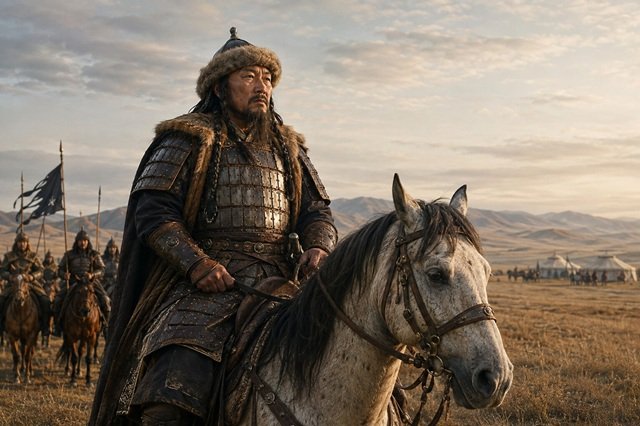
The historical scale of Genghis Khan’s empire was extraordinary. Born Temüjin, the son of a clan chief, he united Mongol groups under his authority and began a campaign of conquest across Eurasia during the 13th century. By the time of his death in 1227, Mongol territories extended from the Sea of Japan to the Caspian Sea, and from Lake Baikal in Siberia to northern China. His successors expanded the empire further, eventually creating the largest contiguous land empire in history.
One of his most consequential decisions was the establishment of Karakorum in 1220 in the Orkhon Valley, in the heart of present-day Mongolia. The city gave a permanent administrative centre to a political system that had emerged from the mobile world of nomadic horsemen. Archaeologists from Germany and Mongolia have investigated the former capital since 2000, although only about 1 per cent of its original area has been excavated. The site, now largely overgrown, still contains evidence of its former urban life, including ceramic fragments and surviving walls.
Wemhoff has explained how vegetation patterns can help identify the vanished city’s streets and buildings. Cattle tend to avoid grazing on areas where former masonry has left the soil less fertile, allowing archaeologists to trace the ancient settlement through differences in plant growth. Excavations and historical records have also revealed Karakorum’s cultural diversity. A report by the Franciscan friar William of Rubruck, who visited in 1254, described a city containing two mosques, a Christian church and 12 Buddhist temples.
Genghis Khan’s political and military methods help explain why his reputation extends beyond his conquests. He reorganised his troops into units of tens, hundreds and thousands, distributed spoils according to performance and allowed capable men to rise through the military hierarchy regardless of family connections. He incorporated defeated enemies into his forces, including the Tatars, traditional adversaries whose members had been associated with his father’s death. He also supported religious tolerance, introduced a writing system and developed a courier and postal service, alongside a legal code.
Yet these achievements coexisted with systematic violence. According to the account published by Die Zeit, Genghis Khan established his reputation as one of history’s most ruthless conquerors through the mass killing of defeated opponents, while selectively sparing people whose military or professional skills could benefit his empire. Women were captured as spoils of war, enslaved and subjected to rape.
The destruction of Nishapur in Persia illustrates the scale of the violence. After Genghis Khan’s son-in-law was killed during an unsuccessful attempt to capture the city in 1220, Mongol forces returned the following year and conquered it. A subsequent mass execution was intended to leave no survivors. Genghis Khan’s son Tolui reportedly ordered the heads of men, women and children, and allegedly cats and dogs, to be piled into pyramids. Hundreds of thousands of people are believed to have died in this episode alone. Estimates of the total number of deaths attributable directly or indirectly to Genghis Khan range from 20 million to 40 million, although no precise figure exists and some historical estimates include subsequent deaths from famine and disease.
The empire’s campaigns also transformed the territories it conquered. A 2011 study by Hamburg’s Max Planck Institute for Meteorology, conducted with the US-based Carnegie Institution, examined the environmental consequences of the depopulation caused by Mongol warfare. The resulting regeneration of forests during the 13th and 14th centuries absorbed an estimated 700 million tonnes of carbon dioxide from the atmosphere, producing a measurable cooling effect.
For Mongolia, Genghis Khan’s modern significance is inseparable from its political circumstances. After decades as a Soviet satellite state, the country has pursued greater independence since 1990. With a population of about 3.6 million and territory more than four times the size of Germany, it lies between Russia and China, relying on Russia for energy and China for access to ports needed for trade. Foreign Minister Batmönkhiin Battsetseg has sought to strengthen relations with Europe, Japan and South Korea while avoiding tensions with its two powerful neighbours.
Genghis Khan remains visible throughout the country, from a 40-metre equestrian statue inaugurated east of the capital in 2008 to banknotes, the international airport and commercial brands bearing his name. At the Chinggis Khaan National Museum in Ulaanbaatar, director Chuluun Sampildondov has sought to present the historical record scientifically. Yet the museum’s highest floor contains a grand ceremonial hall created at the president’s request, where a monumental gold-coloured statue of the ruler presides over a space in which visitors are instructed to bow. There, Die Zeit reports, the historical conqueror is presented not merely as a ruler but as an object of reverence.