Hundreds of thousands of people took to the streets across France on Saturday in demonstrations that brought together previously separate protest movements, as anger over wages, education, living costs, pensions and climate policy converged in a nationwide mobilisation marked by violence and clashes with police. The French interior ministry estimated the number of participants at 550,000, while organisers put the figure at 800,000. The scale of the demonstrations, which spread from north to south and east to west, reflected years of accumulated frustration over grievances that successive protests have done little to resolve.
Reporting on the unrest, the German weekly newspaper Die Zeit described a movement in which groups with different demands had begun acting together. The demonstrations included the gilets jaunes, teachers, secondary-school pupils, university students, trade unionists, farmers and taxi drivers. Their demands ranged from better working conditions and higher wages to smaller school classes, shorter school days, fairer access to universities, assistance for farmers following an exceptionally hot summer, a wealth tax and cheaper petrol. The convergence of these groups gave Saturday’s protests a broader reach than campaigns focused on individual policies.
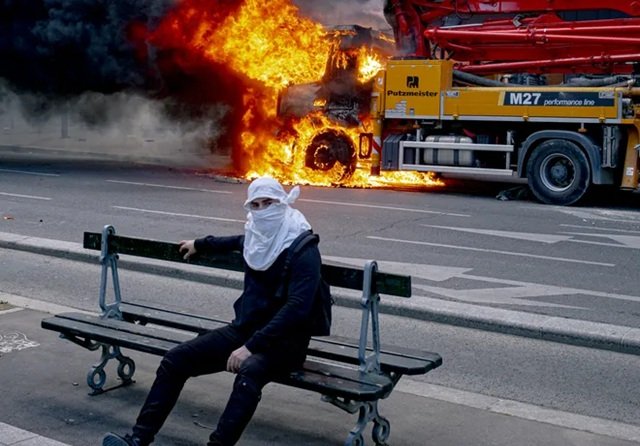
The demonstrations began to take shape almost four weeks earlier, when a small group of striking teachers and pupils at a school north of Paris initiated a protest that subsequently spread. By Saturday, peaceful marches were taking place alongside incidents of serious disorder. Images from across the country showed burning town halls, looted shops, damaged commercial premises and injured demonstrators and police officers. In Marseille, masked individuals set fire to a police station and threw stones at shop windows. Elsewhere, protesters erected barricades, burned rubbish bins and formed human chains.
The police response became another source of controversy. Officers confronted demonstrators with batons, rubber bullets and grenades, while reports of serious injuries sustained during earlier confrontations added to public anger. A 14-year-old had suffered a shattered hand and a 15-year-old had lost teeth in incidents involving police weapons. In Paris, police used tear gas to disperse a musical orchestra performing at Place de la République. The forceful policing tactics had also attracted international scrutiny, with the United Nations becoming involved in the controversy.
The escalation had been anticipated. France’s interior minister had instructed officers to show “no restraint” when dealing with school blockades and said they should be permitted to use “all weapons” during the demonstrations. The Paris police prefecture also prohibited protective equipment capable of shielding demonstrators from tear gas or grenades. Die Zeit reported that confrontations had become a recurring feature of demonstrations in France, with masked rioters contributing to the violence and police repeatedly failing to defuse tense situations. More than 5,000 pupils had been taken into police custody in recent protests, many of them participating in demonstrations for the first time.
The breadth of the mobilisation reflected a wider deterioration in public confidence. An annual survey conducted by the Centre for Political Research at Sciences Po, known as CEVIPOF, found that distrust and disillusionment were the dominant sentiments among the French public. Only one in seven French men and one in eight French women described themselves as experiencing well-being. Since the survey began in 2009, public sentiment had never been as bleak, while confidence in political institutions had fallen to its lowest recorded level, substantially below the level reported in Germany.
Previous protest movements help explain the depth of the discontent. In 2018 and 2019, the gilets jaunes blocked major roads in Paris and hundreds of roundabouts in provincial areas, demanding higher wages, greater public participation in decision-making and referendums. They also called for greater recognition of workers including delivery drivers, nurses and cashiers. The movement secured a minimum-wage increase of €100, but many other demands remained unaddressed. Protesters were also invited to record their grievances in condolence books at town halls, although many of those demands subsequently received little attention.
In 2023, the shooting of 17-year-old Nahel during a police stop triggered unrest among young people in suburban areas. The disturbances frequently involved indiscriminate rioting, and thousands were imprisoned. The residential estates affected by the violence continued to bear physical signs of the destruction, while little had changed in the conditions that had contributed to the unrest, according to Die Zeit’s account.
Protests against pension reform offered another example of mobilisation followed by limited concessions. Millions of people demonstrated and lost wages during strike action in an effort to preserve the retirement age of 62. President Emmanuel Macron made few concessions at the time. Two years later, the government in Paris suspended the pension reform until 2027 in an effort to prevent its own downfall.
The current protests have brought together grievances that extend beyond traditional political and trade union boundaries. Greta Thunberg, the Swedish climate activist, appeared this week outside a secondary school north of Paris, where she addressed journalists. “We are all fighting for the same thing here,” the 24-year-old said, arguing that young people were not being heard and that their future was being taken away.
For Prime Minister Sébastien Lecornu’s government, the diversity of demands has complicated the search for a response. The administration spent two weeks largely ignoring blockades at hundreds of secondary schools before arranging talks with pupil organisations. Saturday’s mobilisation was not organised by established trade unions; its initial online calls came from an anonymous TikTok account. Secondary-school representatives said they would continue striking until the government responded to their demands, while trade unions announced further days of protest.
The political consequences may extend to the presidential election scheduled for 2027. Current polling places Jean-Luc Mélenchon of the radical left and Marine Le Pen of the far right among the leading contenders. Their programmes differ sharply, but both draw support from public anger and disillusionment that successive governments have struggled to diminish.