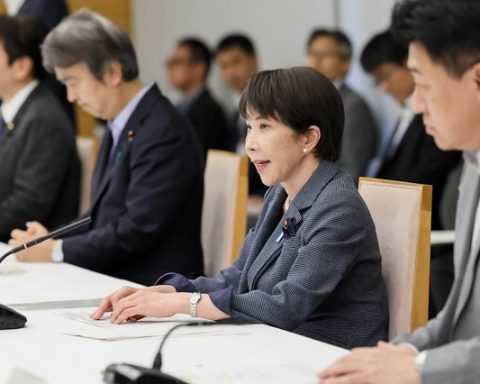
Japan’s Prime Minister Sanae Takaichi has triggered a national debate after saying that makeup, bathing, cooking and other daily tasks consume several hours of her schedule, leaving her with less time to focus on government strategy than male predecessors.
Speaking during a parliamentary budget hearing on Wednesday, Takaichi, Japan’s first female prime minister, said she believed she spent an additional three or four hours a day on such activities compared with a man in the same position. Her comments drew support from those who said they highlighted the demands placed on working women, but criticism from others who accused her of reinforcing traditional gender stereotypes.
“Finding the time to sit down and focus with a truly clear head is a challenge,” Takaichi told lawmakers, most of whom were men. She said she found it difficult to make time to consider “the direction our country should take or the kind of nation we aim to be”.
Her remarks came in response to a report by NXJI Research examining the demands placed on Japanese prime ministers by parliamentary procedures. The report found that national leaders could spend as much as seven hours a day answering lawmakers’ questions. Japanese prime ministers are expected to attend parliamentary sessions on an average of about 72 days a year, compared with 50 days in Britain and 13 in Germany.
Takaichi, who describes herself as a workaholic and has said she sleeps between zero and three hours a night, also complained of taking home a “mountain of paperwork” each day. She said her all-male team of aides had struggled to adjust to her needs, including failing to schedule time for makeup before television appearances.
“They haven’t quite gotten used to the fact that I am a female prime minister rather than a male one,” she said, prompting laughter in parliament.
The comments have focused attention on midashinami, Japan’s cultural expectations surrounding public appearance and presentation. Women can face pressure to wear makeup and high heels while avoiding short skirts and low-cut clothing. Although grooming expectations apply to both sexes, women often face greater scrutiny in schools and workplaces.
Kotoe Hashimoto, a conservative writer, defended Takaichi on the social media platform X. “Are they saying she should show up to the Diet barefaced?” she wrote, referring to Japan’s parliament.
Yoshiko Kira, an opposition lawmaker in Japan’s upper house, took a different view, arguing that the prime minister was normalising restrictive expectations rather than challenging them.
“I find it deeply unsettling that the prime minister would speak as if these specific expectations regarding appearance and demeanor are simply ‘the natural order of things’ — as if they were immutable, foundational premises that cannot be challenged,” Kira said in an interview.
The debate comes amid a substantial domestic workload for Japanese women. By some estimates, they perform more than three-quarters of household chores, while many workers are expected to work overtime, reportedly reaching as much as 22 hours a month in recent surveys. Hiring domestic help remains relatively uncommon, with only about 2 per cent of households employing housekeepers, according to the Ministry of Economy, Trade and Industry.
Takaichi’s official residence also has limited domestic support. Her husband, Taku Yamamoto, a former lawmaker, told the monthly magazine Bungeishunju this year that a cleaner visited once a week but that the residence had no cook. He sometimes ordered pizza, ensuring he obtained the delivery person’s name so the order could pass through security.
Takaichi has frequently highlighted her demanding routine to cultivate an image of a hardworking, down-to-earth leader. After pledging to “work, work, work, work and work” upon her election last year, she prompted another debate in July when she described spending a holiday weekend ironing undergarments, sewing fraying skirts and repairing loose jacket buttons.
Her public emphasis on traditional domestic responsibilities contrasts with her support for policies criticised by opponents as restrictive of women’s rights, including preserving the male-only lineage of Japan’s imperial family and retaining the requirement that married couples share a surname.
Public reactions to her latest remarks have been mixed. Rina Sumi, 22, a part-time cafe worker, said the comments were inappropriate. “Why bring up her gender like that — as if it were an excuse?” she said.
Mika Okado, 27, a nurse who spends an hour each day getting ready and preparing a packed lunch, said she was surprised by the amount of time Takaichi devoted to her routine but appreciated her candour. “In a way, it’s actually quite refreshing — she’s speaking without overthinking it,” she said.