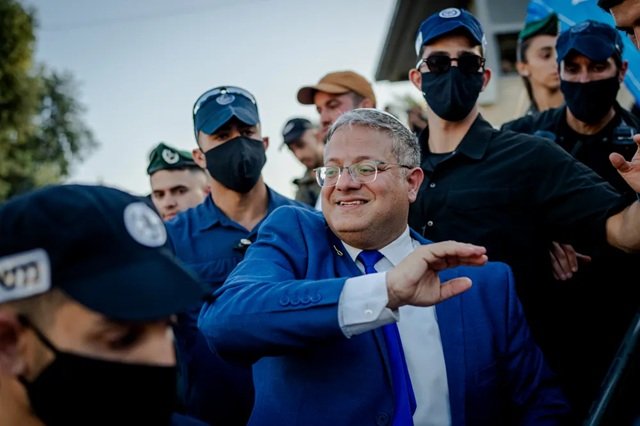
Itamar Ben-Gvir, Israel’s national security minister, danced to nationalist pop music beneath a computer-generated Israeli flag as he addressed a cheering crowd in Tel Aviv, celebrating his record in office and promising further expansion of Israeli control over Palestinian territory. Wearing a white kippah, a crimson tie and a gold noose-shaped pin in support of legislation restoring the death penalty, he presented himself as the political force willing to pursue policies that other politicians have avoided.
At the rally, Ben-Gvir boasted of issuing 300,000 gun licences to Israeli Jews and described a policy of restricting food in prisons as a source of fear among Palestinians. “I’m so happy that I made hell for them,” he said. He declared that Palestinians would be expelled from the West Bank, praised the violent Hilltop Youth organisation and insisted that Israel would “capture all of Gaza because it’s ours”.
The event, reported by Observer UK, took place in what was once considered a liberal stronghold. The willingness of hundreds of people, many of them English-speaking, to applaud Ben-Gvir’s rhetoric reflected the growing visibility of far-right politics as Israel approaches its election on 27 October. When Yishai Fleisher, a candidate for Ben-Gvir’s Jewish Power party and spokesperson for the Hebron settler movement, called for applause for the reintroduction of hanging, the audience responded enthusiastically.
Ben-Gvir has become a prominent representative of the most right-wing government in Israel’s history, led by Benjamin Netanyahu, who is seeking an unprecedented seventh term as prime minister. The election, the first since Hamas’s 7 October 2023 attacks killed 1,200 Israelis at military bases and kibbutzim around Gaza, will determine whether Netanyahu retains power or an opposition bloc led by former general Gadi Eisenkot takes office. But the contest is taking place in a political climate where many of the policies once associated with the far right have gained wider acceptance.
Israel’s military response to the Hamas attacks has become the country’s longest war. Palestinian health officials say Israeli attacks have killed more than 74,000 Palestinians in Gaza, while almost 9,000 people have been killed in Lebanon and dozens more in Syria. Yet the principal opposition to Netanyahu is not offering a fundamental break with his approach to the conflicts or the occupation.
Eisenkot has backed West Bank settlements, rejected the establishment of a Palestinian state and said he would continue many of Netanyahu’s policies in Gaza and Lebanon. Left-wing politician Yair Golan is the only candidate identified in the report as proposing an end to the war. The election debate is therefore focused largely on how Israel should continue fighting and what Netanyahu knew before the 7 October assault.
Polling cited in the Observer report suggests that public opinion favours continued military control. According to a recent survey by the Jewish People Policy Institute, 72% of Israeli Jews support maintaining a troop presence inside Gaza, while 55% favour continued military occupation there for years. Almost 80% of Israelis surveyed want to continue fighting in Lebanon. Netanyahu is regarded as the most suitable candidate for prime minister by 46% of voters, compared with 29% for Eisenkot.
The rightward movement predates the formation of Netanyahu’s current government four years ago. The trend has accelerated as younger, left-leaning and secular Israelis have left the country, while recent immigrants have tended to favour the right. Proposals to annex the West Bank, occupy Gaza indefinitely and impose the death penalty, previously regarded as fringe positions, have moved closer to the centre of political debate. Ben-Gvir has also built a substantial online following, with almost 200,000 followers on TikTok and videos that attract millions of views.
Some of his supporters acknowledge concerns about his public image but continue to endorse his policies. Max, a 34-year-old immigrant from San Diego who declined to give his surname, attended the Tel Aviv rally in his new hometown. Describing himself as a supporter of Donald Trump, he said his politics were “extremely socially liberal, except when it comes to anything to do with security for the Jewish state”.
Max worried that Ben-Gvir represented an unattractive image of Israel abroad. The minister has shared videos of himself taunting detained foreign activists who were kneeling with their hands bound and has advocated installing crocodiles in a moat around Israel’s largest prison. Max nevertheless found the crocodile proposal “hilarious”. Ben-Gvir’s party is projected to make substantial gains in the coming election, according to the report.
David Lander, the party’s press secretary, attributed its growing support to a desire for tangible results. “People want to see someone who gets results,” he said. Jewish Power hopes to secure additional cabinet positions in the next government. Ben-Gvir wants to become defence minister, while the party also aims to take control of the justice ministry and retain the national security portfolio.
The political shift is visible among Israelis whose families once identified with the country’s socialist tradition. Roy Wexler, in his early forties, grew up among generations of kibbutz members and described socialism as something that was “in our blood”. He voted for a Palestinian-Israeli left-wing party in his first election about 20 years ago but has since moved steadily to the right. He and his friend Nir Sovatski now intend to vote for Bezalel Smotrich, the far-right finance minister and a resident of a West Bank settlement.
“Ben-Gvir has done some good things,” Sovatski said, although he argued that the minister had failed to bring about deeper structural change. Smotrich, by contrast, has approved more than 100 West Bank settlements during his time in office, an increase of 80%. Both men regard settlement expansion as essential to Israel’s security.
Their position conflicts with warnings from Israel’s Institute for National Security Studies, a thinktank staffed by former security officials. Last month, it described settler violence as a “strategic threat to the State of Israel and its democratic character”.
Wexler said the attacks of 7 October had helped transform political attitudes, including those of people close to him. “My girlfriend was a leftist, but something changed on October 7,” he said. His movement to the right has created distance between him and his family, whose members remain attached to the socialist kibbutz tradition. “I’m a stranger within the family, even from my brothers and extended family,” he said. “We don’t talk much about politics.”
Attempts to challenge the shift have struggled to reverse it. Satirist Lior Schleien, who visits Israeli schools to debate pupils who support settlements, war and violence towards Palestinians, argues that the failure of the political centre helped the right gain ground. “It’s a slur today in Israel to be a leftist,” he said. Hundreds of schools are now on the waiting list for his visits, and his videos attract millions of views, suggesting that an audience for liberal and democratic alternatives remains.
Schleien nevertheless believes the far right will retain its influence even if Netanyahu loses office. “The next generation of Israel’s far-right, populist political leadership is already here: Itamar Ben-Gvir and others like him,” he said. “They are relatively young, and they are full of energy to destroy.”