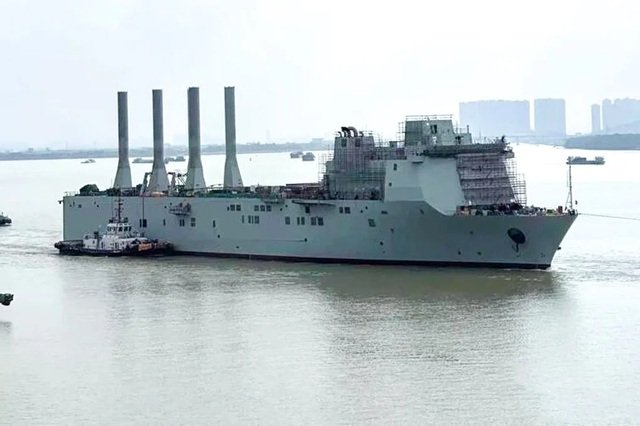
China appears to be developing a second unusually configured vessel that could serve as a mothership for large underwater drones, adding to evidence of a potential effort to extend the country’s uncrewed undersea operations beyond its coastal waters. The vessel, estimated to be about 150 metres long, was seen under tow on the Pearl River near Guangzhou, resembling a larger ship recently launched at a Shanghai shipyard. Neither vessel’s intended purpose nor its operator has been confirmed, but their distinctive stern structures have attracted the attention of naval analysts examining China’s expanding maritime capabilities.
The Guangzhou vessel differs in hull shape from the ship spotted under construction in Shanghai, which measures slightly more than 200 metres (656 feet). Both, however, feature raised deckhouses towards the bow, hangar-like spaces and large openings at the stern. The smaller ship has six tall vertical posts near its stern, while the Shanghai vessel has 12 posts of varying heights. Analysts believe these structures and openings could form part of a system for lowering large uncrewed underwater vehicles (UUVs) into the sea and recovering them after missions.
The US-based defence news website TWZ reported that satellite imagery taken on October 2 showed the Guangzhou vessel at Guangzhou Shipyard International on Longxue Island before its launch. Naval News also identified the facility as a possible builder, although it said further imagery would be needed to establish the vessel’s origin and where it would be fitted out. The images circulated through two short videos originally posted on the Chinese social media platform Weibo, but Naval News cautioned that their authenticity had not been confirmed. Tugboats were seen moving the vessel near Guangzhou’s Panyu district, with scaffolding still in place and sensor and communications equipment apparently not yet fitted.
Thomas Lim, an associate research fellow with the Military Studies Programme at the S. Rajaratnam School of International Studies in Singapore, said the vessels appeared capable of carrying multiple underwater drones. Their rear openings and ramps supported the possibility that they were designed as motherships, he said, although the available imagery provided only a “partial fit”. Confirmation would require evidence of completed supporting infrastructure, including cranes and docks, as well as “proof of concept in deployment or tests”. Neither vessel has been observed launching or recovering underwater drones.
The Shanghai ship first attracted detailed attention after analyst H.I. Sutton assessed it in a Naval News report on September 15 as a possible mothership for very large underwater drones. An experienced military imagery analyst who reviewed the same September 10 imagery for the South China Morning Post independently identified what appeared to be a stern launch-and-recovery system. A cradle positioned behind the ship seemed narrow enough to pass through its rear opening, the analyst said.
The suspected motherships are appearing as China tests two very large underwater drone prototypes in Hainan, estimated by Sutton to measure 35 and 45 metres long. Floating docks have so far been used to transport the craft out to sea for testing and to recover them afterwards. Purpose-built support vessels could provide greater flexibility, allowing drones to be transported towards distant operating areas, recovered after missions and maintained or prepared for subsequent deployments. If the ships are intended for military use, such capabilities could support undersea surveillance, seabed mapping and other operations in the western Pacific, including waters east of Taiwan.
Peter Jones, a retired Australian vice-admiral, suggested the smaller vessel might support “a different class of UUV” or represent “another base ship design”, potentially one already familiar to its builder. If underwater drones proved effective, he said, expanding their numbers would create demand for additional motherships. Meeting that demand could require modifying existing vessels or adapting established designs so that “multiple shipyards” could contribute to production.
Lim offered a more cautious interpretation, saying the differences between the ships could reflect “variety” within a common design or requirements for “different operational theatres”. The vessels therefore do not necessarily demonstrate that China has moved beyond experimentation towards a broader underwater drone capability. Their possible military role would also carry risks. Timothy Heath, a China military analyst, warned in the South China Morning Post’s September report that a large support ship operating in contested waters would be vulnerable to attack and better suited to relatively less hostile conditions close to China.
Alongside these developments, Beijing has revised its export controls on drones and industrial equipment, tightening scrutiny of sensitive components and military-relevant technologies while simplifying procedures for some less advanced products. The new rules, announced on Monday by the Ministry of Commerce, the General Administration of Customs and the Equipment Development Department of the Central Military Commission, will take effect on November 18.
The revised controls add high-performance brushless motors and technologies such as autonomous navigation and obstacle avoidance to the list of controlled exports for military and civilian unmanned aerial vehicles (UAVs). At the same time, the payload threshold for a licensing exemption rises from 20 litres to 80 litres, while certain models become eligible for simplified licensing or registration procedures. The rules also extend the flight-duration threshold for requiring an export licence from more than one hour to more than three hours, reflecting advances in battery technology. Certain drones capable of flying between 30 minutes and three hours can register with the commerce ministry without an additional licence.
Wu Guoxiong, director of the Customs Law Committee at Shenzhen-based Guanghe Law Firm, said the changes would prevent blanket restrictions on mid-to-long-endurance industrial drones while concentrating controls on more sensitive capabilities. “The new rules mark a shift in regulatory focus from vehicle performance towards key components and combat-enabling technologies, while the authorities are leveraging streamlined licensing procedures to make the enforcement more targeted,” he said.
A commerce ministry spokesperson said the changes reflected rapid technological development, as products once regarded as advanced had become consumer goods. They also demonstrated China’s opposition to the unauthorised use of drones for non-peaceful purposes while supporting international trade in civilian drone technology. Zhang Yi, founder and chief analyst at consultancy iiMedia, said consumer drone exports were likely to face few barriers, but industrial UAV manufacturers would need to complete compliance filings and verify end users. Those requirements would “inevitably extend order delivery timelines and increase compliance costs”, he said, warning that smaller companies with limited compliance resources could be forced out of high-performance overseas markets.