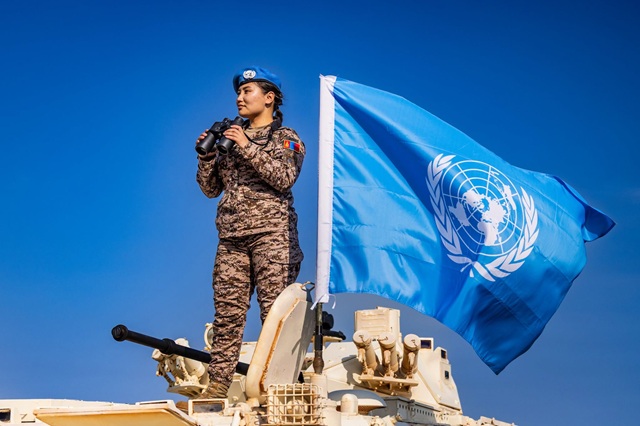
More than 25 years after the United Nations Security Council adopted Resolution 1325 on women, peace and security, women’s representation in multilateral peace operations remains uneven, with progress in some categories offset by declining numbers and setbacks in senior appointments. The Stockholm International Peace Research Institute (SIPRI), in its 2026 overview of United Nations, European Union and Organization for Security and Co-operation in Europe (OSCE) missions, found that budget-driven personnel reductions had contributed to a decline in the number of women deployed in UN and OSCE operations. The figures show that meeting gender-parity targets remains a challenge even as international organisations continue to endorse greater participation by women.
The sharpest setback was in UN military personnel. The UN’s 2018 Uniformed Gender Parity Strategy set a target of 25 per cent women among military experts and staff officers and 15 per cent among troops by 2028. By June 2026, women accounted for 21 per cent of military experts and staff officers, down from 24 per cent in 2024 and below the interim target of 23 per cent for the first time since 2020. Their share among troops remained at 8 per cent, well below the 13 per cent interim target for 2026. The total number of women serving as troops fell by 26 per cent, or 1,098 personnel, while the number of women military experts and staff officers declined by 43 per cent, or 272 personnel. SIPRI described the reductions as the steepest year-on-year declines in these categories in a decade, largely reflecting wider personnel cuts linked to the UN’s financial difficulties.
Women’s representation in UN police followed a different trajectory. In 2026, women made up 35 per cent of individual police officers, exceeding the strategy’s 2028 target of 30 per cent, which had already been reached in 2021. Women accounted for 19 per cent of formed police units, surpassing the 17 per cent interim target for 2026. However, the total number of women police personnel fell as operations reduced staffing. Leadership figures also improved: on 1 October 2026, three of the five chief police officers serving in UN peace operations were women, representing 60 per cent of the total and an increase of 40 percentage points compared with the previous year. The three women held commissioner positions in MINUSCA, MONUSCO and UNISFA.
Civilian representation in UN missions also increased proportionally, despite falling numbers. Women’s share of civilian personnel rose in both peacekeeping operations and special political missions, with the latter recording a 4.7-percentage-point annual increase, the largest in a decade. Four operations—UNFICYP, UNOWAS, UNSCOL and UNVMC—had at least 47 per cent women among civilian personnel, within the UN’s defined gender-parity range of 47–53 per cent. Yet only four of the 21 heads of UN peacekeeping operations and special political missions were women on 1 October, a share of 19 per cent, down 11 percentage points from the previous year. The decline reflected the closure of UNMHA, which had been headed by a woman, and leadership changes in MONUSCO, UNMIK and UNSCOL.
The OSCE faced similar difficulties. Its 2019 Gender Parity Strategy set 2026 as the target year for achieving 45–55 per cent women across staff categories. During the first half of the year, six of its 12 field operations reached at least 45 per cent women, but the overall proportion and number of women personnel declined. By June, the number of women had fallen to 82, largely because of staffing reductions across several operations. On 1 October, only one of the 12 heads of OSCE field operations was a woman, following leadership changes in Moldova, Serbia and Dushanbe. The proportion of women in these senior posts fell by 17 percentage points to 8 per cent.
The European Union recorded gains in both the number and proportion of women in its Common Security and Defence Policy missions and operations, although progress remained limited. Women accounted for 10 per cent of military personnel in December 2025, the latest available reporting period for that category, while their numbers increased substantially following the expansion of the EU Military Assistance Mission in support of Ukraine. Civilian representation also rose modestly. Nevertheless, none of the civilian missions averaged at least 40 per cent women during the first half of 2026, missing the objective established under the renewed Civilian CSDP Compact. Six of the 21 heads of EU missions and operations were women on 1 October, or 29 per cent, up 14 percentage points from the previous year.
SIPRI’s assessment identifies national recruitment systems and the nomination of women for deployment, particularly to senior positions, as continuing obstacles. Limited pools of eligible candidates and low nomination rates constrain progress, while reliance on a small number of contributing countries leaves representation vulnerable when their deployments decline. The report also cautions that headcounts alone cannot establish whether women have equal opportunities or meaningful influence. It calls for greater attention to recruitment, retention, promotion, training and workplace safety, alongside indicators measuring women’s influence and the quality of their participation in peace operations.