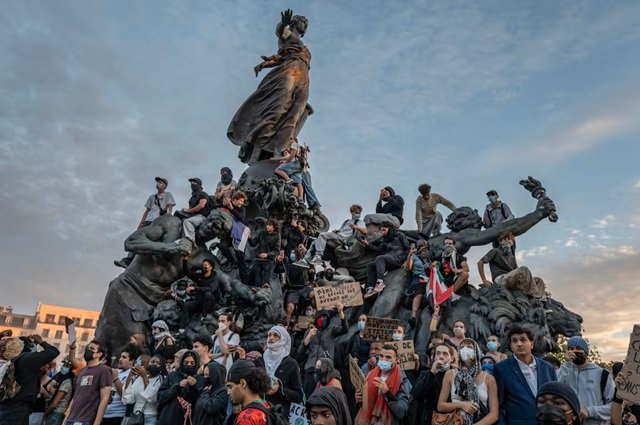
More than 177 protests and demonstrations have taken place across 12 European countries in just over a month, as students, trade unions and other groups mobilise over housing costs, education, inflation and corruption. The wave of unrest, spanning countries from Greece to Belgium and Albania to Spain, has reached a scale comparable to periods of intense social protest during the eurozone crisis of 2010–2012.
Data compiled by the university research project PolDem, which tracks demonstrations through news agency reports, recorded at least 177 protests between 15 September and 23 October. The figure approaches the average of 190 protests a month recorded during the particularly active autumns of 2010, 2011 and 2012. France, Spain, Italy, Portugal and Belgium account for most of the current demonstrations, with the five countries together representing 80% of the protests documented in a separate compilation by the Spanish newspaper El País.
The demands vary between countries, but housing, education and the cost of living have emerged as recurring grievances. France has become a focal point for demonstrations over education and living costs, with similar protests spreading to Italy and Belgium. Spain’s mobilisation has centred on housing, while corruption has driven unrest in Albania and Serbia. In Germany, smaller demonstrations have concentrated on opposition to military service and rearmament.
Although students have led many of the protests, teachers, trade unions and other groups have increasingly joined them. The demonstrations share a period of heightened activity and overlapping concerns, but they arise from different national disputes and do not constitute a centrally coordinated European movement. Their timing is partly explained by the academic calendar. “Students return to educational institutions, organisational networks become active, and changes in fees, grants and study conditions become immediately tangible,” said Luka Lešić of the European Students’ Union.
Education has become a particularly prominent source of discontent in France, where demonstrations began in mid-September with school blockades before spreading nationwide over three weeks. By 1 October, hundreds of schools had been blocked. Students are demanding that vacant teaching posts be filled, class sizes reduced and deteriorating school buildings improved. According to the teachers’ union SNES-FSU, at least 53% of schools lacked at least one teacher at the beginning of the academic year.
The dispute has developed amid France’s need to reduce public spending to address its high level of debt. The pressure on the education system has contributed to what the report describes as the country’s largest protest movement in decades. Students in French-speaking Belgium have followed with demonstrations against higher fees and budget cuts, particularly in Brussels and Liège.
Class sizes provide another point of comparison. Data from the OECD’s Education at a Glance 2026 report put the average number of pupils per class in primary and lower secondary education at 23.6 in France and 22.9 in Spain, both above the OECD average of 21.7. Germany recorded 22.3 pupils per class, compared with 20.9 in Portugal, 19.2 in Greece and 18.9 in Italy.
In Spain, housing has driven some of the largest demonstrations. The first major protest of the autumn took place in Madrid on 26 September following the eviction of Maricarmen. The Government Delegation estimated attendance at at least 25,000, while the Tenants’ Union put the figure at 300,000. It was the largest single-city demonstration of the current cycle up to that date and helped inspire protests in Portugal and Italy.
On 3 October, demonstrations took place in around 50 Spanish cities, a day after parliament rejected two government housing decrees. Major trade unions subsequently called a general strike for 11 November. In Portugal, protesters occupied encampments in Lisbon and Porto to oppose a proposed law facilitating evictions; police cleared the encampments on 20 October.
Living costs have also brought workers into the streets. Transport operators in southern Italy have blocked roads since mid-October over diesel prices of €2.30 a litre. In Germany, trade unions organised a demonstration on 26 September against cuts to pensions and healthcare, with organisers claiming attendance of 175,000. Although inflation has moderated from its 2022 peak, consumer prices across the European Union have risen by 23.6% since then, according to Eurostat.
Corruption has been the principal grievance in Albania and Serbia, although the circumstances differ. In Albania, protests began in May as a peaceful movement known as the Revolution of the Flamingos, opposing the transfer of a nature reserve to business interests linked to Jared Kushner, Donald Trump’s son-in-law. Students joined after the academic year began on 13 October, and the demonstrations subsequently became violent. The education and finance ministries were set on fire on 14 October, while more than 10 days of unrest left the Supreme Court and other buildings damaged by fire. Europa Press reported 310 injuries by 19 October.
Demonstrators have demanded the resignation of Prime Minister Edi Rama, who has been in power since 2013, and accused his government of protecting criminal groups. No court has established those allegations. Prosecutors are investigating former deputy prime minister Belinda Balluku over alleged corruption and money laundering, while Tirana mayor Erion Veliaj has been in pre-trial detention since February 2025 on similar charges.
In Serbia, the student movement has developed over two years of demonstrations following the deaths of 16 people in the collapse of Novi Sad railway station in November 2024. The protests forced Aleksandar Vučić’s government to bring forward elections, which are scheduled for Sunday. Running as the Student List, the movement ranked second in the latest Ipsos poll. Independent counts put attendance at a demonstration in Belgrade on Thursday at around 150,000.
Most demonstrations across Europe have remained peaceful, but the compiled data recorded 49 protests ending in arrests and at least 30 in which police officers were injured. France experienced particularly serious violence on 17 October, when the Interior Ministry reported 550,000 demonstrators nationwide. The day ended with more than 2,000 arrests, nearly 1,000 police officers injured and substantial damage in several cities, including the burning of Limoges town hall. In Milan, around 2,000 young people entered the city centre on 18 October, breaking shop windows and looting stores. Police took 271 people to police stations, 80% of them minors.
Governments have responded with a combination of concessions and restrictions. France announced more than 3,000 substitute teachers, withdrew increases to some university fees and imposed curfews in Paris and other cities. For 24 October, it authorised only trade union marches and prohibited gatherings in Lyon and Marseille, while increasing the police deployment by 20% compared with 17 October.
Further demonstrations and industrial action are scheduled for November, including a French trade union mobilisation on 5 November, Spain’s general strike on 11 November, a German student protest on 17 November, an Italian general strike called by the CGIL union on 20 November and a demonstration organised by Portugal’s CGTP outside parliament on 24 November.