Introduction
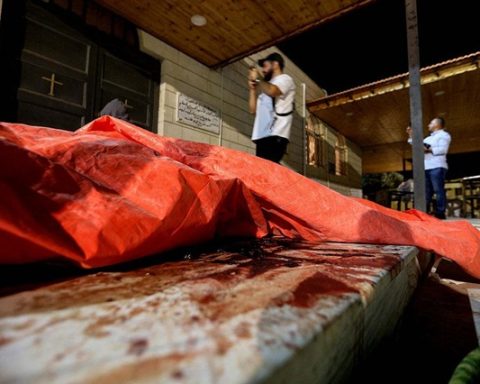
On Friday, October 23, 2026, Islamic State terrorists attacked a church in the Kingdom of Jordan. The Greek Orthodox Church of St. George in the village of Hamoud, is located in the southern Karak Governorate, and is about 180 km south of Amman, the capital.
Three terrorists opened fire on a crowd of mourners attending a funeral and then attacked the church.
Security camera footage showed three attackers firing pistols and a semiautomatic rifle at the entrance before storming the church.
The shooting lasted for several minutes before the assailants fled the scene. The attack killed 9 and injured 38 of which 27 remain in hospital. Notorious for violating the sanctity of places of worship, the Islamic State has claimed responsibility.
The perpetrators stated,
“Allah Akbar and Greatness is only due to Allah,
We have tortured the Christians of Karak in retaliation for Islam and the Islamic State.
Allah Akbar, Allah Akbar.”
Within an hour of the attack, Jordanian authorities identified the suspects.
- Ahmad Waleed Saleh Az-Zunaybat
- Hazza Zaidan Mohammad Az-Zhunaybat
- Jaafar Sami Hussein Az-Zhunaybat
Previously
Muath Al-Kasasbeh, a Jordanian fighter pilot who was born in Al-Karak, was captured by the Islamic State when his plane went down in Syria in December 2014, and was later burned alive in a cage. I have written about this great son of Jordan here. The incident provoked widespread outrage in Jordan.
The Karak people have treasured coexistence between Christians and Muslims. So, the attack came as a surprise. Famous for its historic hilltop Crusader castle, the Al-Karak population comprises of Muslim and Christian families who traditionally maintain close friendships. Hamoud is in the north of the city of Karak in a governorate that is home to longstanding Christian tribes whose roots stretch back centuries and that maintain close social ties with Muslim tribes. The Muslims and Christians in Karak have served the Kingdom faithfully.
The Context
Helmed by exceptionally well educated and far reaching leaders, Jordan’s national security community maintains highly capable security and intelligence structures. Globally, Jordan has been leading the voices against violent extremism at all stages, regionally assisting with collations against Islamic State, Al Qaeda, the Ansarallah of the Houthi movement, and other threat entities. In addition to robust law enforcement, Jordan’s soft and hard approaches have kept the threat under check.
The King of Jordan Abdullah II responded to the attack in Karak by stating that violent extremism was aimed at dividing the country’s Muslim and Christian communities.
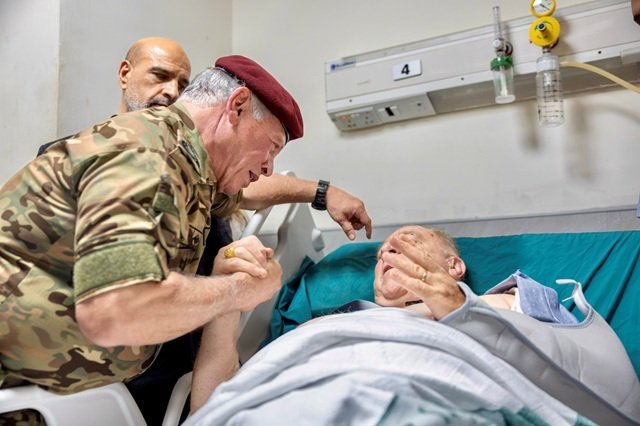
The King said, “Every Jordanian life is precious, and we will strike with an iron fist against those who dare to threaten our nation.” He also said, “the terrorist attack against Karak will be met with the harshest retaliation.” He added, “Those who delude themselves into thinking that they can divide Jordanians with their bullets have no chance in the face of our unity. All Jordanians, from north to south, are partners in land and fate, and nothing stands between them. Our deepest condolences to the families of the martyrs and we wish a speedy recovery to those injured.” The King promptly visited the maimed and injured in the hospital.
The Queen of Jordan and the wife of King Abdullah II, Queen Rania and Jordanian officials used the phrase “larger Jordanian family” to describe national unity and solidarity following a tragic attack in the Karak Governorate. The Queen said, “Today’s heinous crime against worshippers in Karak has devastated us all. This deep wound is borne by all Jordanians and the loss is not only felt by the village of Hamoud, but by each member of the larger Jordanian family.” She added, “Our hearts are with our people of Al Karak. May the martyrs rest in peace, may the injured make a speedy recovery, and may God protect Jordan and its people.”
The Abdoun bridge in the Jordanian capital of Amman was seen lit in Jordanian colors after the attack in Karak. In another moving scene in Amman, Jordanian Muslims were seen reciting Quranic verses outside a Church in Amman in a vigil held for the victims of the Church attack in Karak governorate.
Prime Minister Jafar Hassan declared a three-day period of national mourning across the Kingdom, with flags flown at half-mast on government buildings. The government said the decision reflected “the grief of all Jordanians and their solidarity in this painful tragedy.”
“This is a result of a terrorist ideology and blind extremism and we will not allow society to go down this path,” PM Hassan said on X. He described the attack as the product of “terrorist takfiri ideology and blind extremism,” pledging to confront attempts to spread extremism and incite sectarian strife. It should be a time for reflection of Muslims worldwide of how Islam is allowed to be distorted by politicians and religious leaders.
Jordanian Interior Minister Mazen al-Faraya described Friday’s shooting as a “terrorist attack” carried out by “a group of extremists”. With him, Public Security Directorate chief, Maj. Gen. Obeidallah al-Maaytah said, he received the first report of the Karak attack at about 2:10 p.m.
Background
Jordan has produced its share of extremists and terrorists. The most notorious Jordanian is Abu Musab al Zarqawi, the founding father of Al Qaeda in Iraq (AQI), the predecessor of the Islamic State of Iraq (ISIS). The ISIS evolved into the Islamic State, the group that staged the attack in Al Karak.
Born in Nablus, Palestine in 1959, Assem ibn Muhammad ibn Tahir al-Barqawi alias Abu Muhammad al-Maqdisi, Palestinian-Jordanian Salafi-jihadi theorist and intellectual radicalised a generation of extremists and terrorists. They included Ahmad Fadeel Nazal al-Khalayleh alias Abu Musab al-Zarqawi, who established Al-Qaeda in Iraq. Born on October 30, 1966 in Zarqa, Jordan, Zarqawi was a criminal who was radicalised in prison. The two met and grew close while imprisoned in Jordan during the 1990s, where al-Maqdisi served as an ideological mentor to al-Zarqawi. Al-Maqdisi authored foundational Salafi-jihadi texts such as ‘Millat Ibrahim’, that continues to kill both mainstream Muslims and non-Muslims.
I have written extensively about al Zarqawi, including a full profile analysis and a threat forecast when he was leading IS operations in Iraq.
After the U.S. invasion of Iraq on March 20, 2003, Zarqawi declared Muslims apostates and conducted mass sectarian violence against Shiite civilians in Iraq. A takfiri – meaning he was a ‘Muslim who accuses other Muslims of apostasy (murtadd), declaring them to be an infidel (kafir) or no longer a true believer’ – Al-Zarqawi led Jemaah al-Tawhid wal-Jihad and AQI (Al Qaeda in Iraq), orchestrating high-profile beheading, bombings and insurgent attacks.
In Jordan, Zarqawi mounted a dozen attacks. They included the assassination of the Head of US Agency for International Development (USAID) in Jordan, outside his Amman home in October 2002. Zarqawi was later convicted in absentia by a Jordanian military court.
The Jordanian Embassy was bombed in Baghdad on August 7, 2003. The remote-controlled minibus packed with explosives detonated outside the Jordanian Embassy compound walls killing 17, including 6 police officers and several women and children and injuring 40.
In 2004, Jordanian intelligence disrupted a massive plot led by Azmi al-Jayousi involving 20 tons of explosives aimed at the General Intelligence Department (GID), the Prime Ministry, and the U.S. Embassy. The foiled chemical plot intended to use customized trucks rigged with 20 tons of chemical explosives to unleash a catastrophic blast and a subsequent lethal poison cloud that could have killed and affected up to 160,000 people in the capital.
The rocket attack from Jordan in August 2005 narrowly missed U.S. Navy warships (USS Kearsarge and USS The Sullivans) anchored in the port of Aqaba in the Red Sea.
On November 9, 2005, suicide bombers targeted three luxury hotels in Amman – the Grand Hyatt, Radisson SAS, and Days Inn – killing 60 and wounding 110 mostly Jordanian civilians. At the Radisson SAS Hotel (now known as the “Landmark Hotel”), two suicide bombers – husband and wife Ali Hussein Ali al-Shamari and Sajida Mubarak Atrous al-Rishawi – entered the Philadelphia Ballroom, where Ashraf Akhras and Nadia Al-Alami were celebrating their wedding with around 900 Jordanian and Palestinian guests. One of the deadliest attacks in Jordan’s modern history, Al Qaeda in Iraq suicide bombers included Sajida al-Rishawi who was unable to detonate her belt. Her husband Ali al-Shamari, admonished her and told her to get out of the room. As she was leaving, the lights went out in the ballroom, Ali jumped onto a dining-room table and detonated his explosives. Among the 38 people killed in the explosion were the fathers of the bride and groom.
Zarqawi and his spiritual adviser, Sheikh Abd al-Rahman alias Abu Abdul-Rahman al-Iraqi were killed alongside several other associates. He was killed in Hibhib, Iraq on June 7, 2006. The network’s intelligence was developed after the arrest of clerics who worked with Zarqawi.
The joint U.S. and Iraqi military intelligence operation that eliminated Zarqawi relied on Jordanian intelligence. An F-16C jet dropped two 500-pound guided bombs (GBU-12 and GBU-38) on Zarqawi’s safehouse.
The Karak governorate has previously been targeted by terrorist and extremist groups. On December 18, 2016, Islamic State ambushed emergency responders and then attacked police patrols and the local police station and finally seeking shelter in the historic Crusader-era Kerak Castle. Eleven Jordanian security forces, two Jordanian civilians, and a Canadian tourist were killed during the attacks, while 34 Jordanians, two Malaysians, and one Canadian were injured. Four police were later killed in a manhunt, and five attackers were killed in total. A man was also arrested. The Islamic State claimed responsibility for that attack, too.
In August 2018, an Islamic State cell targeted a security patrol near a festival in the city of Fuheis, west of Amman, before security forces tracked the group to a building in the city of Salt. The two incidents left five security personnel dead. The Interior Minister at the time said the cell’s members embraced the Islamic State ideology and had planned attacks on security installations and public gatherings.
The Future
The attack in Karak demonstrates that Muslim religious institutions needs to promote moderation, toleration and coexistence. Impromptu vigils in Churches in Jordan had Muslim leaders embracing Christians therein. However, that will not address the challenge of religious fanaticism.
Every mosque and madrasah should teach comparative religion and religious knowledge. The Medina Charter should be displayed in all the religious institutions. All the clerics and preachers of Jordan need to be certified and accredited. The attack has created a golden window to fix the problem of religious extremism. In addition to its Muslim Brotherhood, Jordan’s Salafi-Jihadi movement needs to be dismantled.
Known as the ‘Mithaq al-Madina’ or ‘Sahifat al-Madina’, the Medina Charter was drafted in 622 CE by the Prophet Muhammad. The world’s first written constitution and interfaith social pact, it calls for unity among Muslims, converts, polytheists, and Jewish tribes. Similarly, the concept of Ahl al-Kitab (People of the Book), is an Islamic classification for followers of earlier monotheistic religions who received divine scriptures. In addition to the followers of the Torah, the Jews and followers of the Gospel, the Christians, Muslims should extend the designation to include Sabians, Zoroastrians, Samaritans, Hindus, and Buddhists. This is where Islamic and Muslim leadership is needed. Jordan can step up the work it has started in formal and informal education, proactive intervention on social media hate speech (when it borderlines incitement) and ostrasizing radical groups by encouraging the silent majorities to speak up. Jordan called the victims of the Church funeral attack martyrs and prayed for them (the majority was Christian but included Muslim mourners too) and called the attack as terrorist. This is important as there is a new social media debate led by a fringe group calling the custom of Jordanian Muslims paying condolences to Christian deaths as Haram (Forbidden in sharia) as they considered them (kafir or infidel) and not worthy of (God’s) mercy. Jordan should expand its rehabilitation program to deradicalise its citizens who want to kill, maim, injure non Muslims, especially Christians and Jews.
The focus should be not just hunting down the attackers – that is the easy part. The real challenge is addressing religious exclusivism and extremism that leads to violence and terrorism. Salafi Wahhabism and Ikhwanul Muslimeen (Muslim Brotherhood) are the foundational ideologies of Al Qaeda, Islamic State and most threat groups that kill, maim and injure civilians worldwide. Until leaders are willing to address this challenge directly, violence especially targeting civilians will persist. The highest seat of Sunni Islamic education, Al Azhar University and grand imam of Al Azhar should take the leadership!
Ahmed al-Tayeb in Cairo, the grand imam of Al-Azhar, the Sunni Muslim world’s foremost religious institution, offered his condolences to the families of victims in the shooting, calling it a “heinous terrorist attack.” Nonetheless, he needs to do much more to stem the tide of religious exclusivism, extremism, violence and terrorism.
Conclusion
The number of attacks staged by the Islamic State demonstrates that the movement is restoring itself.
In just the first half of 2026, Islamic State claimed 587 operations and 2,529 casualties. The regional activities shifted heavily toward Africa and select cells in the Middle East.
In 2025, the Islamic State and its affiliates were responsible for 1,805 deaths across 22 countries, making it the deadliest terrorist network globally.
In 2024, Islamic State carried out at least 660 attacks across Syria (an average of 60 per month), which tripled its rate compared to 2023.
In 2023, Islamic State carried out 900 terrorist attacks worldwide, which resulted in 3,838 deaths and injuries.
In 2022, Islamic State staged 2,058 terrorist attacks globally, causing 6,881 casualties.
In 2021, Islamic State committed 2,705 terrorist attacks worldwide, resulting in 8,147 casualties.
The targeting of a Christian gathering during a funeral and a Church marks a notable departure in the nature of attacks the Kingdom has experienced during the last two decades. Jordan has been an exception to a worrying trend in the Middle East where Christians and Jews have been targeted by radical and violent Muslims. Christians make up 3% of the population in Jordan. Nine seats are reserved for Christians in Jordan’s 138-member House of Representatives. Despite the assurances given by the Kingdom of Jordan, the Karak attack will prompt Christians to leave Jordan.
Today, over 80% of the terrorist attacks are staged by the Islamic State, Al Qaeda and their affiliates. The threat of religious extremism is affecting the stability and security of the world. In Africa, the emerging epicenter of global terrorism, these threat groups kill, maim and injure civilians every month.
Muslim leadership is imperative to fight the rising threat of religious extremism. As the King and Queen of Jordan are respected worldwide, they should play a leading role to promote moderation, toleration and coexistence worldwide.