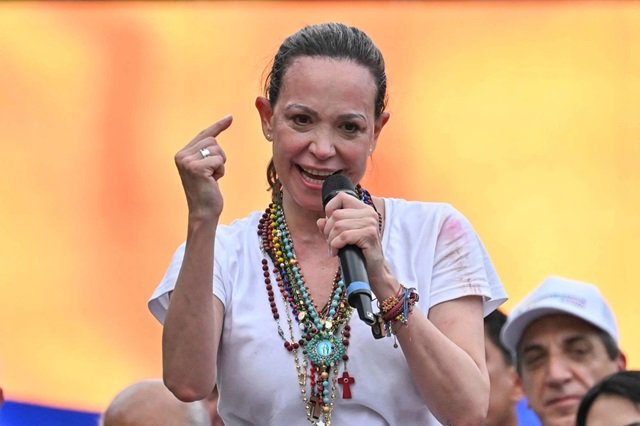
Venezuelan opposition leader and Nobel Peace Prize laureate María Corina Machado returned to Venezuela on Sunday after nearly 10 months abroad, drawing thousands of supporters onto the streets of Caracas and presenting a fresh challenge to the US-backed interim government led by former vice-president Delcy Rodríguez.
Machado appeared in the capital late on Sunday after her communications team said she had arrived earlier at a church in the western state of Lara. Images shared by her team showed her embracing members of the congregation. “I am here. With you all,” she wrote on X, without disclosing how she had entered the country. As she passed through Caracas, she told the Financial Times: “Now comes freedom.”
The authorities did not block her access to the capital or establish police checkpoints and roadblocks to restrict the crowds welcoming her return. Supporters greeted her with fireworks, tears and shouts of emotion, while many called for new elections following the removal of former president Nicolás Maduro.
Machado’s return presents a major test for the administration of US President Donald Trump, which has repeatedly expressed support for a political transition in Venezuela but has developed close ties with Rodríguez. US forces arrested Maduro on 3 January, after which Trump backed Rodríguez to open the country’s oil and mineral resources to foreign investment. Washington has not specified a timetable for elections.
Rodríguez has approved measures to attract US investment into Venezuela’s resources sector, including a controversial deal granting the Pentagon a 35 per cent stake in a company controlling a substantial portion of the country’s oil reserves. The arrangements have fuelled frustration among Machado’s supporters and other opposition figures over the direction of Washington’s approach to Caracas.
Machado is expected to use her return to press for fresh elections, potentially complicating US-led negotiations over a transition to democracy. Any arrest or harassment of the opposition leader by Venezuelan authorities could also place the Trump administration under domestic political pressure to intervene on her behalf.
US Secretary of State Marco Rubio said Machado’s return resulted from political talks sponsored by Washington, which he described as Venezuela’s “best chance in 30 years” to hold free and fair elections. He said the United States expected the “freedom of all sectors of Venezuelan politics” to be respected.
Trump, however, appeared surprised by her arrival, telling reporters he “did not know about that”. Referring to Machado’s decision to give him her Nobel medal during their first meeting in January, he said: “She gave me her Nobel Prize, so how can I say anything else? And I hope she’s safe, she’s a very nice woman, but we’re doing really well in Venezuela.”
Machado’s team said she had made at least seven unsuccessful attempts to return, including three thwarted within 24 hours last month. Those attempts coincided with Trump’s meeting with Rodríguez on the sidelines of the United Nations General Assembly in New York on 22 September.
Machado said earlier this month that Rodríguez’s government, rather than Washington, was preventing her return. “It’s obvious that the regime does not want me to go back,” she told the Financial Times. “The US understands that my presence in Venezuela would be a strong signal that the transition plan is working.”
Her political standing remains significant. A September survey by local polling group Meganálisis found that Machado would receive 61.2 per cent of the vote against Rodríguez’s 3.1 per cent in an election.
Her return comes as the government negotiates with another opposition faction. The group concluded its third round of talks last week with an agreement to lift political bans, including the prohibition preventing Machado from holding office.
Before leaving Venezuela, Machado had been in hiding since August 2024, when Maduro cracked down on dissent following his disputed re-election. Barred from running in that election, she had overseen an independently verified vote tally showing that her stand-in candidate, Edmundo González, defeated Maduro by a margin of two to one.