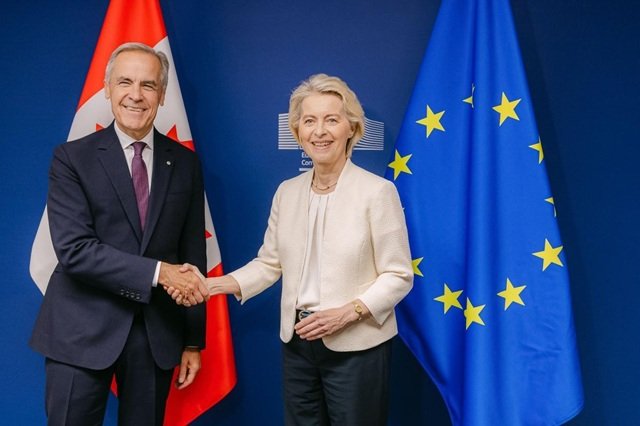
Canadian Prime Minister Mark Carney expects to conclude negotiations with the European Union in June on an unprecedented partnership that could make Canada the bloc’s first associate member, as both sides seek closer economic and security cooperation amid growing trade tensions with the United States.
Carney announced the target on Friday at the conclusion of a two-day Canada-EU summit in Montreal, where he joined European Commission President Ursula von der Leyen and European Council President Antonio Costa in launching a new initiative, the Alliance for the Future. The proposed associate membership would stop short of full EU membership but establish a relationship closer than any the bloc has previously maintained with a country outside its borders.
“In parallel, we are working towards the deepest possible partnership, short of accession – with Canada becoming the European Union’s first Associate Member,” Carney said.
However, the joint declaration issued by the leaders did not explicitly mention associate membership. Instead, it committed both sides to defining an “ever-closer association” by their next summit in 2027. Carney said Canadian cabinet ministers and European commissioners would meet in March to advance negotiations before he attends a meeting of European leaders in June to conclude the discussions.
Costa described the proposed alliance as the closest relationship the EU had ever established with a country outside the bloc, with cooperation extending across trade, research and security.
“Canada is by far the most European of non-European countries,” he said.
Von der Leyen has been advocating associate membership for Canada despite resistance from some European governments to the designation. She said the objective was to establish the closest possible relationship without requiring Canada to become a full EU member.
“We know that Canada cannot be a full-fledged member of the European Union, but to have a relationship as close as possible, this is our goal,” she said.
The Montreal summit produced several concrete agreements aimed at expanding commercial and technological cooperation. Canada and the EU concluded substantive negotiations on a digital trade agreement designed to make it easier for businesses to operate across the Atlantic and transfer data between the two markets. They also completed negotiations on a competition agreement intended to curb anti-competitive practices and reduce consumer prices.
Canada and the European Investment Bank also concluded negotiations on an agreement to encourage European investment in Canadian critical minerals, which are essential to industries including electric vehicle manufacturing and defence. The two sides will additionally explore linking their instant-payment systems to make cross-border transfers faster and cheaper.
Cooperation in artificial intelligence and scientific research featured prominently in the discussions. Canada will participate in a European supercomputing initiative, with Carney highlighting the potential of Europe’s Jupiter supercomputer to accelerate research. He said calculations that would take Canada’s most powerful research computer six months could be completed by Jupiter in a single day.
The broader partnership could also extend to energy, infrastructure and education. The two sides agreed to examine the feasibility of exporting Canadian liquefied natural gas to Europe and explore undersea cable connections linking Canada, Europe and Asia. They will also begin negotiations on expanding Canadian participation in Erasmus+, the EU’s student exchange programme, while examining opportunities to facilitate study and employment for young people across the Atlantic.
The leaders further agreed on a new border security arrangement and pledged closer cooperation on defence, cybersecurity, Arctic security and countering foreign interference.
Carney said the partnership was intended to strengthen the ability of Canada and European countries to protect their economic and political independence and withstand external shocks.
“Above all, this is about sovereignty. Our ability to live our lives as we wish,” he said.
The initiative comes as US President Donald Trump’s trade policies strain relations with traditional allies. Trump has suggested that Canada’s proposed arrangement with the EU could constitute a “hostile act” and threatened tariffs on European countries if he considered the partnership unfriendly.
The United States accounted for 71.7 per cent of Canada’s merchandise exports in 2025. Carney has set an objective of doubling Canadian exports to countries other than the United States over the next decade, making closer commercial relationships with Europe an important part of Ottawa’s efforts to diversify its international trade.