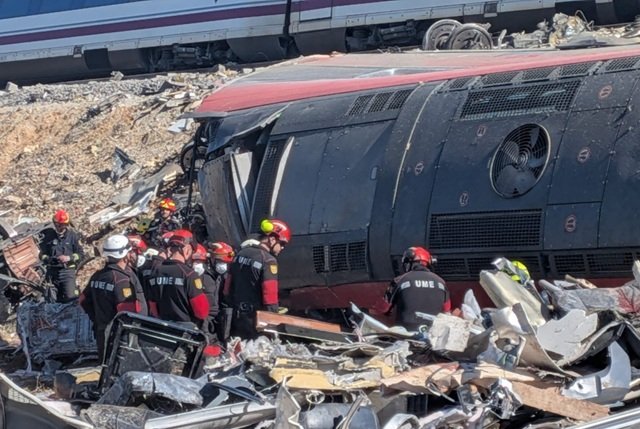
Spain’s railway network is facing renewed scrutiny over maintenance funding and operational safety following the Urda train disaster in Toledo province on Wednesday, 28 October, less than nine months after a collision in Adamuz, Andalusia, killed 46 people and injured more than 150. The two accidents, involving Spain’s state-owned rail operator Renfe and private operator Iryo, have brought the condition of the country’s high-speed infrastructure and the management of increasingly complex railway operations back into the centre of political and public debate.
The Adamuz disaster on 18 January involved the high-speed line linking Madrid and Seville. Both Renfe and Iryo, whose largest shareholder is Italy’s historic railway company Ferrovie dello Stato, the parent company of Trenitalia, were among the operators affected by the tragedy. Although the investigation remains open, its early findings suggested that a broken section of track caused the initial derailment. The subsequent Urda disaster has renewed attention on the possibility that weaknesses in railway infrastructure and operational management require closer examination, although the circumstances of the two accidents differ.
The debate over railway maintenance had already intensified following a separate accident in Barcelona, two days after the Adamuz collision, when a commuter train struck a collapsed wall on the tracks. One person was killed and 41 injured. The sequence of accidents has increased pressure on the Socialist government to explain how railway infrastructure is maintained, particularly given the scale of Spain’s investment in expanding its high-speed network over recent decades.
A report published in March by the Instituto de Estudios Económicos (IEE), a think tank close to Spanish business leaders, identified a substantial gap between Spain’s railway maintenance expenditure and that of several other European countries. Between 2019 and 2024, Spain spent €45,500 per kilometre of railway network, compared with an average of €80,600 across the 14 European countries examined. Italy allocated €60,400 per kilometre, while the United Kingdom and the Netherlands each spent more than €330,000. France and Germany were not included in the study.
The report also found that expenditure on maintenance per high-speed passenger transported fell by 27% between 2015 and 2024. The figures have strengthened criticism of the government’s spending priorities, particularly the longstanding emphasis on extending the high-speed network rather than maintaining existing infrastructure.
Spain has invested more than €55 billion in high-speed railways between 1990 and 2018, with the bulk of the funding directed towards expanding the network. The investment produced Europe’s longest high-speed railway system, surpassing France, and the world’s second-longest after China. However, an assessment by the Spanish government four years before the 2026 accidents had already identified an imbalance in railway spending: 70% was allocated to constructing new high-speed lines, while only about a third went towards maintenance and the expansion of the conventional railway network.
The financial imbalance became more significant as Spain introduced competition on its high-speed routes. From 2021-2022, three operators began competing in the market: Renfe, Iryo and Ouigo España, operated by France’s SNCF. The increased number of operators placed additional demands on railway infrastructure and its management, although the network was not considered overloaded, with the exception of the Madrid-Barcelona line.
Following the Adamuz disaster, the government announced a catch-up programme in February, ring-fencing €8.15 billion for railway maintenance. The allocation represented an additional €1.8 billion compared with the amount previously planned. Initial projects have since begun, but their implementation has already had a considerable effect on railway services, particularly on the Madrid-Barcelona route. The disruption has added another dimension to the debate over how to improve infrastructure while maintaining services across a heavily used network.
The Urda accident, however, appears to have involved a different set of operational problems. Preliminary indications pointed towards a traffic management failure associated with a malfunction in the LZB signalling system. The reported disorganisation following the system outage may have resulted in a breach of the strict railway block operating principle, under which a train must not enter a section of track already occupied by another train. The system is designed to prevent collisions by ensuring that trains remain separated along the railway network, a requirement of particular importance on high-speed routes.
The incident has also drawn attention to the technical complexity of Spain’s high-speed infrastructure, which uses several different signalling systems. A railway expert familiar with both Spanish and French networks described the system as unusually heterogeneous despite its relatively recent construction.
“Paradoxically, even though the Spanish high-speed network is much newer than the French one, and was built over a much shorter period of just over 20 [years], it is far more heterogeneous,” the expert said. “One of its peculiarities is the presence of three different signalling systems and the use of the LZB system only on the Madrid-Seville section.”
The differences have also created difficulties for international operators entering the Spanish market. SNCF, which does not use the German-developed LZB system on its domestic network in France, encountered technical and certification challenges when preparing to operate services to Seville. The company had to postpone the launch of its Ouigo España service to 2025 to modify its trains and obtain the necessary recertification.
The coexistence of three signalling systems, alongside the competing demands of network expansion, maintenance and commercial operations, has therefore become an important part of the examination of Spain’s railway safety arrangements. While the Adamuz investigation remains open and the Urda disaster has been associated with a signalling malfunction, the two accidents have placed infrastructure condition, maintenance expenditure and the technical management of high-speed rail operations under renewed scrutiny.