Europe is confronting a growing crisis of confidence, and its younger generation is increasingly taking that frustration onto the streets. From France and Belgium to Greece, Italy, Spain, Portugal and Albania, protests are exposing a common sense of economic insecurity: precarious employment, unaffordable housing, stagnant purchasing power and the growing conviction that the next generation will enjoy fewer opportunities than the one before it.
The unrest comes at a particularly sensitive moment for European democracy. With major elections approaching in countries including Spain, Poland, Italy and France, public dissatisfaction is putting pressure on established political parties and weakening the political centre. The far right, meanwhile, has consolidated support approaching 30% or more in some countries, drawing strength from a wider sense of abandonment among voters.
The grievances differ from one country to another, but the underlying frustrations are strikingly similar. Belgian protesters are resisting anticipated spending cuts. In Greece, demonstrations reflect anger over the cost of living, expensive rents and reductions in education spending. Italian students have joined protests against government policies, while young people in Spain and Portugal are mobilising over the housing crisis. Albania, too, has experienced unrest amid wider political tensions in the Balkans.
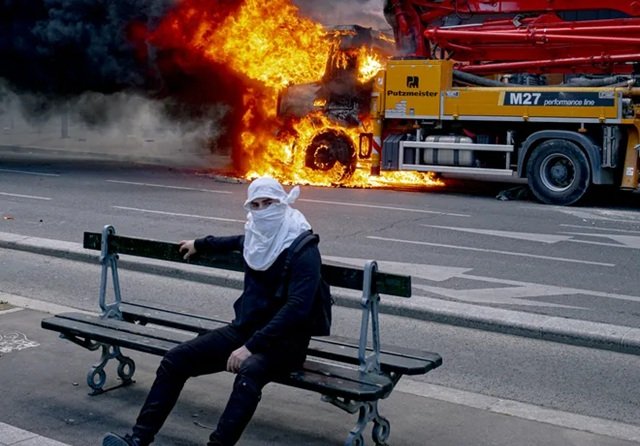
France has become the most visible expression of the crisis. Its political, fiscal, financial and economic difficulties have converged with a wave of street demonstrations and episodes of violence. The protests have exposed deep dissatisfaction with the government of Emmanuel Macron, whose two presidential terms have failed to resolve a series of structural problems. The unrest has also strengthened the political position of Marine Le Pen and the far right.
But the protests are not simply a reaction to individual governments. They reflect a generation shaped by successive economic shocks and a prolonged erosion of expectations. Surveys cited in the analysis indicate that half of those born in the 1980s believe they will be worse off than their parents. For many younger Europeans, the promise of social mobility and economic security appears increasingly distant.
The roots of this discontent reach back to the Great Recession of 2008. While the United States rescued Wall Street during the financial crisis, the economic damage suffered by ordinary households helped create the conditions for Donald Trump’s political rise. Europe’s response, based heavily on austerity and spending cuts, left deep social scars. The consequences have been compounded by subsequent crises, including the pandemic, the energy shock triggered by the wars in Ukraine and the Middle East, and the uncertainty surrounding artificial intelligence and automation.
Daniel Fuentes Castro, the economist who describes this generational frustration as the “Great Dissatisfaction” in his book Nadie elige cuándo nace, argues that the accumulated shocks have produced a lasting sense of socioeconomic anxiety. Young people experience it as anger over their future; older generations feel it as a persistent economic insecurity that has barely receded since the collapse of Lehman Brothers.
Housing has become one of the most powerful symbols of that frustration. A basic social need has increasingly been treated as a financial asset, placing secure accommodation beyond the reach of many young people. At the same time, stagnant real incomes and renewed inflation have reduced purchasing power, while weak economic growth and industrial decline have intensified concerns about employment and future opportunities.
The paradox is that Europe’s economic position is not uniformly disastrous. Employment levels remain high across much of the Western world, unemployment rates are relatively low and economic growth, although weak, has not disappeared. Financial markets have continued to rise despite geopolitical tensions and competition from China. Yet these indicators have done little to ease the daily pressures experienced by households.
Dan Hamilton, a political analyst at Johns Hopkins University, describes the combination of limited expectations among young people and stagnant purchasing power as a particularly dangerous socioeconomic force. The problem is compounded by public debt, which has sharply reduced governments’ capacity to respond. France and Italy have debt levels approaching 120% of gross domestic product, while Spain and Belgium are close to 100%.
Peter Praet, a former chief economist of the European Central Bank, argues that France has become the focal point because of its size, its central position in the European Union and the accumulation of its problems. He also points to a disconnect between public anger directed at governments and the role of external shocks, particularly the energy crisis linked to the military actions of Vladimir Putin and Donald Trump. Public debt, accumulated since the Great Recession and the Covid-19 pandemic, leaves governments with little room to manoeuvre, he warns.
French economist Thomas Piketty offers a different diagnosis. He argues that the crisis is manageable if the European Central Bank fulfils its responsibilities. He identifies education spending as a central source of the current student unrest, pointing to what he describes as a 20% collapse in the budget per student since 2017. For Piketty, the protests expose one of the most significant failures of the Macron government: its inability to provide young people with adequate resources to access quality education.
The pressures are also testing Europe’s welfare state, long regarded as the continent’s principal protection against economic shocks. Unemployment benefits and other automatic stabilisers continue to cushion households during difficult periods, but public debt and rising demands on government budgets are straining the system. The welfare state remains an important instrument for addressing inequality, yet the financial resources needed to strengthen it are increasingly constrained.
The political consequences are becoming harder to ignore. In France, Macron has struggled to secure a budget capable of addressing the country’s fiscal difficulties. Public debt servicing costs have risen, the deficit is approaching 6% of GDP and economic growth remains weak. The unrest has strengthened Le Pen’s position, with her promise of a tougher response appealing to voters demanding order and security.
Similar dynamics are visible elsewhere. Italy’s Giorgia Meloni has promised a tougher approach to public disorder and announced plans to lower the age of criminal responsibility from 18 to 14. In Spain, polling points towards a possible governing arrangement between the conservative People’s Party and Vox, the far-right party. Across the continent, established centre-left parties have struggled to respond to economic insecurity, while sections of the centre-right have moved closer to the far right.
Harvard economist Dani Rodrik argues that inflation, inequality and economic stagnation have contributed to the weakening of centrist political forces. Centre-left parties, he says, have failed to offer an adequate response, while centre-right parties have increasingly approached the far right. Younger voters, in particular, feel abandoned by political and economic elites.
The scale of public dissatisfaction is reflected in polling by Pew Research. Some 69% of people in France, 68% in Spain and 62% in Italy say they are dissatisfied with democracy. Nobel laureate Daron Acemoglu has argued that liberal democracy has failed to fulfil its promises and called for a programme of shared prosperity — an agenda that he believes is largely absent from the platforms of centrist parties.
Yet the prospect of a far-right political ascendancy is not inevitable. Historian Kevin O’Rourke points to political developments in Hungary and Brazil as evidence that populist victories can be reversed, while arguing that Europe has strengthened its institutions since the Great Recession. Political scientist Enrico Letta also maintains that the continent is in a stronger position than it was during the financial crisis.
The immediate challenge, however, is the anger already visible on European streets. Political thinker Ivan Krastev anticipates a major transformation of European politics, with coalitions dominated by the right increasingly dependent on far-right parties. Such arrangements could give extremist movements considerable influence over governments, even where they do not hold power themselves.
Europe’s young protesters are demanding more than temporary relief from rising prices or housing costs. Their anger reflects a deeper loss of confidence in the promise that each generation can expect a more secure life than the one before it. Unless governments find credible ways to address that insecurity, the widening distance between citizens and political institutions could reshape European politics long after the current wave of demonstrations has subsided.