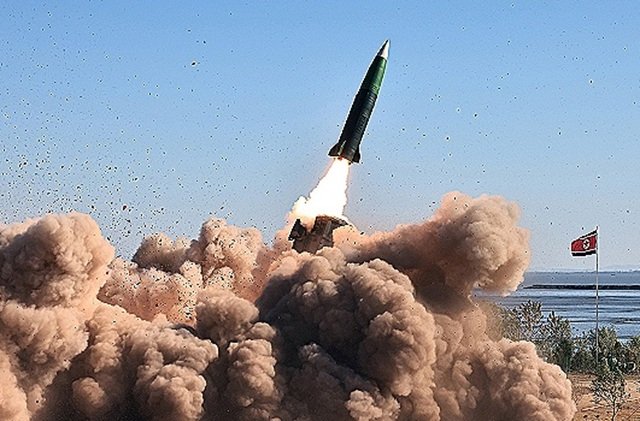
North Korea said on Sunday that it had tested cluster-bomb warheads for its tactical ballistic missiles, claiming the weapons could devastate large target areas as Pyongyang continues to expand its military capabilities amid heightened tensions with South Korea.
The test was conducted on Saturday, according to the state-run Korean Central News Agency (KCNA), which described it as a major weapons development milestone. North Korean defence officials said the Standard Type 2 cluster-bomb warhead could cover an area of 12 to 13 hectares with what they described as its highest-density destructive power.
Images released alongside the report showed Hwasong-11D short-range ballistic missiles being launched, with their cluster warheads striking an island target.
North Korea’s Missile Administration described the exercise as part of its regular scientific research activities to improve the effectiveness of its combat systems.
The agency said cluster-bomb warheads had been divided into four categories for different operational purposes. It added that the military intended to make all four types available to units within the year, allowing commanders to select weapons according to operational requirements and the characteristics of their targets.
The test was overseen by General Kim Jong Sik, a senior official involved in developing North Korea’s munitions programme. Leader Kim Jong Un did not attend.
The latest announcement forms part of a broader series of weapons-related activities by Pyongyang, which has increasingly highlighted developments in drones, artificial intelligence and precision-guided systems.
Last week, Kim called for North Korea to achieve “absolute superiority” in drone technology while attending an exhibition and demonstration of uncrewed aircraft systems. The event included advanced technologies that Pyongyang said incorporated artificial intelligence.
Earlier this month, North Korea announced tests of a new precision-guided torpedo system using artificial intelligence for target detection and guidance. The announcement followed its claim that it had successfully tested two types of cruise missiles launched from a submarine.
The cluster-warhead test also comes amid renewed military tensions between the two Koreas. South Korea confirmed last week the unusual and conspicuous positioning of a North Korean artillery piece near the heavily armed border separating the countries.
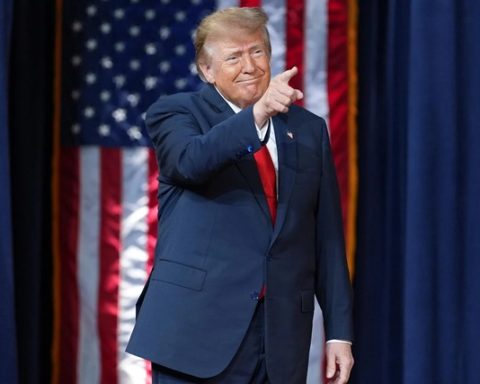
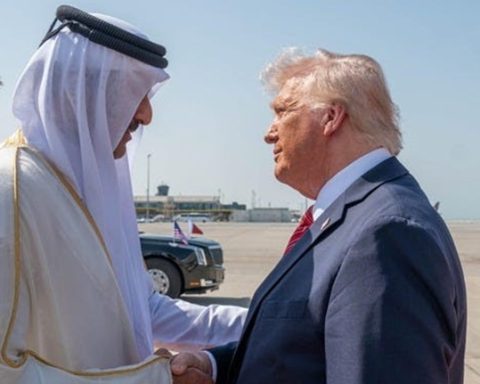
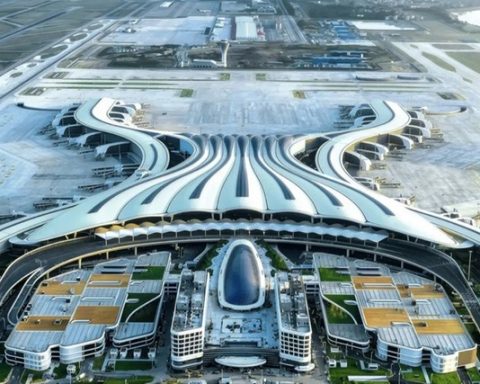
Pyongyang’s latest weapons demonstrations could also strengthen its position ahead of a possible meeting between Kim and US President Donald Trump at the Asia-Pacific Economic Cooperation summit in Shenzhen, China, later this month. Trump has repeatedly raised the possibility of talks with the North Korean leader, although Kim has not publicly responded to those overtures.
The prospect of renewed diplomatic engagement remains uncertain as North Korea continues to reject demands for nuclear disarmament.
On Saturday, the United States, South Korea and Japan reaffirmed their commitment to the “complete denuclearisation” of North Korea. Pyongyang, however, has repeatedly dismissed the prospect of giving up its nuclear weapons.
North Korea has formally enshrined its status as a nuclear-armed state in law, while Kim and other senior officials have maintained that relinquishing the country’s nuclear arsenal is not an option.
The latest missile test therefore highlights the widening gap between international efforts to secure North Korea’s denuclearisation and Pyongyang’s continued emphasis on expanding and diversifying its military capabilities.