
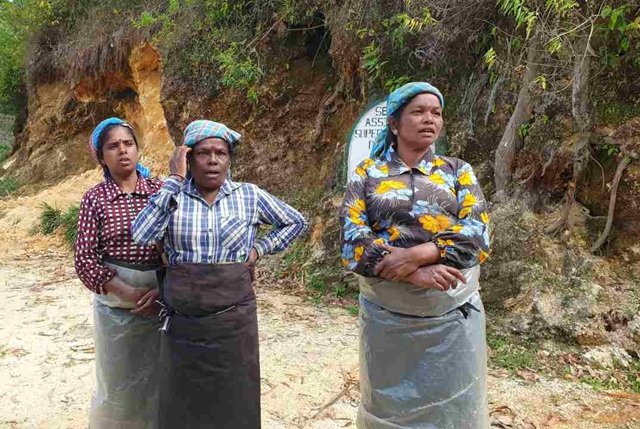
Uplifting the living standards of the plantation community in Sri Lanka and guaranteeing safe as well as permanent homeownership for them has been a primary national requirement for a long time. For generations, tea plantation workers have harbored in their hearts the dream of escaping the dark line-room culture and becoming owners of independent homes. Recognizing this real need, a large-scale development project to construct 14,000 houses, prioritizing the plantation population of this country, is currently underway with complete financial and technical assistance from the Government of India. The entire project, implemented under two phases, is scheduled to incur a massive cost of over LKR 16,000 million in Sri Lankan currency.
However, unfortunately, behind this massive foreign aid project lies the bitter reality of failed planning at the ground level, bureaucratic delay, incomplete infrastructure, and actions taken by certain house-owning residents to rent or sell new houses for money instead of moving into them. Nevertheless, our investigation into how brand-new houses constructed at the expense of tens of millions in foreign aid are being sacrificed to the thick jungle due to people being unable to reside in them, as well as the governance issues behind it, revealed a wealth of serious information.
State Institutions Delaying Information Disclosure
Under the first phase of this estate housing development program, arrangements were made to construct 4,000 houses, and the construction work of that housing system has now been completed at an expenditure of LKR 4,400.97 million. Under the second phase that commenced thereafter, another 10,000 houses are scheduled to be constructed, and a massive financial allocation of over LKR 11,490 million is set to be provided by the Indian Government for that purpose.
However, an inquiry into the current progress of this massive project reveals its slow pace. According to official information obtained under the Right to Information (RTI) Act from the Ministry of Plantation and Community Infrastructure, only 22% of the construction work of this second phase housing project had been completed as of June 30, 2026. Considering the project plans and timeline, this is a very low level of progress.
A main weakness existing in the implementation of this housing project is the severe lack of mutual coordination among the relevant state institutions. This housing project is not implemented solely by the Ministry of Plantation and Community Infrastructure alone, but is carried out under the full supervision and intervention of several state institutions.
For this reason, even though information was officially requested under the Right to Information Act from the National Housing Development Authority (NHDA) as well for the purpose of overall monitoring regarding the project, it must be pointed out that the relevant public authority continues to delay without providing the information. Attempting to conceal information regarding such national-level development projects where public money and foreign aid are utilized raises severe doubts regarding the transparency of the project.
18 Unoccupied Houses in Bounsic Emelina Division
Receiving foreign aid to provide permanent housing facilities for the plantation community who lack proper housing as well as those affected by various disasters in this country, and allocating a large sum of money for that purpose, is a commendable act. However, our investigation clearly revealed that during the construction of most housing projects, due to the extremely difficult geographical location of the land chosen, steep slopes, and the failure to provide adequate infrastructure, people do not move into those constructed houses even after completion.
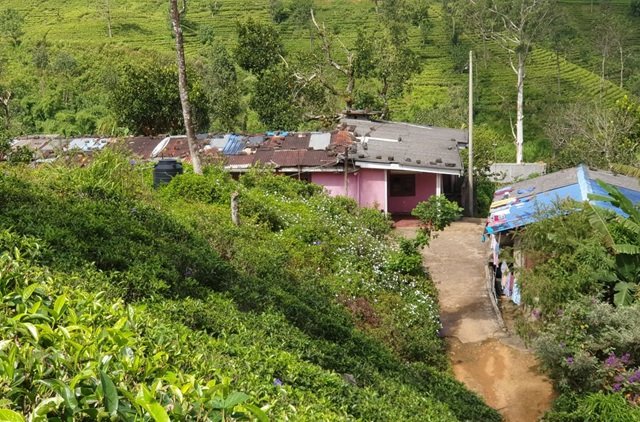
The closest example of this unfortunate situation is reported from the Emelina division in the Bounsic area of Hatton, Nuwara Eliya District. A few years ago, 18 houses belonging to the residents in the Emelina division were hit by a severe landslide disaster. Nearly 05 years ago, a project of 18 houses was constructed for those helpless people who lost their homes by spending a large sum of money. But today, that housing complex remains without any use, turning wild and being engulfed by the jungle.
The Challenge of No Road Despite Handing Over Keys
Mr. M. Bariya Raja, a resident who became entitled to ownership of these houses after being rendered helpless by the landslide, described the bitter reality he faces as follows:
“18 houses were built for us with aid from the Indian Government. But the keys were not given until 2025. The keys were given only in 2025. Even though the keys were given like that, the reason we don’t come to live in these houses is the lack of roads. If one wants to come to these houses located on a high mountain peak, a proper road is definitely needed. Not only that, even the roads located in the lower section of the estate have become severely dilapidated, making it very difficult to travel on them. No matter which government comes into power, they do not build the roads leading to our estate.”
Similarly, Mr. Muthulingam Mogan, a resident of the area, points out that serious incomplete work has occurred in providing electricity to the houses as well:
“These houses were built for the 18 houses that were destroyed by the landslide. Although the houses were built, roads were not built. Similarly, although the main line was brought to supply electricity, supplying electricity into the houses has not been done yet. Earlier it was said that these houses would be given after completing all tasks, but that did not happen. The poor people in the estate do not have money to get these things done on their own. Therefore, we request the government to take steps to provide these houses to the people after arranging the necessary infrastructure.”
Position of Officials and the Trend of Selling Houses
When we inquired from an official of the Plantation Human Development Trust (PHDT) who was in charge of the supervision work of this housing project constructed under Indian aid, he stated that although more than two years have passed since these houses were given to the people of this area, those people have not moved in. He also stated that although a road existed for the houses in the early stages, that road has now become dilapidated due to non-use and prevailing weather conditions, and that wires required to get electricity to the houses have also been drawn. However, the people of the area state that the road provided is too far from the estate where they work, so they are requesting a shorter path.
In addition, another serious fact was revealed during the field observations we conducted. That is, certain estate workers who are provided with these houses tend to lease or sell them to other parties for money instead of using them for residence.
Immediate Solutions to Be Implemented to Save Wasting State Resources
However, when houses built at a massive financial cost are abandoned without people moving in due to lack of infrastructure or other reasons, what happens is merely the destruction of a valuable foreign aid resource received by the country without any use. Providing immediate solutions to this crisis is an unevadable responsibility of the government and the relevant officials. Likewise, immediately allocating funds to fully provide the required access roads, electricity connections, and drinking water facilities for the housing complexes through government intervention is necessary. Attention must be focused on selecting suitable land where people can easily travel, instead of steep, inaccessible mountain peaks, when constructing houses in the future.
Furthermore, after completing the infrastructure, issuing final notices to the relevant house owners to move in within a specified timeframe will make it possible to prevent the sale of these houses as well as rescue people living in high-risk areas from that risk. However, if any party fails to move in or attempts to sell/lease the houses even after infrastructure has been provided, the government should take legal action to transfer those houses to other qualified families in the plantation sector who genuinely have a housing requirement. A solution process regarding this can be formulated by creating an integrated oversight mechanism jointly by the Ministry of Plantation and Community Infrastructure, the National Housing Development Authority, and the Plantation Human Development Trust.
Without allowing foreign aid received in tens of millions to fall victim to the jungle, ensuring ownership of these houses as well as a suitable living environment for the truly helpless people of the plantation sector is the foremost duty of the authorities.