
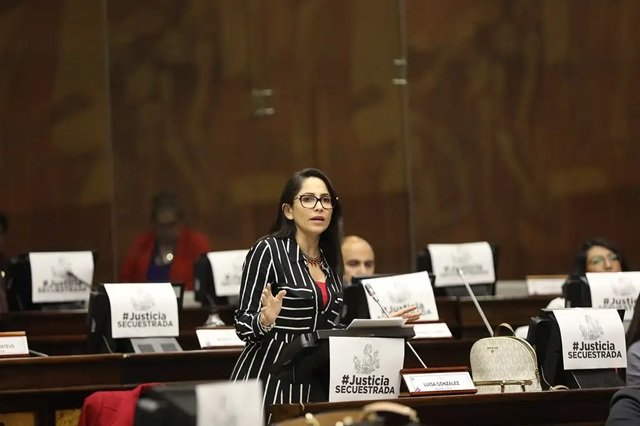
Ecuadorian leftist leader Luisa González recently warned that there is “a whole sinister network involving Marco Rubio, MAGA, and Latin American presidents who are destroying our countries to turn Latin America into their backyard.” A few days after her eerily prescient statement, she was arrested on politically motivated charges.
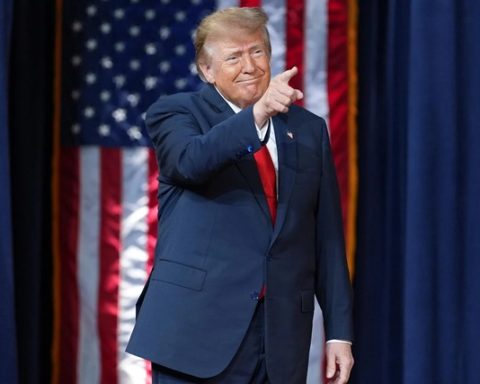
MAGA, in this context, refers to the larger US imperial project under Donald Trump. A key tool in MAGA’s offensive in Latin America is the intensified use of “lawfare.” This politically selective use of a country’s legal and judicial institutions against progressives often involves accusations of corruption and related crimes.
The term gained prominence during the partisan prosecution of Brazil’s Lula da Silva in 2018. Lawfare has since intensified with the rise of MAGA-aligned governments and Washington’s escalating intervention across much of the hemisphere, continuing a long history of US interference in the region.
The González case in Ecuador
Luisa González was the runner-up in the last two Ecuadorian presidential elections, themselves widely believed to have been stolen. On September 12, Ecuador’s Electoral Disputes Tribunal (TCE) upheld González’s questionable disqualification from the upcoming provincial elections.
She had run with the Citizen Revolution Movement, a party founded by former President Rafael Correa. A victim of lawfare, he now resides in Belgium, where he was given political asylum. Correa’s former vice-president, Jorge Glas, has been incarcerated since 2017 in a prosecution widely denounced as lawfare.
The movement is Ecuador’s main opposition party, whose coalition won 67 of 151 National Assembly seats in the last election. The ruling right-wing party of President Daniel Noboa (a US citizen) won 66 seats. Conveniently for the right wing, the TCE “temporarily” suspended Citizen Revolution Movement candidates from running for public office.
Another prominent opposition figure, Aquiles Álvarez, mayor of Guayaquil, Ecuador’s largest city, has been imprisoned since February 2026 on politically motivated charges after he scrutinized proven drug trafficking involving the Noboa family’s shipping company. His wife, Fiorella Ycaza, then came under investigation when she accused the government of political persecution. She is now running to succeed him as mayor.
After her arrest, González protested: “We have reached an untenable situation… attacks on civil liberties and political persecution have become a permanent reality.” Her accusation extends well beyond Ecuador.
Extreme lawfare in Venezuela
In Venezuela, lawfare has extended beyond the manipulation of domestic judicial systems to the extraterritorial exercise of US criminal jurisdiction. US special forces kidnapped Venezuela’s lawful President Nicolás Maduro and his wife, National Assembly delegate Cilia Flores, last January 3. The imperial power claimed the prerogative to indict in absentia and seize a sitting head of state in an egregious exercise of naked judicial overreach.
Alfred de Zayas, former UN independent expert on the promotion of a democratic and equitable international order (2012-2018), condemned the abduction as a violation of international law and an international crime. De Zayas lamented “the death of international order,” a characterization that is proving anything but hyperbolic.
Acting President Delcy Rodríguez continues to govern under asphyxiating US sanctions, part of Washington’s broader campaign of unilateral coercive measures that violate international law.
Lawfare to appease anti-Cuba hardliners
The obduracy of Cuba’s socialist government in resisting the mounting pressure for regime change from Washington provoked a new example of lawfare in October – this time from outside the country in question.
Probably aimed at appeasing Florida’s Cuban gusanos, who have a profound hatred of Raúl Castro and his deceased brother Fidel, the state’s attorney general announced an arrest warrant against Raúl. Although Castro is unlikely to appear before a Miami court, the warrant was issued just two weeks before the US midterm elections and ahead of the annual UN vote condemning Washington’s blockade of Cuba.
Lawfare and “impunity-fare” in Honduras
Trump’s blatant intervention in last year’s Honduran election swung it heavily in favor of the neoliberal candidate Nasry Asfura. Just two days before the election – in what might be called “impunity-fare” – Trump announced his intention to pardon former Honduran president Juan Orlando Hernández, a right-wing politician who was serving a 45-year US federal sentence for drug trafficking.
Asfura has targeted opponents in the progressive Libre party while restoring the mano dura policies of previous neoliberal governments. Libre’s president of the National Congress until 2026, Luis Redondo, was the subject of an arrest warrant in October, along with 13 other prominent party members. Marlon Ochoa, Libre’s representative on the electoral tribunal, had challenged the questionable validity of Asfura’s election win. Ochoa fled the country in March, fearing for his life.
Lawfare in Bolivia
In Bolivia, allegations of lawfare arose after the right-wing government arrested Attorney General Roger Mariaca, who had been investigating figures associated with the political right. Shortly before his arrest, the US revoked his visa, accusing him of facilitating drug trafficking. Mariaca denounced the move as political interference and linked it to his investigation of Fernando Cerimedo, a former adviser to President Rodrigo Paz. Cerimedo has been dubbed Trump’s “MAGA man” in Latin America.
Meanwhile, former leftist president Evo Morales faces political persecution that appears to involve Cerimedo, backed by Washington.
Brazil’s Lula vindicated
The 2016 parliamentary coup that led to the impeachment and removal of Brazilian President Dilma Rousseff preceded the prosecution and imprisonment of Lula in 2018. Both instances are emblematic of the political use of legal proceedings against Brazil’s left.
Lula returned to office in 2023 and won reelection on October 25, defeating right-wing Flávio Bolsonaro. The apparent irony is that legal actions against Flávio’s father have also been dubbed “lawfare.” The key difference is that these involve genuine crimes. Further, Flávio fled to the US on October 27, reportedly with White House assistance, amid serious corruption allegations detailed by Globo, Brazil’s leading media conglomerate.
US imperial playbook
Progressive leaders who have lost power have faced not only defeat at the polls but a risk of subsequent imprisonment, sometimes resulting in lengthy sentences. Peru’s former president Pedro Castillo was arbitrarily imprisoned following his attempted dissolution of congress in December 2022. Argentina’s former president Cristina Fernández de Kirchner is under house arrest, unjustly convicted in a fraud case that led to a lifetime ban from public office in 2025.
Taken together, these cases illustrate how the US imperial playbook can operate both before and after elections. Lawfare has become an essential tool in securing right-wing governments:
- Prior to the vote, scare the electorate into choosing a candidate favored by Trump who promises a firm hand against crime and “narcoterrorism.”
- After the vote, imprison political opponents to prevent them from undermining the government or mounting new electoral challenges.
- Shield political allies from prosecution, as Trump did with Juan Orlando Hernández, while denying such protection to opponents such as Luisa González.
These tactics form part of a broader US interventionist strategy that includes sanctions, weaponized tariffs, and direct military force. Although intensified under Trump, the underlying imperial project has long enjoyed bipartisan support.
However, after a streak of seven right-wing presidential election victories in Latin America, the outcome of Brazil’s contest has global implications – the rightward trajectory is reversible. According to Guillaume Long, former Ecuadorian foreign minister in the leftist Correa administration, Lula’s epic win“deals a major blow to…Trump’s increasingly interventionist agenda in the Western Hemisphere.”