Name one Sri Lankan government that inherited a repressive law and declined to use it on its critics. The search is short, and it ends empty-handed.
The Prevention of Terrorism Act was passed in 1979 as a “temporary” measure. Forty-seven years on, it has served every administration since: UNP and SLFP, Rajapaksa and Yahapalanaya, Wickremesinghe and now the National People’s Power (NPP). It has been used against Tamil and Muslim communities, writers, human rights defenders, student activists and citizens whose only offence was displeasing the government of the day. Every party that suffered under it promised to abolish it. Every party that came to power found a reason to keep it.
Ranil Wickremesinghe pledged its repeal in 2017 to win back European trade concessions. As President in 2022, he used it against Aragalaya student activists. JVP General Secretary, comrade Tilvin Silva said then that it was surprising a man who had advocated repeal was now using the Act to take revenge. He was right.
The pledge and the practice
The NPP’s record in opposition was clear. In 2023 its parliamentarians opposed the Wickremesinghe government’s Anti-Terrorism Bill and challenged it in the Supreme Court. Its 2024 manifesto promised to abolish “all oppressive acts including the Prevention of Terrorism Act.”
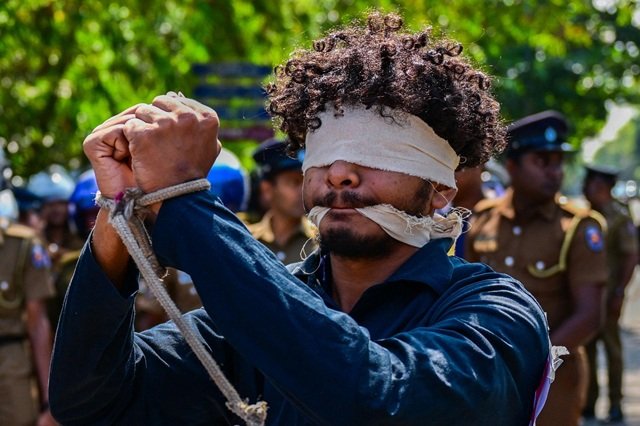
In office, the story changed. At least 12 people were reportedly arrested under the PTA between September 2024 and May 2025, with more since then. The Human Rights Commission of Sri Lanka has reported 46 PTA-related detention cases in 2025 and 12 more in the first three months of 2026. Those detained include a man accused of pasting anti-Israel stickers and, in June 2026, a 24-year-old Tamil hip-hop artist over a music video. The Act has even been used when ordinary criminal law would do.
The government that promised to abolish the PTA has shown, within two years, what every government does with extraordinary powers: it uses them.
“Trust us” is not a safeguard
Now the government wants two new laws. The Protection of the State from Terrorism Bill (PSTA) went to Parliament on 6 October to replace the PTA. The Prevention of Organised Crimes Bill was gazetted the same day.
The objections to it are not partisan. The bills’ broad definitions, executive detention powers and bail restrictions would preserve, and sometimes expand, the powers that made the PTA notorious. Detention orders of up to a year would rest with the executive, not the courts. The organised crime bill would presume gang membership from hairstyles, tattoos, clothing, hand signs or loose “associations”, and bind a magistrate to remand the person produced. Its schedule of “serious crimes” stretches to bigamy, copyright infringement and unlicensed gambling. Sections 46 and 47 would make confessions to police officers of ASP rank and above admissible: the very PTA rule the PSTA itself drops, and one that has historically encouraged coercion and torture.
The Human Rights Commission of Sri Lanka calls the organised crime bill potentially more draconian than the PTA and wants it withdrawn. Amnesty International warns that a suspect could be held for a year before being charged and another year in pre-trial detention. Lawyers, clergy and rights advocates have raised similar alarms.
The response from NPP ministers and their spokespeople amounts to: do not assume these laws will be misused, by us or by those who follow us.
That is not an argument. It is a forlorn wish, as history has repeatedly shown it betrays little experience of how power actually works. The law is applied not by the minister who drafted it, but by the officer on the ground, who reads a clause as he or she understands it. Those most exposed are the poor, people outside Colombo and those without a lawyer. And laws outlive the governments that write them. The PTA has outlived nine presidencies.
The JVP, at the NPP’s core, should know this better than anyone. It was proscribed in 1983 by a government that found it convenient to blame it for Black July. The NPP also knows how quickly fortunes turn: from about 3 per cent in the 2019 presidential election to a two-thirds parliamentary majority in 2024. The pendulum that carried it in can carry it out. When it does, these laws will be waiting, fully loaded, for the next occupant of the Defence Ministry.
Realpolitik, not idealism
Democracies write security laws for the worst person who might ever hold power, not the best. “If men were angels, no government would be necessary,” James Madison wrote. That is why democracies rely on independent courts, narrow definitions, time limits and parliamentary scrutiny rather than the virtue of office-holders. Only authoritarian systems draft laws on the assumption that the ruler can be trusted.
The quiet of much of the opposition is astounding, if understandable. Many on its benches shaped the 2018 Counter Terrorism Bill and the 2023 Anti-Terrorism Bill, both shelved after public outcry and both ancestors of what is now before Parliament. It is hard to condemn convincingly a law whose first draft you wrote. So civil society, lawyers, the clergy and the Human Rights Commission of Sri Lanka have been left to lead.
One word of advice
The President and the government need not weaken the fight against terrorism or organised crime; both threats are real. They need to close the gaps their predecessors exploited, and which their successors certainly will, To do this, the legislation enacted needs to:
- Narrow the definitions. Expressly exclude dissent, advocacy, peaceful protest, industrial action and journalism; drop appearance-based presumptions; reserve “serious crime” for genuinely organised serious crime.
- Return detention, surveillance and bail to judges. No executive detention orders; a judicial warrant before intercepting communications or unlocking a phone; magistrates free to decide bail case by case.
- Strike out police confessions and untested hearsay and guarantee confidential access to a lawyer from first contact.
- Publish the drafting record, including the expert committee’s draft of the organised crime bill, and explain every departure from it.
- Withdraw both bills for revision and confine the organised crime bill to what Sri Lanka’s treaty obligations on transnational organised crime actually require.
No government deserves blind faith. The test of a security law is not how its authors would use it, but how the people they fear most would. The President and his government should draft these bills as if their fiercest rival will be the ones holding them.
One day, it may happen.