India is investing billions of dollars to establish itself as a major semiconductor manufacturing centre, but its strategy differs from the approach taken by the world’s leading chipmakers. Instead of entering the expensive race to produce the most advanced processors for artificial intelligence, New Delhi is concentrating on established semiconductor technologies that underpin automobiles, telecommunications, industrial machinery, electricity networks and consumer electronics.
The strategy reflects a calculated attempt to enter an industry dominated by a small number of technologically advanced manufacturers. India already has a substantial presence in semiconductor design, employing nearly one-fifth of the world’s chip-design workforce. However, it remains heavily dependent on foreign manufacturers for the physical production of semiconductors. Government estimates indicate that imports currently account for approximately 90 to 95 percent of India’s semiconductor requirements.
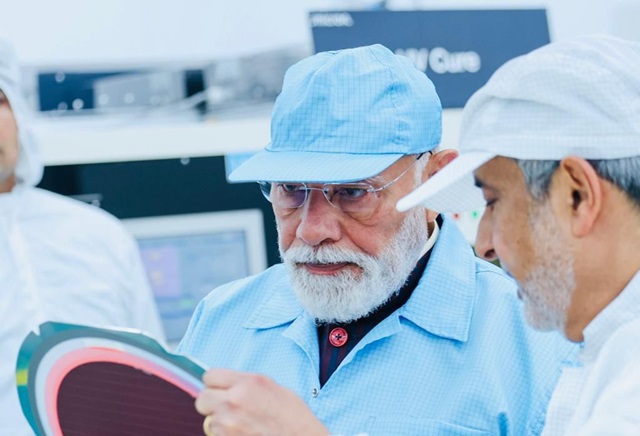
Prime Minister Narendra Modi has made domestic chip production a central part of his Make in India manufacturing programme. Addressing the Semicon India conference in New Delhi in September, Modi presented the country as a reliable alternative for international manufacturers seeking to diversify production and reduce dependence on concentrated supply chains. He argued that the global semiconductor industry needed additional trusted manufacturing locations as demand increased and supply uncertainties persisted.
The timing is significant. Artificial intelligence, electric vehicles, data centres, telecommunications and expanding electronics production are increasing worldwide demand for semiconductors. These industries require enormous quantities of specialised chips, creating opportunities for countries capable of establishing reliable manufacturing capacity.
India’s decision to concentrate initially on mature-node semiconductors is particularly important. While companies such as Taiwan Semiconductor Manufacturing Company (TSMC) and South Korea’s Samsung are competing to manufacture increasingly advanced processors using technologies measured in just a few nanometres, India is targeting production technologies ranging from 28 to 180 nanometres.
These chips are less advanced in terms of transistor size, but remain essential to modern industrial systems. They control power distribution, manage electronic signals, support vehicle operations and connect telecommunications infrastructure. Even advanced AI data centres depend on mature semiconductor technologies for power management, networking and other essential functions.
According to Neil Shah, co-founder and vice-president of research at Counterpoint Research, mature-node technologies account for approximately 70 percent of global semiconductor production by volume. Establishing manufacturing capabilities in this segment therefore gives India access to a substantial existing market rather than forcing it to compete immediately in the most expensive area of semiconductor production.
The financial barriers explain much of the decision. A leading-edge semiconductor fabrication facility using 3-nanometre technology can cost more than $15 billion to construct, according to Indian government think tank NITI Aayog. Such facilities also require advanced manufacturing equipment, specialised materials and decades of accumulated technical expertise. India’s Electronics and Information Technology Ministry Secretary S. Krishnan has acknowledged that pursuing 2-nanometre production at this stage would be prohibitively expensive.
By concentrating on mature technologies, India can develop industrial experience, train engineers and establish domestic supply chains before attempting more advanced manufacturing. The market also offers commercial opportunities. Rising demand for power-related semiconductors, including components used in AI infrastructure, has tightened manufacturing capacity, with industry researcher TrendForce reporting that supply pressures could support price increases into 2027.
India’s existing semiconductor expertise provides a foundation for this expansion. Major international companies, including Intel, Qualcomm and Texas Instruments, operate research and development facilities in the country. Indian engineers contribute to the design of sophisticated processors used in products worldwide, but much of the manufacturing takes place abroad.
The government’s objective is to close this gap between design and production. NITI Aayog projects that India’s semiconductor market could exceed $200 billion by 2035, supported by expanding demand from automobiles, telecommunications, electronics and digital infrastructure.
Under its first semiconductor mission, India approved 12 manufacturing projects involving more than $17 billion in planned investment. These include one silicon fabrication facility, two specialised semiconductor facilities and nine assembly, testing and packaging units.
Five of the nine assembly and packaging facilities have already entered commercial production. They include operations involving American memory-chip manufacturer Micron and Indian companies Kaynes Semicon, CG Semi, CDIL Semiconductor and Suchi Semicon. During the September industry event, Modi inaugurated commercial production lines at CDIL’s facility in Punjab and Suchi Semicon’s facility in Gujarat.
However, assembly and packaging do not provide the same manufacturing capabilities as producing integrated circuits directly on silicon wafers. Developing domestic wafer fabrication is therefore the next major challenge.
The government has introduced the Semicon 2.0 programme, backed by approximately $13.5 billion, to develop the wider industrial ecosystem required for semiconductor production. Its objectives include supporting equipment manufacturers, specialised chemicals, raw materials, research institutions, chip-design companies and technical workforce development.
This is a significant challenge because India remains heavily dependent on foreign suppliers for much of the machinery and foundational materials required by semiconductor factories. Without reliable domestic or diversified international supply chains, manufacturing facilities could remain vulnerable to external disruptions.
The Tata Group is developing one of India’s most important semiconductor projects in Dholera, Gujarat, through a partnership with Taiwan’s Powerchip Semiconductor Manufacturing Corporation. The proposed facility represents an investment of approximately $11 billion, with commercial production targeted for mid-2028. It is expected to begin with 55-nanometre and 90-nanometre technologies before progressing towards 28-nanometre manufacturing.
International investment is also expanding. US-based Applied Materials announced plans to invest $5 billion in India over the next decade, covering research, workforce development and domestic supply-chain capabilities. Such commitments could help India develop the technical infrastructure needed to support large-scale semiconductor manufacturing.
New Delhi is also looking beyond conventional chip production. A roadmap released by NITI Aayog in May proposes building a semiconductor value chain worth between $120 billion and $150 billion by 2035. It identifies advanced packaging, specialised analog chips and materials such as silicon carbide and gallium nitride as important areas for future growth.
Advanced packaging is particularly relevant because it allows multiple semiconductor components to be combined into increasingly sophisticated systems, improving performance without relying exclusively on smaller transistors. Silicon carbide and gallium nitride technologies, meanwhile, are important for electric vehicles, renewable energy equipment and industrial power systems.
India’s semiconductor ambitions are therefore not limited to replacing imported chips. The broader objective is to establish a competitive domestic industry that can supply international markets, attract foreign investment and support the country’s expanding manufacturing sector.
The strategy will take years to deliver results. Operating commercial wafer fabrication plants requires specialised skills, reliable infrastructure, consistent investment and a network of qualified suppliers. Delays, production costs and dependence on imported equipment could affect the pace of development.
Nevertheless, India’s decision to prioritise commercially established technologies provides a route into an industry where demand extends well beyond advanced AI processors. Rather than competing immediately with the world’s leading chipmakers on their most expensive products, New Delhi is attempting to build its position through mature manufacturing, specialised semiconductors and advanced packaging.
The success of this approach will depend on whether India can convert investment announcements into sustained industrial production. If it succeeds, the country could become an increasingly important part of global semiconductor supply chains at a time when manufacturers and governments are seeking alternatives to concentrated production networks.