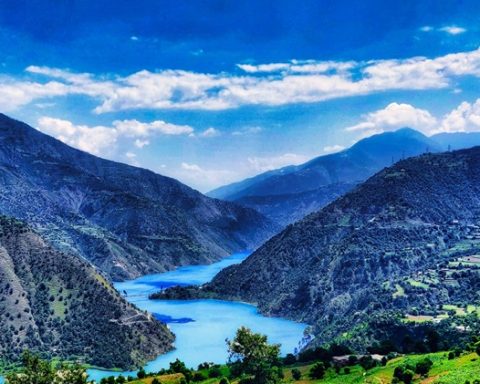
In Nanping, Fujian
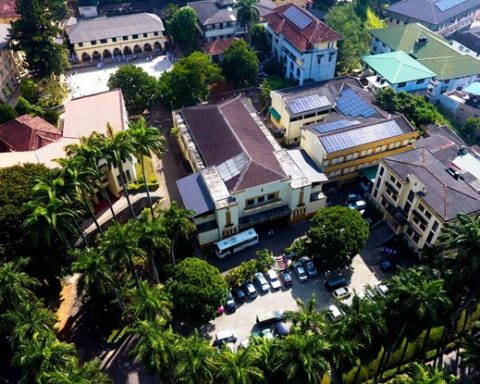
Well, it is the early hours of the morning. Almost everyone is deeply asleep. I have disturbed my colleagues over a technical problem, and one of them has generously come forward to help, despite the door alarm sounding. Yet sleep refuses to come. Through the window I can see the night sky and the faint lights reflected on the swimming pools below. The water seems to offer an invitation to swim at this unlikely hour, although I cannot swim. I find myself thinking that there is something rather appropriate about this small contradiction. Here is water inviting me towards an experience for which I am not equipped, just as the previous evening’s performance has drawn me towards a philosophical world that I am only beginning to understand.
I had intended to write a series on Fujian after collecting what I considered some of the most interesting details of our journey. Two days earlier, I had been deeply moved by an opera inspired by the Silk Road and had thought about writing something on it. But Moon Over Wuyi, directed by Xiao Xiangrong with Saga Dorje as chief producer, has interrupted those plans. It has stayed with me, scene after scene, refusing to become merely another cultural event recorded in a travel diary. I watched it without understanding a single Chinese word, yet found myself repeatedly returning to its images, its music, its movements and the extraordinary coordination of its performers. That experience has left me with a more demanding question than whether I enjoyed the production. How can an artistic work communicate something so deeply when its language remains inaccessible to the spectator?
Perhaps this is where Ludwig Wittgenstein becomes relevant, although I would hesitate to claim that the performance proves any philosophical proposition about language. The limits of language are not necessarily the limits of human experience. Music, movement, light, rhythm, gesture and silence can communicate through forms of recognition that do not depend entirely on verbal comprehension. What I experienced was not an understanding of every idea presented on stage, but an emotional and intellectual disturbance produced by the combination of artistic elements. The performance made me want to know what I had not understood. That, in itself, is a significant achievement. It did not simply entertain me. It sent me looking for Zhu Xi.
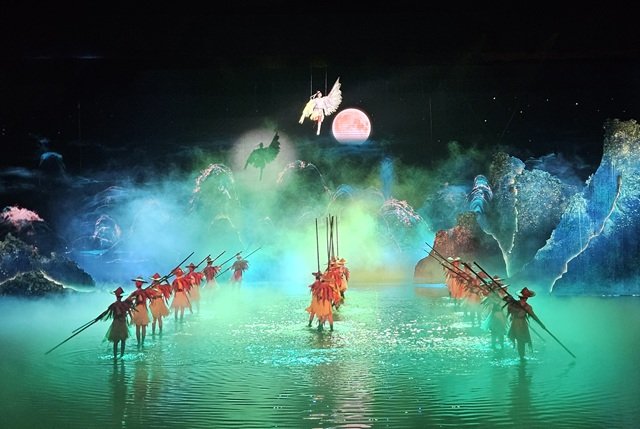
The production unfolded on what was described as the world’s largest single indoor water-screen stage. The scale was extraordinary, but scale alone cannot explain its effect. The water, projections, lighting, sound, mechanical movements, costumes and choreography had to operate as parts of a single composition. The stage reportedly measures 45 metres in length and incorporates a complex system of screens, lifting mechanisms and an intelligent water platform. Hundreds of performers and technical personnel, from different age groups and disciplines, appeared to move within an arrangement that demanded immense preparation and discipline. I found myself wondering how many hours of rehearsal, how many failed experiments and how much technical adjustment had been required to make such apparent fluidity possible. The audience sees the final movement. It does not see the labour that makes the movement look effortless. Perhaps there is a lesson there, too.
Yet the real subject of the evening was not technology. It was Zhu Xi, known in China as Zhu Zi, one of the most influential philosophers in Chinese intellectual history. He lived from 1130 to 1200, more than a millennium after Confucius, and became the central figure in the development of Song Neo-Confucianism. His commentaries on the Four Books eventually became authoritative in the imperial examination system, shaping education and political thought across East Asia for centuries. He was born in Fujian, and Wuyi became one of the most important settings of his intellectual life. He studied, taught and wrote in the region, helping establish it as a centre of learning. To describe him merely as a famous philosopher of ancient China is therefore inadequate. He was an educator, scholar, public official and moral thinker who sought to recover the ethical foundations of society at a time of political and cultural uncertainty.
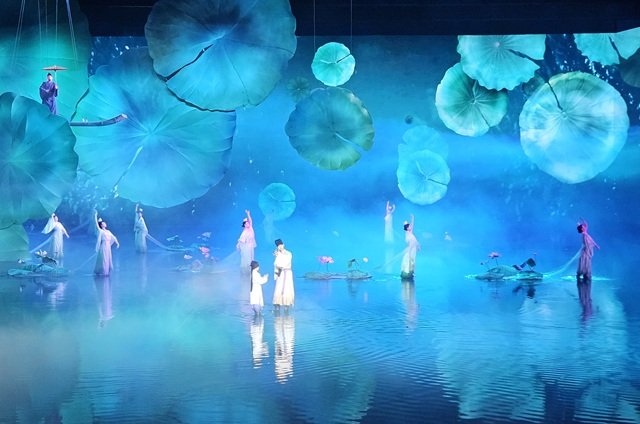
A conversation after the performance with my colleague Sophia added an unexpectedly human dimension to this encounter. She explained that she had studied Zhu Xi’s name at school but had known relatively little about his thought. The performance, she said, had given her a much clearer sense of his life and importance. Zhu Xi did not live before Confucius, as we briefly wondered during our conversation. He lived after him and sought to reinterpret and strengthen the Confucian tradition. But Sophia’s response revealed something the production had apparently intended. A theatrical experience had turned a familiar historical name into a subject of renewed curiosity. It had made her want to know more.
What was Zhu Xi actually trying to change? His concern was not simply to preserve an inherited tradition or to impose a collection of moral rules. He was attempting to explain how the moral order of the universe was related to the conduct of ordinary human beings. His concept of li, commonly translated as principle or pattern, refers to the underlying order that makes things what they are. His concept of qi, often translated as psychophysical or material force, concerns the dynamic substance through which that order takes concrete form. Neither should be reduced to a convenient Western equivalent. Their relationship was central to Zhu Xi’s understanding of nature, human beings and society. In his recorded conversations, he explained, “When we speak of heaven, earth, and the myriad things together, there is but one principle.” Yet that principle appears in different forms throughout the world. Unity does not eliminate particularity. The same underlying order is expressed through the distinct nature of different things and relationships.
This is the philosophical significance of the expression li yi fen shu, one principle with many differentiated manifestations, which the production connects with the image of the moon reflected in innumerable rivers. It is a compelling theatrical metaphor. One moon appears in countless bodies of water without being divided into separate moons. But the image also raises a question that deserves more than admiration. If there is one underlying principle, how do we recognise its different manifestations without confusing them? For Zhu Xi, the answer required intellectual discipline. His method of gewu zhizhi, investigating things to extend knowledge, demanded that people examine the particular circumstances of the world rather than retreat into abstract declarations of virtue. He argued that knowledge had to be accumulated through study, observation, reflection and moral practice. The purpose was not simply to collect information. It was to develop the judgement necessary to act rightly. As he put it, “If we wish to extend our knowledge to the utmost, we must probe thoroughly the principle in those things we encounter.”
This is why Zhu Xi’s philosophy cannot be dismissed as an abstract speculation about the universe. It was also a programme of moral education. He believed that human beings had to cultivate themselves before they could responsibly contribute to the ordering of society. Reverential attentiveness, or jing, was essential, but it could not replace inquiry. Inner discipline and the investigation of the external world had to reinforce one another. His intellectual ambition was to connect the smallest details of everyday conduct with the larger moral order. The relationship between parents and children, rulers and subjects, teachers and students, and individuals and their communities was not peripheral to philosophy. It was where philosophy had to prove its worth. His concern was not merely what people claimed to believe, but whether their understanding could be translated into conduct.
The performance translated these difficult ideas into visual and dramatic language. Its rain scene, in which the character of Zhu Xi reflects on cliffs shaped by weather and a stream negotiating its way around rocks, was particularly memorable. The dialogue suggested that principle could be discerned through the natural world, in endurance, movement, resistance and adaptation. These lines can be understood as dramatic writing rather than verified quotations from Zhu Xi. Nevertheless, they offer a useful introduction to his method of thought. The Jian ware sequence, with its clay being shaped and transformed through fire, similarly connects craftsmanship with the philosophical idea of becoming. Tea culture, Jianyang woodblock printing, Shaowu Nuo traditions, dragon-fish performances and Zhu Xi’s family rituals were not simply inserted as colourful regional exhibits. They were presented as expressions of a civilisation formed through accumulated knowledge, labour, belief and social practice. The production’s strongest moments emerged when these traditions became part of a larger intellectual argument rather than decorative attractions.
There is, however, a danger in this approach. Zhu Xi was a demanding thinker, and his philosophy cannot be adequately conveyed through spectacular images alone. His ideas about li and qi, moral cultivation and the investigation of things require sustained study. The theatrical image of the moon reflected in many rivers may awaken curiosity, but it cannot substitute for understanding the philosophical distinctions behind it. Nor should the production’s representation of Zhu Xi be confused with a complete account of his historical life. His intellectual influence was immense, but his career was not an uninterrupted triumph. His teachings encountered political resistance, and the learning associated with him was at one point subject to official restrictions. The irony is striking. A thinker who encouraged investigation and moral seriousness would eventually become the intellectual authority of an examination system that could also reward conformity and memorisation. His legacy therefore contains a tension between independent inquiry and institutional orthodoxy, a tension that deserves to remain visible.
It is also worth considering the contemporary political interest in this inheritance. President Xi Jinping’s political journey began in Fujian in 1985, when he took up a post in Xiamen. He subsequently served in Ningde and Fuzhou and held senior provincial responsibilities before moving to other positions. In March 2021, during an inspection of Wuyi Mountain, he spoke of the need to promote the creative transformation and innovative development of China’s traditional culture and the integration of Marxism with China’s outstanding traditional culture, a policy subsequently described as the “second integration”. The connection between this contemporary cultural programme and Moon Over Wuyi is evident. The production presents traditional philosophy and regional heritage through modern theatrical technology, seeking to make an older intellectual inheritance meaningful to contemporary audiences.
Xi’s Up and Out of Poverty, a collection of writings from his period in Fujian, offers an additional point of reference, although it is important not to confuse its geographical and historical setting with that of Zhu Xi. The book draws particularly on Xi’s work in Ningde between 1988 and 1990. In “The Glories of Ningde”, written in January 1990, he argued that a region’s natural beauty and cultural inheritance were sources of confidence, not merely assets for tourism. “The area’s splendid cultural traditions are also glorious,” he wrote. He insisted that people needed to understand their own history before they could properly appreciate and develop their homeland. His discussion of cultural communication is equally relevant to the theatrical experience I had just witnessed. “Content is the soul and starting point of the message,” he wrote, while warning that even important cultural content would fail if presented in a form audiences could not receive. He also invoked the old saying, “Words without elegance will not become popular.” These observations help explain the logic behind a production that uses advanced technology and popular theatrical forms to communicate historical and philosophical material. The connection should not be overstated. Xi’s writings on Ningde were concerned with local development, public awareness and cultural confidence, not with Zhu Xi’s philosophical system. But they reveal a continuing concern with how inherited culture can be communicated and made socially meaningful.
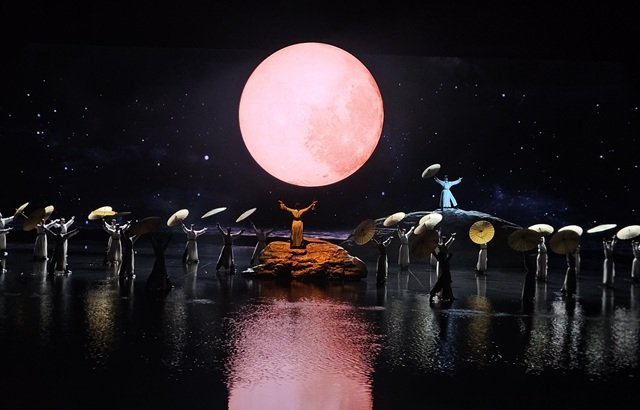
I return, finally, to the swimming pool below my window. It is 2.30 am, and my fingers are now asking to rest after dancing across the keyboard for the last few hours. The water is still, the lights remain faint, and I am no closer to becoming a swimmer. Yet I find myself thinking about the images of the previous evening, about the moon and the rivers, the movement of water, the transformation of clay and the extraordinary discipline of the performers. Perhaps this is the most interesting thing Moon Over Wuyi achieved. It made a spectator who could not understand its language want to enter the intellectual world behind its images. It made me look beyond the performance towards the writings of a man who believed that understanding required patient investigation and that moral knowledge had to be tested in the conduct of life.
I am grateful to our Chinese hosts and to colleagues from other countries who have travelled with us, some from nearby and others from distant places, for making this journey an opportunity to encounter things we might never have otherwise seen. From one city to another, one bamboo grove to another, one mountain to another, one river to another, and one generous smile to another, Fujian has offered a remarkable experience of how a civilisation presents its memory to the present. But the real measure of such an encounter cannot be the number of performances watched or places visited. It must be what remains after the lights go out. Zhu Xi’s enduring challenge is that knowledge should not end in admiration, nor should moral philosophy remain an elegant language for describing the world. We must investigate, understand and act. I left the theatre moved. I have woken in the early hours still thinking. The next responsibility is to read.