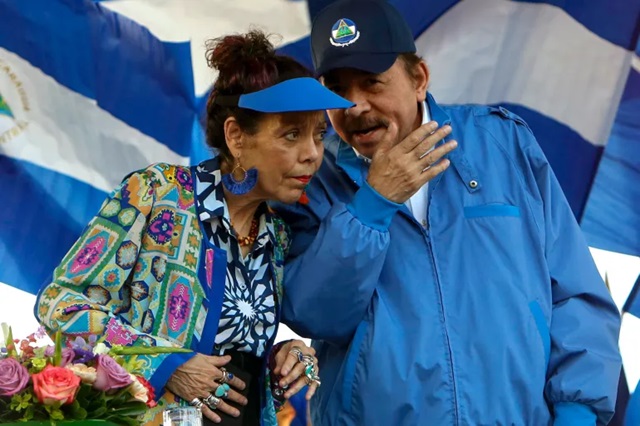
Nicaraguan President Daniel Ortega made his first public appearance in 68 days on Monday night, attending a ceremony in Managua to commemorate Carlos Fonseca, one of the founders of the ruling Sandinista National Liberation Front (FSLN). His return did little to dispel speculation about his health, as he appeared physically weakened, walked with difficulty and delivered only a few brief remarks.
Ortega, who turns 81 on Wednesday, arrived at the old Plaza de la Revolución accompanied by members of the Sandinista Youth, one of his daughters and other relatives. During a short procession around Fonseca’s mausoleum, he walked extremely slowly, taking short steps. His complexion appeared pale and he seemed disoriented at moments. At one point, he raised a bouquet of flowers towards his mouth as though it were a microphone, despite having one attached to the lapel of his jacket.
The ceremony, announced unusually by his wife and co-president, Rosario Murillo, on Sunday afternoon, took place amid growing speculation about the president’s prolonged absence. Ortega did not deliver a formal speech and managed only a few disconnected sentences while Murillo watched him closely. The official broadcast avoided close-up shots, relying instead on aerial drone footage and wide-angle views.
“Carlos, here are the young people, those who will never forget you, those who will never betray you, those who will always remain loyal to you, until death,” Ortega said in a noticeably slower voice.
His absence began after his last public appearance on 2 September, when he presided over a ceremony marking the 47th anniversary of the Nicaraguan Army. The 68-day gap was the longest since he returned to power in 2007, exceeding his previous record of 61 days, recorded in 2024 and repeated in 2026.
Ortega’s public appearances have become increasingly infrequent. Before 2020, his absences did not exceed 37 days, but subsequent periods away from public view lasted 52, 55 and 61 days. According to a tally by the newspaper Confidencial, he had appeared publicly only 11 times during 2026, compared with an average of 26 appearances between January and October in each year from 2018 to 2025.
His prolonged absence also kept him away from traditional national commemorations. During September’s Independence Day celebrations, Murillo had announced that the presidential couple would receive the Central American torch, as they had done in previous years. However, the ceremony on 12 September proceeded without either Ortega or Murillo. Their children Maurice and Camila Ortega Murillo appeared instead.
The president’s silence extended to several diplomatic developments that would previously have prompted strong public reactions from him. During his absence, the Nicaraguan government rejected the appointment of Natasha Franceschi as the US ambassador designated by President Donald Trump, prompting Washington to recall its senior diplomatic representative in Managua, Elias Baumann, for consultations. Neither Ortega nor Murillo publicly explained the decision or responded to the resulting deterioration in bilateral relations.
They also remained silent following remarks by Colombian President Abelardo de la Espriella that revived tensions over sovereignty in Caribbean waters, the subject of a longstanding territorial dispute between the two countries. Murillo, who has effectively assumed responsibility for the government’s daily public communications, considerably moderated her usual confrontational rhetoric towards Washington, although she continued attacking Nicaragua’s opposition.
The uncertainty surrounding Ortega’s health has been compounded by the government’s refusal to disclose medical information or explain his prolonged absences. Speculation intensified after the National Assembly unexpectedly approved another constitutional reform during his disappearance, abolishing the vice-presidency and introducing a system of designated presidential successors, just 20 months after a previous amendment established the co-presidency.
Opposition analysts interpreted the changes as an attempt by Murillo to redistribute positions of power among relatives and associates and secure a dynastic succession should Ortega become permanently absent.
A May investigation by the media outlet Divergentes reported that Ortega has access to a specially equipped VIP room at the Carlos Roberto Huembes Hospital, operated by the National Police. Hospital sources and people close to the ruling circle said he suffered a relapse in mid-2025, was hospitalised for at least five days between September and October that year, and visited the facility once or twice a week during the first quarter of 2026 for medical treatment and preventive care under strict security arrangements.