In Beijing, Exclusive to Sri Lanka Guardian
China, one of the world’s largest and most consequential economies, has embraced what diplomats call “soft power” — the subtle exercise of influence on the global stage.
In championing multilateralism and rejecting the notion of a “G2” — a world in which China and the United States concentrate global power — Beijing has positioned itself within BRICS and supported a greater leadership role for countries across the Global South.
This was evident, for example, at the annual gathering hosted here in Beijing by Xinhua, China’s state news agency. More than 100 countries from Africa, Latin America and Asia took part, alongside representatives from European nations such as France and Britain, as well as the United States.
With a population of more than 1.4 billion, China faces the challenge of maintaining its domestic balance while preserving its history and advancing at extraordinary speed in technology.
Research into robotics for health care, electric vehicles and high-speed trains that dramatically shorten distances across this vast country are just a few examples of technological progress increasingly linked to investments in quality of life. Health care robotics, in particular, is already opening the door to partnerships with Brazil.
At Beijing’s National Robotics Center, a robot modelled after the German physicist Albert Einstein delivers a message that reflects a distinctly Chinese perspective: science is essential, but so is sharing knowledge.
It can also be understood as a reminder of the importance of international partnerships.
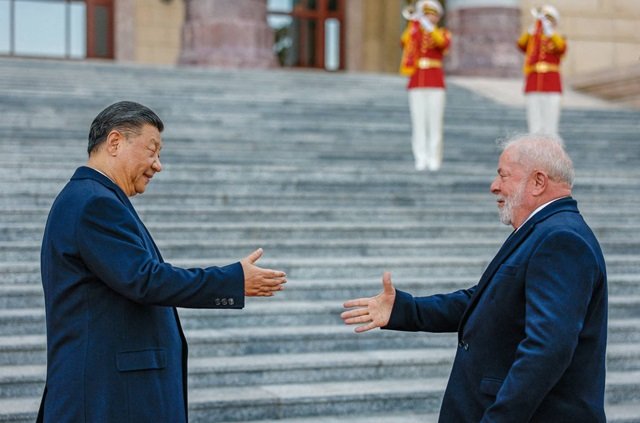
Brazil and China are essential partners. China is the leading destination for Brazilian exports, while Brazil became the world’s largest recipient of Chinese investment in 2025, according to figures released by the Brazil-China Business Council (CEBC).
One of the challenges ahead, Brazilian observers say, is for Brazil to expand its exports of higher-value-added goods.
“But this is a relationship that has grown enormously over the past 10 to 15 years, and it will continue to grow,” a senior Brazilian government official said, speaking on condition of anonymity.
“Brazil is a country held in extremely high regard by the Chinese. And we, as the Brazilian government, understand China’s fundamental role and value this relationship.”
Today, people in China know considerably more about Brazil than they did 20 years ago.
During a visit to Beijing and Shanghai in 2003, I noticed that shopkeepers would mention the names of soccer stars Ronaldo and Ronaldinho whenever they realised that a customer was Brazilian.
That familiarity now extends far beyond soccer. Many Chinese followed Brazil’s presidential election and rooted for President Luiz Inácio Lula da Silva’s re-election.
On a flight from Fuzhou to Shanghai, a Chinese entrepreneur in the semiconductor industry recounted the Brazilian election in remarkable detail, including Flávio Bolsonaro’s flight from the country.
This level of interest in Brazil underscores the country’s importance on the global chessboard.
In a brief conversation with a philosophy student in Beijing, she brought up Flamengo, the Brazilian soccer club, as well as writers Jorge Amado and Clarice Lispector.
She also mentioned having friends from Rio de Janeiro and São Paulo who had visited Beijing the previous year.
Between 2003 and 2026, Brazilians have begun travelling to China in significantly greater numbers, particularly following the removal of visa requirements last year.
China is now the leading trading partner of almost every country in Latin America. Mexico is the notable exception, largely because of its geographic proximity to the United States.
According to economists, one of China’s current challenges is to rebalance its trade and domestic economy. The country runs a substantial external surplus, while household consumption remains relatively moderate given the scale of its economy, population and development trajectory.
Domestically, China’s elimination of extreme poverty is one of the country’s most striking transformations, according to official figures.
Over the past four decades, more than 850 million people have been lifted out of poverty. The extreme poverty rate, which once exceeded 80 per cent, has fallen to zero, according to international organisations.
China’s model of social inclusion places considerable emphasis on education. Thousands of young people now hold master’s degrees and are entering the workforce with qualifications for skilled and specialised positions.
Another important element of this strategy is the expansion of domestic tourism, which has brought millions of Chinese citizens closer to their country’s cultural and historical heritage.
The line to enter Beijing’s iconic Forbidden City stretches for several city blocks. Yet it moves quickly, despite the security checks at the entrance to the Imperial Palace, inaugurated in 1420.
Visitors come from every corner of the world, alongside thousands of Chinese travellers, many from the country’s interior. They come to discover how the 24 emperors of the Ming and Qing dynasties lived in this extraordinary architectural complex, whose intricate details reflect the pursuit of power and the search for harmony through the principles of Feng Shui.
Today, beyond being a magnificent tourist attraction, the Imperial Palace preserves memories of other aspects of imperial life, including the civil service examinations and the academic distinctions that shaped the imperial system.
During a visit to the Imperial Palace organised by Xinhua as part of its Seventh World Media Summit, our tour guide explained that the Forbidden City was built in a strategic location that allowed the emperor to survey the entire city.
But something was missing: the balance required by Feng Shui.
There was no water, nor were there hills or mountains — elements considered essential to the site’s harmony.
The solution was to build an enormous artificial river and a mountain. Both remain there today, forming part of the breathtaking landscape.
During our two-hour visit, we learned about the emperors’ political power, the role of concubines and the significance of colours, numbers and animals in the details of the Imperial City’s architecture.
Every carefully planned element evokes the principles of yin and yang, the fundamental concepts of Chinese philosophy that represent opposing yet complementary forces in a constant state of transformation.
They seem, in many ways, to capture the foundations of China itself: a country in perpetual transformation, seeking to preserve its history while navigating an increasingly complex world and nurturing relationships with its international partners — particularly Brazil.