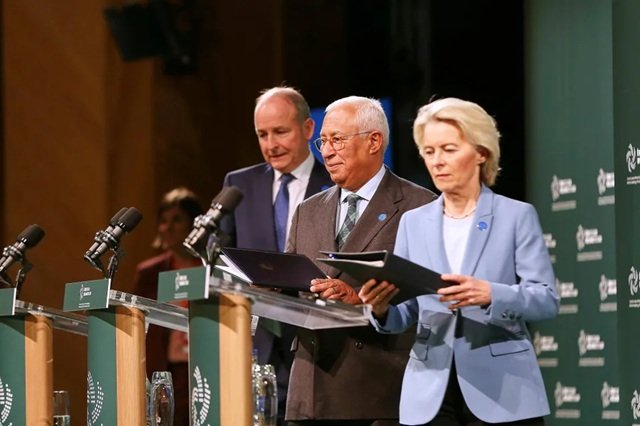
European Union leaders have agreed to establish a joint negotiating team comprising five major European countries and EU institutions to represent the bloc in future discussions on ending Russia’s war against Ukraine. The arrangement, announced on Friday following an informal EU summit in Dublin, brings together Germany, France, Britain, Italy and Poland, alongside the European Commission and the Council of the European Union.
European Council President António Costa confirmed the agreement, describing the proposed delegation as the European peace negotiating team for Ukraine. The five countries, collectively referred to as the E5, will work alongside the EU institutions to represent European interests in discussions involving Russia and Ukraine.
European Commission President Ursula von der Leyen said the institutional representatives would come from the European Commission and the Council, which represents EU member states. “We will support Ukraine and protect our interests,” she said.
The German government welcomed the agreement, saying it confirmed the approach Berlin had previously advocated. A government spokesman said the priority should now be to concentrate on the substance of a possible peace settlement.
Costa said the EU’s negotiating principles and positions were already established and that its representatives would continue to act in close coordination and with complete unity. Europe, he argued, needed to speak with a clear and united voice in all discussions shaping Ukraine’s future and the security of the continent.
He also emphasised the EU’s central role in negotiations concerning Ukraine’s European future, reconstruction and prosperity.
The agreement represents a compromise between competing positions among European governments over who should occupy seats at the negotiating table with Moscow. Several smaller EU member states had favoured giving senior representatives of the bloc’s institutions responsibility for conducting negotiations, rather than allowing a group of individual national leaders to represent Europe.
Estonian Prime Minister Kristen Michal had proposed that Costa and EU foreign policy chief Kaja Kallas represent the bloc. Kallas, who is from Estonia, had also indicated her readiness to participate in a negotiating team alongside European foreign ministers.
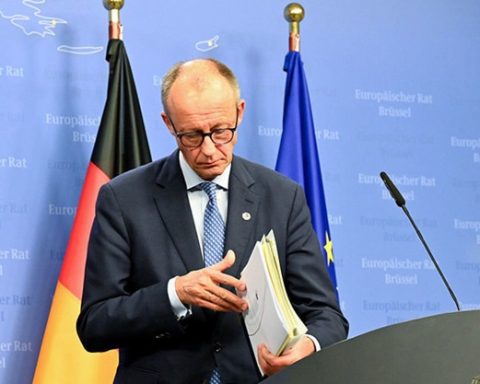
German Chancellor Friedrich Merz, however, had insisted that Germany should be directly involved in any peace negotiations. Speaking in Dublin, he said concrete discussions were expected to begin in the coming weeks and that Germany’s participation was assured.
Although the E5 arrangement settles the composition of the broader European negotiating team, questions remain over who would represent Europe in possible high-level discussions involving US President Donald Trump, Russian President Vladimir Putin and Ukrainian President Volodymyr Zelenskyy.
The debate intensified after US special envoy Steve Witkoff announced that European representatives would be included in the next round of negotiations involving Washington, Moscow and Kyiv. Following discussions with Putin, Witkoff told reporters that European participation would be significant because European countries were partners whose involvement was important.
“The Europeans will be at the next meeting, which we think is a very big deal, because it is important – they are our partners, and it is important that they are included,” he said.
European representatives from Germany, France and Britain had already attended the first direct discussions between Ukrainian and Russian delegations in eight months, held on Tuesday and Wednesday. However, they did not participate directly in negotiations with Russian representatives, leaving the question of Europe’s formal role in the peace process unresolved.
The Dublin agreement now establishes a broader framework for European participation, bringing together five national governments and the EU’s central institutions in a single negotiating arrangement.