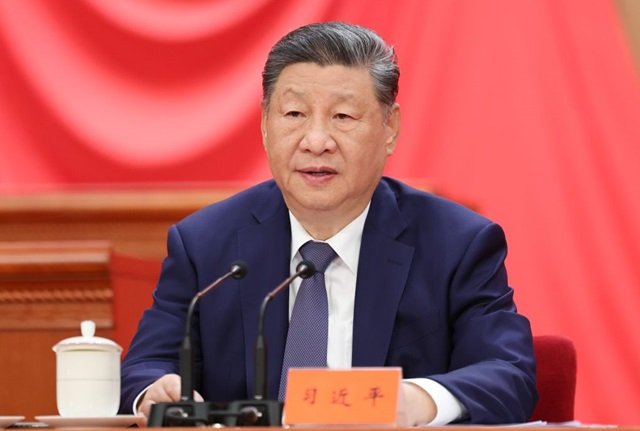
Chinese President Xi Jinping has declared that reunifying Taiwan with mainland China is an unshakable historical mission of the Communist Party of China (CPC), placing the disputed island at the centre of his vision of national rejuvenation and the political legacy of revolutionary leader Sun Yat-sen. Addressing a ceremony in Beijing on Thursday (12) to mark the 160th anniversary of Sun’s birth, Xi described reunification as a shared aspiration of the Chinese people and an inevitable requirement for the country’s transformation into a strong nation.
“Resolving the Taiwan question and achieving the complete reunification of the motherland is an unshakable historical mission of the Communist Party of China, a shared aspiration of all the sons and daughters of the Chinese nation, and an inevitable requirement for the great rejuvenation of the Chinese nation,” he said.
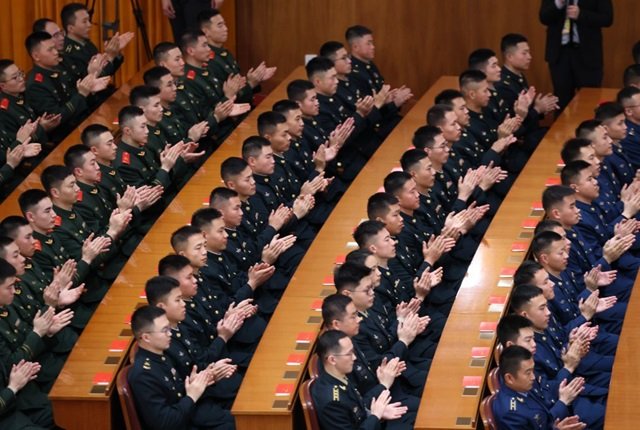
The address at the Great Hall of the People brought together approximately 3,000 participants, including Chinese Party and state leaders, representatives of social organisations, members of Sun’s family, foreign diplomats and guests from different sectors of society. Chaired by Wang Huning, the ceremony was also attended by members of the Standing Committee of the Political Bureau of the CPC Central Committee.
Xi used the anniversary to connect Sun’s revolutionary struggle against imperial rule in the early 20th century with the Communist Party’s contemporary political and economic programme. His speech covered sovereignty, national unity, economic development, public welfare, political leadership and China’s international role, presenting the current modernisation drive as the continuation of a national project initiated more than a century ago.
Born in 1866, Sun Yat-sen was a leading figure in modern Chinese political history. He led the 1911 Revolution, which overthrew the Qing dynasty and ended imperial rule, paving the way for the establishment of the Republic of China in 1912. Sun became its first provisional president. Xi described him as “a great national hero, a great patriot and a great pioneer of China’s Democratic Revolution”, recalling that he had devoted approximately four decades to revolutionary activity during a period of foreign aggression and political instability.
Sun’s political programme was shaped by the Three Principles of the People – nationalism, people’s rights and people’s livelihood – and the aspiration expressed in the slogan “Revitalize China”. Xi also recalled the influence of the October Revolution and Marxism-Leninism on Sun’s later political thinking. With assistance from the Communist Party, Sun developed a new formulation of the Three Principles and adopted three policies: alliance with the Soviet Union, cooperation with the CPC, and support for workers and peasants. The reorganisation of the Kuomintang and preparations for the Northern Expedition, which advanced the struggle against imperialism and feudalism, also featured in Xi’s historical account. Sun died in 1925, before the military campaign began in 1926.
The president portrayed the Communist Party as the principal inheritor of Sun’s revolutionary objectives, arguing that its successive political campaigns and development programmes had transformed China. “Chinese communists are the staunchest supporters, most loyal collaborators and most faithful heirs of Mr. Sun Yat-sen’s revolutionary cause,” Xi said.
He traced this claimed continuity through the New Democratic Revolution, the socialist revolution and construction, reform and opening-up, and the development of socialism with Chinese characteristics in the new era. The economic and infrastructural transformation of the country, he argued, had fulfilled many of the ambitions Sun outlined in his work The International Development of China.
Sun had envisaged an extensive network of railways, highways, communications systems, water conservancy projects, canals, ports and industrial facilities. Xi said many of these proposals had subsequently been realised on a scale exceeding the revolutionary leader’s expectations. He pointed to China’s position as the world’s second-largest economy and improvements in living standards as evidence of the country’s progress.
“Today, our great motherland stands tall in the East. Its economy firmly ranks second in the world, the people have achieved moderate prosperity in all respects, and the Chinese nation has made the great historic leap from standing up and growing prosperous to becoming strong,” he said.
Xi also drew on Sun’s emphasis on national sovereignty and economic independence to defend the Communist Party’s leadership. He recalled the revolutionary leader’s assertion that “the right to development, when in our own hands, survives; when in the hands of others, it perishes”, linking it to the principle that China’s development must remain under the control of its own people. Xi called for the unity of patriotism, loyalty to the Party and support for socialism, alongside the Party’s overall leadership and the centralised leadership of its Central Committee.
Social welfare formed another significant part of the address. Xi recalled Sun’s belief that the state had a responsibility to secure the conditions necessary for people’s well-being, quoting his statement: “What the people cannot do, we must do for them; the rights the people do not possess, we must fight to secure.” Sun’s proposals to equalise land rights and regulate capital were presented as efforts to reduce economic inequalities and establish more equitable living conditions.
Xi linked these ideas to his own emphasis on people-centred development, whole-process people’s democracy and common prosperity. “We must remember that the country is the people and the people are the country,” he said, calling for the benefits of modernisation to reach the population more extensively and fairly.
The speech also highlighted Sun’s perseverance, intellectual approach and efforts to mobilise support among Chinese people at home and abroad. Recalling the revolutionary leader’s determination to continue despite repeated setbacks, Xi quoted him as saying: “My determination is to move forward without hesitation; the greater the setbacks, the stronger my resolve, and I will continue to fight.” Sun’s final words, “Peace, struggle, save China”, were also cited as an expression of his commitment.
Xi used this aspect of Sun’s legacy to call for greater coordination between domestic and international priorities, development and security, and stronger preparedness to confront risks and challenges. He also advocated combining Marxism’s fundamental principles with China’s specific realities and traditional culture, a process the Party describes as the “two integrations”.
The most direct contemporary political application of Sun’s legacy concerned Taiwan. Xi recalled Sun’s opposition to initiatives to divide China and his assertion that “China is a unified country”. He argued that people on both sides of the Taiwan Strait share historical and cultural ties and belong to the same national family.
“Compatriots on both sides of the Strait are Chinese, members of the same family bound by blood. When members of a family talk openly and consult one another about their affairs, there are no differences that cannot be resolved,” Xi said.
He reiterated Beijing’s support for peaceful reunification under the “one country, two systems” framework and said the Chinese government was prepared to maintain dialogue and consultations with figures from different sectors in Taiwan. Such discussions, he said, would be conducted on the basis of the One-China principle and the 1992 Consensus, taking account of Taiwan’s circumstances and the interests and feelings of its population. However, he ruled out accommodation of separatist activities advocating Taiwan independence.
“Taiwan’s future lies in national reunification, and the interests and well-being of our compatriots in Taiwan are linked to the great rejuvenation of the Chinese nation,” he said. He concluded his remarks on the issue by declaring: “The tide of history cannot be stopped. The complete reunification of the motherland must be achieved and will certainly be achieved.”
Taiwan’s authorities reject Beijing’s proposal. Responding to the “one country, two systems” framework, Taiwan’s Mainland Affairs Council said it would amount to submission to the government of the Communist Party of China. Reuters reported that Xi did not mention the possible use of force in his speech, although Beijing has not formally renounced that possibility.
Beyond Taiwan, Xi presented Sun’s international outlook as a foundation for China’s contemporary engagement with the world. He recalled the revolutionary leader’s belief that national development should contribute to humanity and cited the traditional expression Tianxia weigong, meaning “the world for the common good”. He also referred to Sun’s support for openness and exchanges between civilisations without requiring China to follow the historical paths taken by Western powers.
Xi connected these ideas to China’s advocacy of peace, development, equity, justice, democracy and freedom, as well as its ambition to build a community with a shared future for humanity. He described Chinese modernisation as the contemporary expression of Sun’s “Revitalize China” ideal and compared the process to a new Long March.
“Advancing the all-round building of a strong country and the great rejuvenation of the nation through Chinese modernization is the new Long March of the Communist Party of China and the Chinese people, as well as the necessary path to realizing Sun Yat-sen’s ideal of ‘Revitalize China’,” he said.