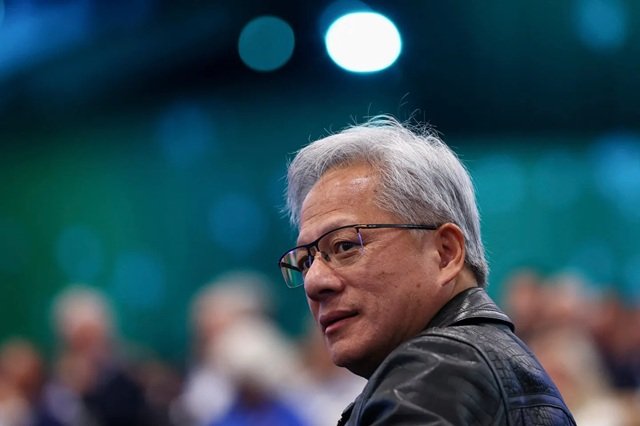
Nvidia’s position at the centre of the artificial intelligence industry has come under scrutiny following allegations involving its chief executive, Jensen Huang, and a suspected Chinese intelligence operative accused of facilitating access to restricted computing chips. The controversy has drawn international attention because of the company’s central role in supplying the hardware used to develop and operate advanced AI systems. Huang has resigned as chief executive, while Nvidia has appointed its chief financial officer, Colette Kress, as interim chief executive and begun searching for a successor. The allegations, which China has dismissed, have emerged at a time when governments are imposing restrictions on advanced semiconductor exports and major technology companies are attempting to reduce their dependence on Nvidia.
The company’s importance to the AI industry is the result of a transformation that began long before the current boom. Nvidia was originally known primarily as a manufacturer of graphics processing units (GPUs) for computer games. These processors were designed to perform the intensive calculations required to generate three-dimensional images, converting geometric information into increasingly realistic visual scenes. As computer graphics became more sophisticated, the number of calculations required to render images increased from hundreds of triangles to thousands and eventually hundreds of thousands. GPUs were developed to handle this workload efficiently.
Their significance, however, extended beyond gaming. Unlike conventional central processing units (CPUs), which traditionally execute instructions sequentially, GPUs can perform large numbers of calculations simultaneously. This parallel processing capability eventually attracted researchers who recognised that the same architecture could be adapted to other computing tasks. By translating general computing problems into forms that GPUs could process, they found ways to use graphics hardware for applications unrelated to generating images.
Nvidia began formalising this approach in 2007 with the introduction of CUDA, a software platform designed to translate algorithms into instructions that could run efficiently on GPUs. The decision to develop and distribute the technology across the company’s graphics processors was driven by Huang, who had co-founded Nvidia in 1993 and remained its chief executive until his resignation. At the time, the company’s customers were predominantly computer gamers, most of whom had little reason to use general-purpose computing capabilities. Nevertheless, Huang insisted that CUDA be incorporated into every GPU Nvidia sold, increasing production costs even though most purchasers would never use the software. In effect, gaming customers helped finance the development of a computing platform that would later become central to the company’s commercial success.
The strategy began producing significant results in 2012, when researchers increasingly adopted CUDA for artificial intelligence applications. A major turning point came with AlexNet, an artificial neural network that demonstrated substantially better image-recognition performance than existing techniques. Neural networks had previously attracted research interest but had failed to achieve comparable mainstream acceptance. The combination of Nvidia GPUs and CUDA enabled AlexNet to demonstrate the practical advantages of the approach, helping revive neural network research and accelerate the development of deep learning, the field that subsequently contributed to today’s AI industry.
As interest in deep learning expanded, demand for Nvidia processors increased. In 2016, the company introduced the DGX-1, a computing system containing eight GPUs that it described as the world’s first deep learning supercomputer. Huang personally delivered the first unit to OpenAI, which had recently been established as a non-profit organisation. Nvidia’s share price subsequently began rising alongside the expansion of artificial intelligence research and commercial applications.
The company’s competitive advantage has come from combining its processors with the software infrastructure required to use them. Although other technology companies have developed alternative hardware, Nvidia’s established ecosystem has made it difficult for competitors to displace. Google’s DeepMind demonstrated the potential of specialised AI processors in 2016. In January that year, the organisation announced that it had used 176 GPUs to power AlphaGo in a match against leading Go player Fan Hui. Neither company confirmed the identity of the processors, although they were almost certainly Nvidia products. By March, when AlphaGo defeated world champion Lee Sedol, DeepMind had switched to 48 tensor processing units (TPUs), an alternative processor developed by Google.
Google continues to use TPUs, while Amazon, Meta and Microsoft are developing or experimenting with their own specialised chips. Nevertheless, Nvidia retains a dominant position, supported not only by its hardware but also by decades of software development built around CUDA. Researchers and technology companies that have invested heavily in this ecosystem face substantial difficulties in moving to competing platforms.
This dominance has acquired additional geopolitical significance since the United States introduced restrictions in 2022 on exports of advanced computing chips to China. The measures cover many of Nvidia’s highest-performance products and are intended to limit China’s progress in artificial intelligence and prevent the technology from being used for military applications.
The allegations surrounding Alice Huang, who is not related to Jensen Huang, have brought these restrictions into the centre of the controversy. US intelligence officials suspect her of being a Chinese spy, a claim rejected by China. According to the Financial Times, Alice Huang told Chinese investors that she could secure access to Nvidia GPUs. The Information has also reported allegations that she was involved in a proposed deal to purchase 240,000 restricted GPUs. She has not publicly responded to the allegations.
The New York Times subsequently reported allegations of a second affair involving Jensen Huang and an Nvidia executive, which he has not confirmed. Huang’s resignation has added to uncertainty surrounding the company, whose valuation had reached $4.5 trillion, making it the world’s most valuable company before the controversy. News of the initial allegations wiped almost $500 billion from its market value, with further share-price declines following the announcement of his departure.
The leadership change comes as Nvidia faces growing competition from technology companies developing alternative AI processors. Its position has also become increasingly important to investors and businesses whose AI operations depend on its hardware and software. The company must now identify a new chief executive while Colette Kress serves as interim leader, following the departure of the executive who directed its transformation from a gaming hardware manufacturer into a central supplier of the global artificial intelligence industry.