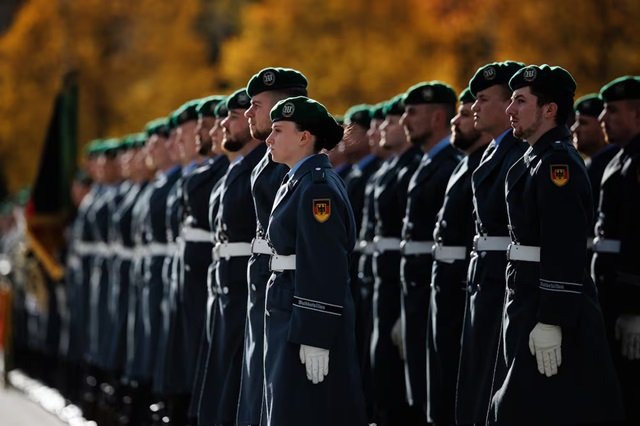
Three out of four women serving in Germany’s armed forces have experienced sexual harassment at least once during their military careers, according to a comprehensive study that also found that more than a third of male personnel had experienced some form of sexual misconduct. The findings have prompted Defence Minister Boris Pistorius to announce a 34-point action plan, declaring that the Bundeswehr would adopt a policy of zero tolerance towards sexual misconduct.
The study, commissioned by the Defence Ministry and conducted by the Centre for Military History and Social Sciences of the German Armed Forces, examined incidents that had frequently gone unreported. It found that 75 per cent of female soldiers and 35 per cent of male soldiers had experienced some form of sexual harassment during their careers. The findings suggest that the problem is considerably more widespread than previously indicated by official complaints.
The figures for the 12 months preceding the survey reveal the range of misconduct reported by female personnel. Some 38 per cent experienced verbal harassment, including sexually suggestive or lewd remarks. Seven per cent reported having photographs taken without their consent or images of themselves altered using artificial intelligence. A further 9 per cent said they had experienced physical assaults, while 2 per cent reported sexual violence. In addition, 40 per cent of female soldiers expressed dissatisfaction with the lack of transparency surrounding the handling of complaints involving sexual misconduct.
The researchers identified a lack of confidence in the reporting system, military structures and the wider military environment as major reasons why incidents were not formally reported. Depending on the category of misconduct, between 36 and 61 per cent of respondents said they had refrained from reporting incidents because they feared negative consequences. Between 44 and 59 per cent questioned whether submitting a complaint would achieve anything.
According to Pistorius, the number of incidents identified by the survey was between three and five times higher than the number recorded through formal complaints. Presenting the findings to the Defence Committee of the German parliament on Wednesday morning, the Social Democratic minister acknowledged that the results had exposed serious problems within the military. “We were clear from the beginning that the analysis would bring unpleasant truths to light,” he said.
The study also identified differences in the prevalence of reported misconduct across military settings. Women serving in lower ranks were particularly affected, while units with a higher proportion of female personnel, including the medical service, recorded noticeably fewer complaints. Pistorius also highlighted recurring incidents aboard naval vessels, attributing some of the difficulties to the confined living and working spaces in which personnel remain together for extended periods.
The survey was conducted by contacting 45,000 military personnel, of whom 18 per cent responded. It is the most comprehensive investigation of sexual misconduct within the Bundeswehr undertaken in Germany to date. Its publication comes as the government seeks to expand the armed forces as part of a broader military build-up, with the objective of creating Europe’s largest conventional army.
Germany aims to increase the number of military personnel to 260,000 by 2035. Women currently remain significantly under-represented across most areas of the armed forces. In September 2026, the Bundeswehr had approximately 186,200 soldiers, of whom around 25,500 were women. Women therefore accounted for 13.7 per cent of military personnel, compared with 86.3 per cent for men. The government has also reactivated military service, initially on a voluntary basis, as part of its efforts to expand recruitment.
Pistorius announced that the 34 measures would strengthen prevention, improve support for victims, make reporting procedures more accessible and increase accountability among military commanders. Although he did not provide a detailed breakdown of every measure, he said personnel would receive better information about reporting channels and available assistance.
A central element is the HELP advisory centre, which began operating in early November. Once fully staffed, it is expected to provide round-the-clock assistance, seven days a week, to people affected by sexual misconduct. Crucially, the centre operates outside the Bundeswehr’s military hierarchy, allowing victims to seek advice without having to report incidents directly through their superiors.
The establishment of independent reporting mechanisms had already been advocated by the Green Party before the survey findings became public. Sara Nanni, a Green Party member of the Defence Committee, told German public broadcaster ARD that sexualised verbal harassment was so common that she believed very few women could go a week without experiencing some form of it. She argued that victims should have access to external reporting centres independent of the military, removing the requirement to approach their commanding officers.
The proposed reforms also link the handling of sexual misconduct to career progression and appointments to positions of authority. Future assessments of senior officers will explicitly consider whether they have addressed inappropriate behaviour within their units. Pistorius said commanders who failed to set an example, tolerated misconduct or did not respond consistently would no longer be eligible to hold leadership positions.
The ministry also plans to establish a specialised investigative group to provide support directly within military units, strengthen disciplinary sanctions and improve investigative procedures. This will include greater specialisation among military disciplinary lawyers and dedicated investigative capacity for sexual misconduct cases.
Pistorius said the scale of under-reporting was among his greatest concerns. “What worries me most is the fact that so many incidents, of varying degrees of severity, simply go unreported,” he told German broadcaster ZDF. Official complaints involving sexual misconduct reached a record 472 cases last year, although the minister acknowledged that the figure represented only a fraction of the actual incidents.
The problem has attracted attention within the Bundeswehr for several years. In 2024, the then Parliamentary Commissioner for the Armed Forces, Eva Högl, initiated the investigation into unreported sexual assaults. A year later, the military base at Zweibrücken in Rhineland-Palatinate became the centre of a major scandal after 59 members of a paratrooper regiment were accused of alleged far-right extremism, sexual misconduct and drug use.
More recently, allegations of sexual misconduct involving instructors in the medical service at a barracks in Weißenfels, Saxony-Anhalt, became public. According to judicial sources, all those accused were considerably older and held higher military ranks than the alleged victims.