


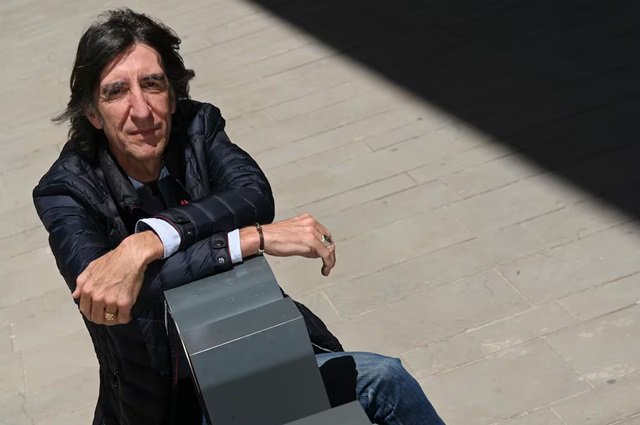
Benjamín Prado has spent decades inhabiting multiple literary identities at once: poet, novelist, journalist, lyricist, and occasional actor. But in a recent conversation recorded by El País, he appears in a more fragile register, describing what he calls a quiet “countdown” shaped by a neurological illness he chooses not to specify. At 64, one of Spain’s most recognisable literary voices confronts the unsettling possibility that his memory, the foundation of his craft, may no longer be fully reliable.
The interview, conducted during the Barbitania festival in Barbastro, unfolds between humor and unease, revealing a writer who continues to perform lightness even as he acknowledges fear. Prado’s new memoir, Qué estoy haciendo aquí, becomes the narrative vessel for this tension. It is both a retrospective of friendships, artistic encounters, and cultural history, and an implicit confrontation with the erosion of time and mental clarity.
Speaking to El País, Prado describes his life as one of constant experimentation, shaped by what he calls a tendency to “try everything.” He recalls accepting acting work from filmmaker Rodrigo Sorogoyen almost impulsively, seeing it as another extension of his habit of crossing boundaries between disciplines. For him, writing poetry, collaborating with musicians, and stepping into film are all variations of the same instinct: a refusal to remain confined to a single identity.
That instinct, however, now collides with a more fragile reality. Prado admits that he is writing under the pressure of forgetting, aware that names, events, and entire sequences of his life are beginning to slip away. The memoir, in this sense, is not just reflective but urgent, a way of preserving a personal archive before it dissolves. He speaks openly about fear, describing a sense of “countdown” that accompanies his awareness of illness, though he avoids medical detail.
The tone of the conversation, as reported by El País, shifts repeatedly between irony and vulnerability. Prado jokes about his superstitions and obsessive habits, describing a life governed by small rituals and irrational rules. Yet beneath the humor lies an acknowledgment of fragility, particularly as he reflects on mortality and the loss of friends who once formed the core of Spain’s literary and cultural landscape.
Much of the interview is devoted to memory itself—both personal and collective. Prado recalls his early encounters with figures such as Rafael Alberti, Jaime Gil de Biedma, and other major voices of Spanish literature, describing a generation in which literary giants were still accessible in everyday life, encountered in bars, conversations, and informal gatherings. These memories form the emotional backbone of his memoir, but they also underscore the passage of time that now feels increasingly compressed.
As El País notes, Prado’s reflections are not limited to nostalgia. He situates his personal experience within a broader cultural shift, describing a world in which literature, friendship, and intellectual exchange once felt communal, but now appear fragmented and individualized. He contrasts a past “world of the we” with a present dominated by isolated individualism, where cultural consumption and public discourse are increasingly shaped by digital platforms and algorithmic attention.
At several points, Prado returns to the idea that he is “faking being better than he is,” a phrase that encapsulates both resilience and exhaustion. He describes continuing to perform normality while privately acknowledging decline, a tension that runs through the memoir itself. Writing becomes both a creative act and a form of preservation, a way to hold onto experiences before they disappear.
The interview also explores his long career as a cultural intermediary between poetry and popular music, particularly his collaborations with Spanish singer-songwriter Joaquín Sabina. Prado describes his ambition to bring poetry into broader public spaces, blending literary language with musical performance in an effort to break down barriers between “high” and “popular” culture. For him, poetry has always been something that should circulate beyond academic or elite contexts.
Yet even this cultural optimism is tempered by a growing sense of loss. Prado speaks candidly about fear of death, describing it not in abstract terms but as a daily presence shaped by memory and absence. The accumulation of deceased friends, writers, and cultural figures forms what he describes as a mental landscape populated as much by absence as by presence.
The El País interview highlights how this personal narrative intersects with broader questions about aging, creativity, and literary production. Prado suggests that long-term creative projects become increasingly precarious with age, as time itself becomes unpredictable. His decision to write memoirs, he explains, is partly motivated by urgency—a desire to document before memory fades further.
Despite this, he resists framing his illness as a defining identity. Instead, he emphasizes continuity, humor, and ongoing creative work. He continues to write, reflect, and engage with public life, even as he acknowledges limitations. The act of “faking being better than I am,” as he puts it, becomes less deception than performance—a way of sustaining participation in the world.
Throughout the conversation, Prado also reflects on relationships, love, and failure, speaking with characteristic irony about the difficulty of sustaining intimacy over time. He frames personal relationships not as narratives of success or failure but as complex, often unresolved exchanges shaped by expectation and misunderstanding.
In its final sections, the interview turns toward a broader cultural diagnosis. Prado describes contemporary society as increasingly fragmented, where shared narratives have weakened and attention is dispersed across digital platforms. He contrasts this with earlier literary cultures in which collective experience and intellectual exchange were more concentrated.
Yet even in this critique, he avoids nostalgia without tension. Instead, he acknowledges ambiguity: the present is neither entirely degraded nor entirely coherent, but marked by contradiction. Literature, in his view, remains one of the few spaces capable of preserving depth in an increasingly superficial informational environment.










