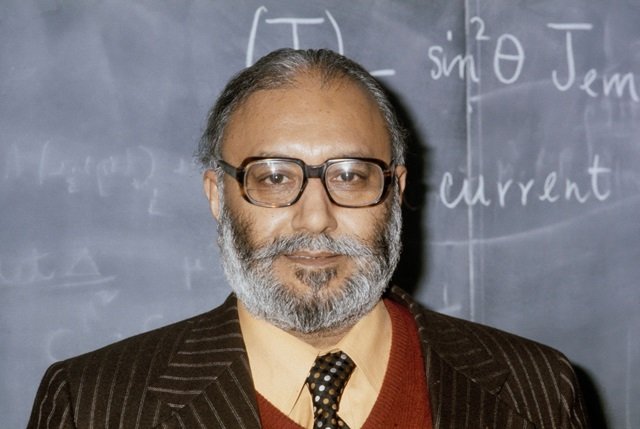
In the history of modern science, few figures embody the intersection of discovery, identity and institutional struggle as profoundly as Abdus Salam. Born on January 29, 1926, and remembered for his groundbreaking contribution to theoretical physics, Salam became the first Muslim recipient of the Nobel Prize in Physics in 1979. Yet his scientific achievements unfolded alongside a complex personal and political reality: while he gained worldwide recognition, the Ahmadiyya Muslim community to which he belonged faced increasing exclusion in Pakistan.
The significance of Salam’s life is particularly visible in the month of June. On June 9, 1968, he officially opened the International Centre for Theoretical Physics (ICTP) in Trieste, Italy, an institution created from his vision of expanding access to advanced scientific research for developing countries. In June 1974, Pakistan’s National Assembly began debates that eventually resulted in the declaration of Ahmadis as non-Muslims under the country’s Constitution. The two events represent the contrasting paths surrounding Salam’s legacy: one defined by international scientific cooperation and another shaped by religious marginalisation.
As reported by Frontline India, research into Salam’s career traces a journey from Jhang in Pakistan to the University of Cambridge, Princeton, and ultimately Trieste, where he transformed his belief in science as a tool for humanity into a lasting institution. Salam’s work in theoretical physics culminated in his sharing the 1979 Nobel Prize in Physics with Sheldon Glashow and Steven Weinberg for their contribution to electroweak unification theory.
Salam’s scientific outlook extended beyond personal achievement. He identified strongly with the developing world, now often described as the Global South, and believed scientific advancement could help societies overcome economic and intellectual challenges. His efforts to create opportunities for scientists from developing countries reflected this commitment.
Before establishing the ICTP, Salam had hoped Pakistan could become a centre for theoretical physics. During the early years after independence, the country had opportunities to strengthen scientific institutions, particularly under the Ayub Khan government, which supported scientific development. However, Salam’s ambitions required a level of institutional investment and political support that did not emerge. The comparison with India’s scientific development, where Homi Bhabha secured backing from Prime Minister Jawaharlal Nehru and financial support from the Tata Group for major research institutions, highlighted the importance of sustained national commitment to advanced science.
Salam’s relationship with Pakistan became increasingly complicated after the 1974 constitutional change concerning Ahmadis. As a committed nationalist, he approached Prime Minister Zulfikar Ali Bhutto to discuss the issue, but Bhutto deferred action. In the years that followed, restrictions on Ahmadis intensified, particularly during the administration of General Zia-ul-Haq.
His religious identity increasingly shaped how he was viewed within Pakistan, sometimes overshadowing his scientific accomplishments. While physicists in Pakistan continued to recognise his contributions to theoretical physics, influential religious figures criticised him because of his Ahmadi affiliation. Some opponents also questioned his international collaborations, including his work with Jewish scientists and researchers of different national backgrounds.
For the Ahmadiyya community, however, Salam became a symbol of the possibility of combining religious belief with scientific excellence. The community encouraged scientists, economists and researchers to follow his example by contributing to humanity through intellectual achievement. Yet the path from educational success to the highest levels of global recognition remains influenced by access to advanced universities, research facilities and international scientific networks.
Salam himself understood the importance of scientific environments. His own transformation as a physicist began after he secured a scholarship to study at Cambridge in the late 1940s, entering a world of leading scientific thinkers. He interacted with figures including Paul Dirac, Fred Hoyle, Albert Einstein and Robert Oppenheimer, and later collaborated with researchers across major institutions in Britain and the United States.
Among his greatest influences was Dirac, whom Salam considered one of the most important scientists of the twentieth century. His exposure to leading intellectual communities reinforced his belief that scientific talent required strong institutional foundations to flourish.
This understanding shaped his creation of the ICTP. Supported by Italy, UNESCO and the International Atomic Energy Agency, the centre was designed as a place where scientists from developing countries could conduct research, collaborate and gain access to an environment comparable to leading Western institutions. Salam’s achievement extended beyond his own Nobel Prize; it was also reflected in building a platform that connected scientists from across the developing world.
Salam’s connection between faith and science began early. Family accounts describe his father, Muhammad Hussain, as deeply committed to nurturing his son’s education after receiving what the family interpreted as a meaningful dream about Salam’s future. Guidance from prominent Ahmadi figures, including Chaudhry Zafrulla Khan and Mirza Bashir-ud-Din Mahmud Ahmad, contributed to Salam’s educational development.
The relationship between religion and science remained central to Salam’s worldview. He believed the Quran shaped his intellectual outlook and admired classical Muslim scholars such as Al-Haytham, Ibn Sina and Al-Biruni. Within the Ahmadi interpretation, science represented the study of creation and was not viewed as separate from faith.
Earlier efforts to promote scientific research within the community included the establishment of the Fazle Umar Research Institute in Qadian in 1946. The partition of British India disrupted its development, and later attempts to continue research faced difficulties. Salam’s own career, however, followed a broader national and international path rather than a specifically community-based scientific mission.
Today, Salam remains a reference point for discussions about science, education and identity. The Ahmadi community continues to highlight his achievements while encouraging younger generations to pursue scholarship and research. Figures such as Atif Mian, an Ahmadi economist at Princeton University, have continued this tradition of academic engagement despite facing controversy in Pakistan.
Nearly three decades after Salam’s death on November 21, 1996, his legacy continues to be defined by both his scientific achievements and the circumstances surrounding them. His career demonstrated how access to global research networks, institutional support and intellectual opportunity shaped one of the most significant scientific figures to emerge from South Asia.