


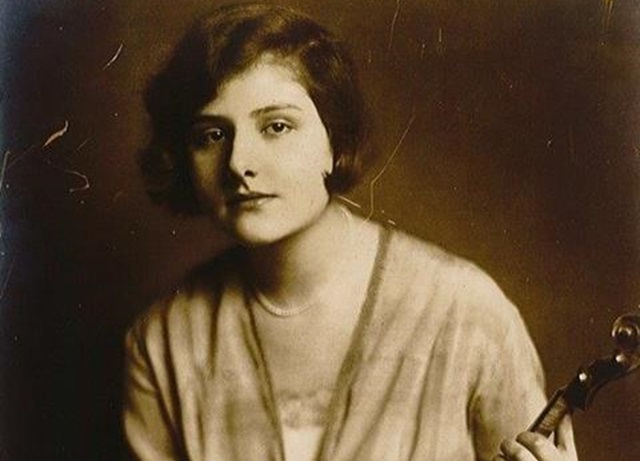
When Alma Rosé, an Austrian violin virtuoso and niece of composer Gustav Mahler, was taken to a barracks at Auschwitz concentration camp known for brutal medical experiments, she feared death on the operating table. In a desperate final act, she asked for a violin and played — a performance that not only saved her life but ultimately spared dozens of other women from certain death.
Rosé’s extraordinary talent impressed Maria Mandl, a senior SS guard notorious as “the Beast,” who appointed her conductor of the women’s orchestra of Auschwitz II-Birkenau. Comprising women and girls from 11 countries, the orchestra was forced to play as prisoners marched to forced labor and to entertain Nazi officers. Despite its tragic role, the orchestra became a fragile lifeline for its members.
Speaking at the Chalke History Festival, author and journalist Anne Sebba, whose book The Women’s Orchestra of Auschwitz recounts these stories, told The Times UK that Rosé “was given her life on condition that she ran a properly functioning orchestra.” Sebba added that by tripling the size of the group, Rosé saved as many young Jewish girls as she could, knowing those outside the orchestra faced almost certain death.
Rosé came from “musical royalty.” Her father, Arnold Rosé, led the Vienna Philharmonic for over 50 years, and before the war, Alma had founded the women’s orchestra of Vienna, touring extensively across Europe. Though her family had largely converted from Judaism, Nazi racial laws still classified her as Jewish. After fleeing to London in 1938, Rosé tried to revive her career in the Netherlands and France but was arrested by the Gestapo attempting to escape to Switzerland. She was sent to Auschwitz in 1943 at age 36.
Inside the camp, Rosé acted as a kapo, working with the Nazis while leading the orchestra. This role gave her certain privileges and a measure of protection for her fellow musicians, who were exempt from hard labor and housed together. However, the orchestra’s relative safety bred resentment among other prisoners.
Rosé fiercely protected her musicians, defying Nazi bans on Jewish composers by secretly rewarding the women with forbidden pieces, including the Mendelssohn violin concerto. Sebba described this as one of Rosé’s acts of resistance: “She couldn’t give them food or presents, so she gave them wonderful music that was forbidden.”
The orchestra’s influence grew, performing Sunday concerts for Nazi commanders and securing a grand piano and supplies like strings and resin through Rosé’s persuasion. Despite her vital role, Rosé was the only orchestra member who did not survive Auschwitz. She died in April 1944, reportedly from botulism, less than ten months before liberation.
After Rosé’s death, the orchestra faltered and stopped performing later that year. Several members were later killed at Bergen-Belsen, where the orchestra had been transferred. Survivors were deeply affected; many could not play music again and felt their performances had been tainted by the horrors they endured.
Sebba told The Times UK, “The women knew that however strict Alma had been, their lives had been saved by Alma.”










