In a claim reported by Iran International, an Iranian sailor killed in the U.S. submarine strike on the frigate IRIS Dena contacted his father shortly before his death, saying that American forces had issued two warnings for the crew to abandon the vessel ahead of the attack, according to a source close to the family. The source told Iran International that the ship’s commander allegedly refused to allow the crew to evacuate despite the imminent threat, and that survivors were mainly those who defied his orders and reached lifeboats on their own.
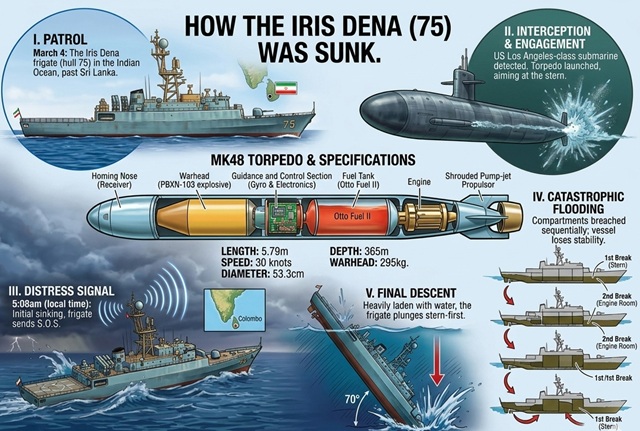
The incident occurred in the Indian Ocean on March 4, when a U.S. submarine torpedoed the Iranian warship roughly 19 nautical miles from the southern Sri Lankan port of Galle, killing dozens of Iranian sailors and marking one of the most dramatic escalations of the conflict between Washington and Tehran. U.S. Defense Secretary Pete Hegseth described the sinking as a “quiet death,” underscoring the significant geographic expansion of hostilities beyond the Middle East.
While American officials have framed the strike as a lawful military action against a legitimate combatant vessel, Tehran has vehemently rejected this narrative, asserting that the ship was not warned and condemning the attack as an unprovoked act that violated international norms. Independent accounts of the alleged warnings come from family sources and Iran International’s reporting rather than U.S. military confirmation.
The loss of life and conflicting accounts of whether warnings were given add to the controversy surrounding the incident, which has drawn international attention not only for the combat implications but also for humanitarian and diplomatic fallout in the region. Sri Lankan authorities recovered survivors and bodies from the water and have been involved in medical care and repatriation efforts, while political and military leaders in New Delhi and Colombo have expressed concern over clashes occurring near their maritime zones.