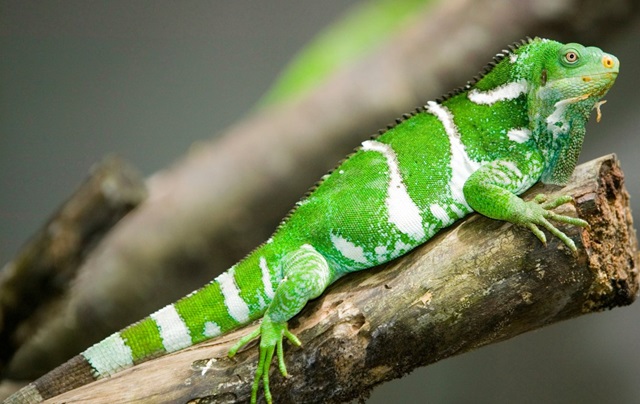
A new study has provided a fascinating answer to the long-standing mystery of how iguanas, which are native to the Americas, ended up on the Pacific island of Fiji. According to researchers, the reptiles may have made a remarkable 5,000-mile journey across the Pacific Ocean on “rafts” of tree trunks, carried by ocean currents. This accidental voyage is thought to be the longest such journey ever undertaken by a terrestrial vertebrate.
Previously, it was believed that the Fijian iguana was part of a branch of the iguana family that once thrived in East Asia or Australia before becoming extinct in other parts of the world. However, the latest research, which included DNA analysis of more than 2,100 iguana sub-species, revealed that the Fijian iguana, Brachylophus, is actually most closely related to the desert iguana, Dipsosaurus, found in North America. The two species diverged around 34 million years ago, coinciding with the emergence of Fiji from the sea due to volcanic eruptions. This discovery led scientists to conclude that the iguanas’ ancestors must have crossed the Pacific Ocean by sea, possibly aided by natural events such as cyclones.
Simon Scarpetta, an assistant professor at the University of San Francisco and lead author of the study published in the Proceedings of the National Academy of Sciences, explained, “You could imagine some kind of cyclone knocking over trees where there were a bunch of iguanas and maybe their eggs, and then they caught the ocean currents and rafted over.”
Iguanas, particularly desert iguanas, are known to be resistant to dehydration and starvation, making them well-suited for surviving such a long and hazardous journey. The study suggests that if any group of lizards could have undertaken the 8,000-kilometer trip, it would have been the ancestors of the desert iguana.
The journey of these iguanas would be the longest known example of “transoceanic dispersal” by a terrestrial vertebrate. The distance between California and Fiji is equivalent to a fifth of the Earth’s circumference, and while modern seafarers would take about a month to sail the route, these iguanas would have taken much longer, depending on the wind and ocean currents. They would also have had to consume parts of their raft to survive, according to the study.
This extraordinary journey is further described in a report by The Times UK, which highlights the breathtaking scale of the dispersal event. Co-author Jimmy McGuire, a professor at the University of California, Berkeley, noted, “That they reached Fiji directly from North America seems crazy. But alternative models involving colonisation from adjacent land areas don’t really work… Regardless of the actual timing of dispersal, the event itself was spectacular.”