


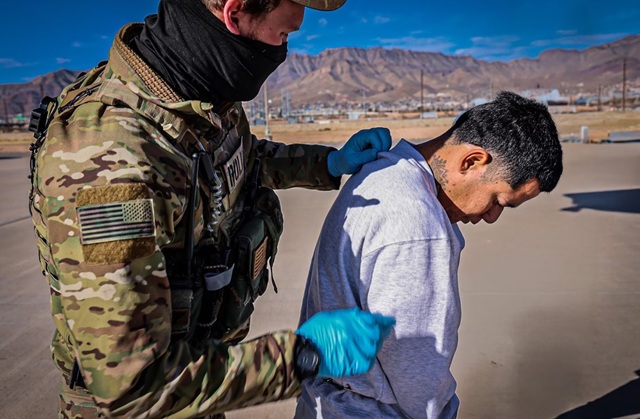
The ongoing situation surrounding migrants being sent to Guantánamo Bay has raised serious concerns regarding their treatment and the accuracy of claims made about their criminal affiliations. As reported by The Washington Post, when the Trump administration first transported a group of Venezuelan migrants to the U.S. naval base in Cuba, officials described them as members of the notorious Tren de Aragua gang and labeled them “the worst of the worst.” Homeland Security Secretary Kristi L. Noem even stated that they posed a high threat to U.S. communities. However, family members of the detainees, as well as newly surfaced records, paint a very different picture, casting doubt on these accusations.
Despite the harsh rhetoric surrounding the group, it appears that many of these migrants had no violent criminal history. In fact, The Washington Post found no federal criminal records for several of the men, including Luis Alberto Castillo and Tilso Gómez. In some cases, the only legal issues they faced were related to minor incidents, such as an assault charge in a detention center or issues tied to their immigration status. Their relatives firmly deny the claim that their loved ones are tied to Tren de Aragua.
The broader context of the gang itself, however, does not make the accusations entirely unfounded. Tren de Aragua has emerged as a powerful criminal organization in Venezuela, specializing in kidnapping, extortion, and migrant trafficking. But experts highlight that its influence in the U.S. remains minimal, and there is no clear evidence linking most of the men detained at Guantánamo to the gang.
The role of tattoos in this identification process has also raised concerns. ICE has used tattoos as one of several indicators of gang affiliation, but experts argue that tattoos alone are not a reliable sign, especially when they are common among many young Venezuelans. The story of Diuvar Uzcátegui, one of the migrants held at Guantánamo, illustrates how tattoos, along with the fact that he was from a region associated with Tren de Aragua, may have been misinterpreted as signs of gang membership. His family members expressed disbelief at his detention, insisting that Uzcátegui’s goals were simple: to escape the violence and poverty of Venezuela and start a new life in the United States.
As more details continue to emerge, it’s clear that the narrative presented by authorities may not fully reflect the reality of these migrants’ lives. What began as a swift characterization of the group as dangerous criminals now looks more like a tragic misunderstanding, where a combination of immigration status, appearance, and arbitrary associations led to the detainment of innocent individuals. This situation underscores the broader issues surrounding U.S. immigration enforcement and the treatment of migrants in detention.










