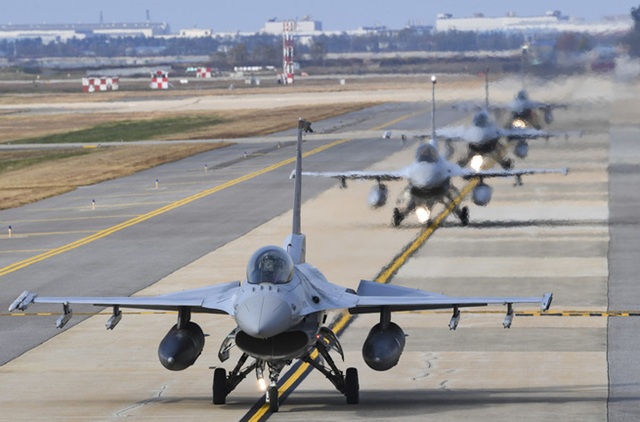
Japanese and South Korean defence stocks have hit record highs as the growing uncertainty in global security dynamics, spurred by former US President Donald Trump’s threats to withdraw the US security umbrella, has led European countries to eye more military equipment from Asia. South Korea’s Hanwha Aerospace, a leader in artillery, has seen its shares surge by 131% this year, while Mitsubishi Heavy Industries, Japan’s largest defence contractor, has seen a 28% increase in its stock value. This comes after German lawmakers agreed to ramp up their defence and infrastructure spending, further fueling optimism in the sector.
Shares in Hanwha Aerospace and Mitsubishi Heavy Industries spiked by 6.8% and 12.2%, respectively, following the announcement of Germany’s €500 billion programme, which is expected to be voted on by German lawmakers this week. Wendy Pan, an analyst at Macquarie in Tokyo, remarked that sentiment around defence stocks is particularly strong in light of this development. Since the onset of the war in Ukraine, which has sparked global rearmament, Hanwha Aerospace and Mitsubishi Heavy Industries have seen their stock prices increase more than fivefold.
South Korean defence companies are poised to benefit significantly, with Hyundai Rotem, a tank producer, up 115.3% this year as it anticipates supply contracts from Poland and Romania. Korea Aerospace Industries, a manufacturer of fighter jets, has risen by 72.3% in 2025. Analysts predict South Korean companies could secure up to Won154 trillion ($106 billion) in orders, representing a quarter of non-US western countries’ military spending.
The demand for defence equipment from Asia has increased as Europe struggles to expand its production capabilities, particularly in the wake of Russia’s invasion of Ukraine. Trump’s rhetoric, which calls for NATO countries to allocate 5% of their GDP to defence spending, has added additional pressure on European nations. South Korea, having maintained robust production capabilities for decades due to the North Korean threat, is uniquely positioned to meet this surge in demand, with its military production scale and cost advantages outpacing those of European nations.
Japan, traditionally a smaller player in the global defence export market, is now benefiting from increased demand following significant policy shifts. The Japanese government overturned its post-war pacifist stance on arms exports in 2014 and has progressively loosened export restrictions, with further relaxations in late 2023. Japanese companies such as IHI, Kawasaki Heavy Industries, and Japan Steel Works have seen gains of 22.3%, 32.6%, and 7.5%, respectively, this year.
The rise of Asian defence contractors is attracting attention worldwide, with analysts noting the potential for Japan and South Korea to secure substantial defence contracts with European and other Western nations. Japan’s Mitsubishi Heavy Industries is already involved in Europe’s next-generation fighter jet programme, while South Korea’s Hanwha has acquired a significant stake in Australian shipbuilder Austal.
According to the Financial Times, European defence companies have also witnessed significant stock price increases, with shares in Rheinmetall, Germany’s largest defence company, up 122.6% this year, and BAE Systems shares rising by 42.5%. The increasing defence spending commitments in Europe have led to record highs for both Asian and European defence stocks, highlighting the shifting dynamics in global military procurement.
As the geopolitical landscape evolves, Asian defence manufacturers are becoming increasingly vocal about the export opportunities ahead, with Japan’s Mitsubishi Electric raising its defence order expectations for 2025 to ¥600 billion ($4 billion), focusing on radar systems as a key growth area. The global rearmament trend, coupled with increased defence budgets in Europe, ensures that Asian defence companies will play a central role in meeting the growing demand for military hardware.