by Durga Velayudham
Soon before Sri Lanka’s Foreign Minister filled the United Nations General Assembly with declarations about trust, humanity and international responsibility, President Anura Kumara Dissanayake offered a far more revealing glimpse of the country’s economic condition. Sri Lanka’s current account, he acknowledged, had moved into negative territory, while the monthly fuel bill had doubled from roughly US$150 million to US$300 million. This is not the Sri Lanka of the 2022 catastrophe, and there is no reason to pretend that the country has returned to that precipice. But neither is it a detail that can simply disappear beneath the language of recovery. The International Monetary Fund says reserves reached US$6.9 billion at the end of August, economic growth was 4.2 per cent and debt restructuring was largely completed. Those are substantial developments. Yet the Fund has also warned that risks remain tilted to the downside and continues to call for stronger revenue mobilisation and further reforms. Discussions on the Seventh Review of the IMF programme remain under way. This is precisely the point at which a government representing a financially vulnerable country should make its language more exact, its claims more measurable and its diplomacy more closely connected to the realities it must manage at home.
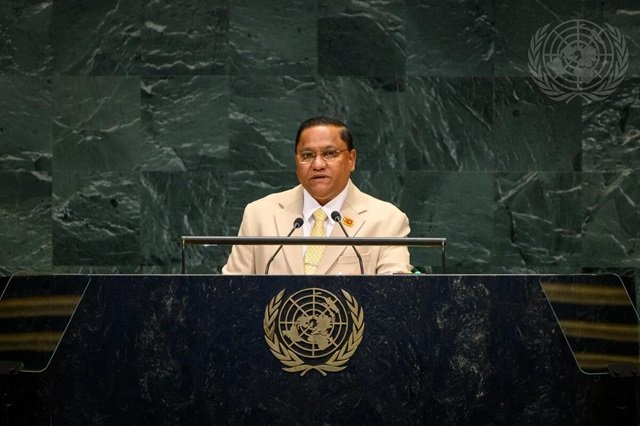
Instead, Foreign Minister Vijitha Herath told the General Assembly: “We are building trust through action — not rhetoric.” The sentence is striking because it establishes its own standard of measurement. The speech repeatedly invokes “delivery, discipline” and “the courage to confront wrongdoing”, while presenting Sri Lanka as a defender of humanity, international law and multilateralism. Such language is entirely legitimate in an international forum, but it becomes more demanding when examined against the Government’s conduct and responsibilities beyond the UN chamber. What happens when the language of humanity, accountability and trust is brought back from New York to Colombo, to the migrant worker waiting for a decision in Israel, to the family watching the cost of living, or to the economist examining a current account that has again moved into deficit? A diplomatic speech does not exist in isolation from the country whose name appears beneath it. Its credibility is inevitably measured against what that country is actually doing.
Herath is also Minister of Foreign Employment, which makes the Government’s handling of Sri Lankan workers in Israel particularly relevant. Parliament was told in August that around 7,000 Sri Lankan workers were facing deportation or status difficulties after moving outside the employment categories under which they had entered Israel. Deputy Minister Arun Hemachandra said Israeli authorities had provided an amnesty period and alleged that the previous Government had failed to intervene adequately. Those allegations require independent verification, but the issue itself has been placed on the parliamentary record and therefore cannot simply be treated as a matter belonging to the past. It raises a question the UN speech should have anticipated: what does the Government’s language about humanity and protecting people mean when the people requiring protection are Sri Lankan citizens working thousands of miles from home? If an amnesty or regularisation mechanism was made available by Israel, what were its conditions, when was it communicated to Sri Lankan authorities, how many workers were able to benefit from it, and what diplomatic intervention followed? If the previous Government mishandled the matter, that may explain how the problem began, but it does not explain what the present Government is doing to resolve it.
This becomes still more complicated because Sri Lanka continues to send workers to Israel. In September, hundreds of Sri Lankan workers were sent there while thousands already in the country remained caught in unresolved circumstances. That creates a paradox which the Government cannot resolve through political blame. Sri Lanka can stand firmly for Palestinian rights and still recognise that it has an important bilateral relationship with Israel, including the employment of Sri Lankan citizens. Indeed, precisely because Sri Lanka’s position on Palestine is morally grounded and consistent with its longstanding support for Palestinian self-determination, the country needs a diplomacy capable of defending that position while maintaining channels through which its own interests can be protected. Gaza is a humanitarian catastrophe, and Sri Lanka’s concern for Palestinian civilians is entirely legitimate. But moral solidarity cannot become a substitute for diplomacy. If Sri Lanka’s public position places additional pressure on its relationship with Israel, the Government must demonstrate how it is using negotiation, engagement and bilateral channels to ensure that the consequences do not fall disproportionately upon Sri Lankan workers. Continuing to send workers to Israel while thousands already there face unresolved legal or employment difficulties makes that obligation even more immediate. The public is entitled to know what Colombo has actually negotiated, rather than simply being told who was responsible for the original problem.
The same demand for precision applies to the IMF. Minister Bimal Rathnayake has said that the Government intends to complete the present Extended Fund Facility when it expires in March 2027 and does not presently see a need for another programme, while maintaining relations with the IMF and World Bank. That position is not equivalent to rejecting the IMF, nor should it be presented as such. But it creates a serious policy question that cannot be answered by saying that Sri Lanka will simply chart its own course. If the existing programme ends while the current account is weakening, fuel expenditure is rising and external risks remain, what replaces the programme’s policy anchor? How will fiscal discipline be maintained? What assumptions will govern external financing, reserves, energy pricing and revenue mobilisation? What institutional mechanism will reassure investors and creditors that the reforms underpinning the recovery will continue? Political independence from an external programme may be a legitimate objective, but economic independence requires a framework capable of carrying the weight that the programme currently carries.
This is where the UN speech risks losing contact with the country it represents. Climate justice, Gaza, multilateralism, debt reform, disarmament, artificial intelligence, the oceans, Palestine and reform of the United Nations are all legitimate subjects for a Sri Lankan Foreign Minister. Sri Lanka should have a voice on international questions. But when so many global themes are assembled in one speech, there is a danger that the country begins to sound less like a government explaining its immediate national interests and more like a commentator delivering a catalogue of the world’s problems. The speech declares: “Managing transformation cannot mean managing change for some while asking others merely to adapt to its consequences.” Thousands of Sri Lankan migrant workers facing uncertainty abroad could reasonably ask how that principle operates in their own circumstances. Sri Lankans dealing with the consequences of rising energy costs and an increasingly demanding external sector could ask the same question in a different form.
The deeper problem, therefore, is not that Sri Lanka speaks about Palestine, nor that it seeks a voice on global questions. The problem arises when the moral vocabulary of foreign policy becomes detached from the practical obligations of government. A country can condemn injustice abroad, defend Palestinian self-determination, support international law and demand reform of global institutions while simultaneously negotiating firmly with Israel, protecting its migrant workers, managing its economic exposure and maintaining relationships with the IMF and World Bank. There is no contradiction in doing so. That is precisely what serious diplomacy is supposed to accomplish. The contradiction emerges when a government presents moral conviction as though it were itself a diplomatic strategy, without explaining how that conviction is translated into negotiations, agreements, safeguards and measurable outcomes.
The writer who drafts or generates via prompts such a speech, and the statesman who delivers it, must therefore think critically, constructively and diplomatically. Critical thinking should test whether the claims being made correspond with the circumstances confronting the country. Constructive thinking should move beyond denunciation and identify what Sri Lanka can actually achieve. Diplomatic thinking should recognise that even when a government holds a firm moral position, it must still negotiate with countries whose cooperation is necessary to protect its citizens and national interests. Palestine does not require Sri Lanka to abandon its relationship with Israel. Economic independence does not require Sri Lanka to abandon international financial institutions. Defending national sovereignty does not mean refusing external scrutiny. The difficult task is to hold these positions together and make them work in practice.
Sri Lanka needs to make every sentence work harder. “We are building trust through action — not rhetoric” is a demanding standard, and it should remain one. The credibility of that sentence will not be determined by how elegantly it sounds in New York, nor by how warmly it is received in diplomatic circles. It will be determined by whether the Government can demonstrate the same discipline when dealing with the current account, the fuel bill, the IMF programme, Sri Lankan workers in Israel, its relationship with Israel and the difficult economic and diplomatic choices waiting at home. Otherwise, the speech risks becoming something diplomacy should never become: an impressive performance standing in for an unfinished policy.